Between 1722 and 1729 Iran had two rulers who each called himself shah: the Safavid prince Tahmasp II, a fugitive in the north, and the Afghan Hotaki rulers Mahmud and then Ashraf, who held Isfahan. Russia and the Ottoman Empire took large parts of the country in these years, and the deadlock was broken only when the general Nader, fighting in Tahmasp’s name, destroyed the Afghan army in 1729.
| Period | 1722–1732 |
|---|---|
| Safavid claimant | Tahmasp II (proclaimed at Qazvin, 10 November 1722; deposed 1732; killed 1740) |
| Hotaki rulers in Isfahan | Mahmud (1722–1725), Ashraf (1725–1729) |
| Foreign invasions | Russia on the Caspian coast; Ottomans in the Caucasus and western Iran |
| Turning point | Battle of Mihmandust near Damghan, autumn 1729 |
A shah without a capital
Tahmasp had escaped from Isfahan in June 1722, during the siege described in the siege and fall of Isfahan. When news came that his father had abdicated, he declared himself shah at Qazvin on 10 November 1722. He was about twenty, with little experience and no army of his own beyond the tribal contingents and governors willing to back him.
An Afghan force sent north soon drove him out of Qazvin, though the townspeople later rose and killed many of the occupiers. Tahmasp moved to Tabriz and later to Mazandaran, south of the Caspian, where the Qajar chief Fath Ali Khan became his most important supporter. For several years he was a shah in name, recognised by many Iranians as the rightful heir but unable to march on Isfahan.
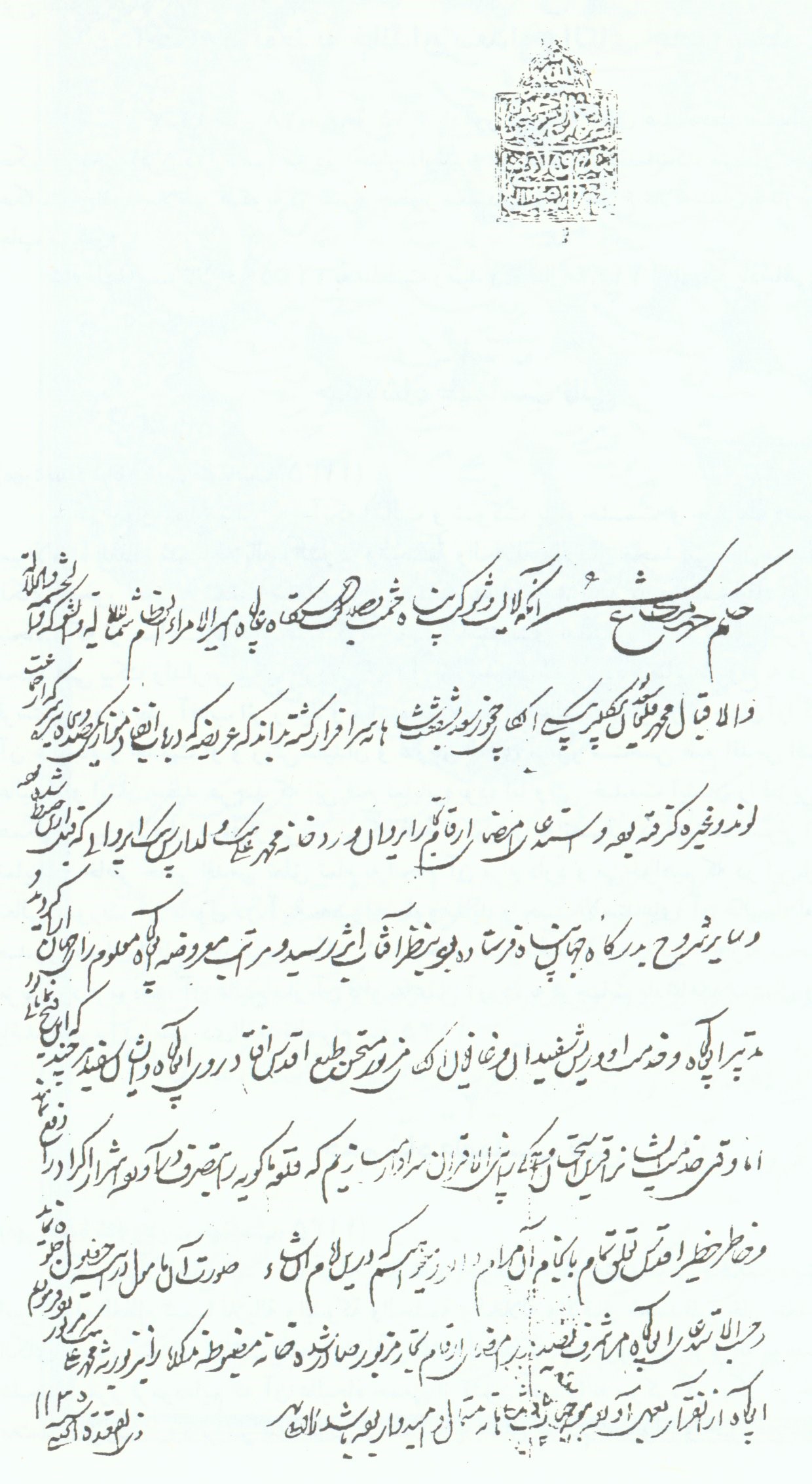

Neighbours divide the country
Russia and the Ottomans both moved into the vacuum. Russia took Derbent, Baku and Gilan in 1722–1723 (see Peter the Great’s Persian campaign). Tahmasp’s envoy even signed away the Caspian provinces at St Petersburg in 1723, an agreement Tahmasp refused to ratify.
The Ottomans invaded from the west. Their armies took Tiflis in 1723, then Erivan and Hamadan in 1724, and Tabriz in 1725 after stiff resistance from its people. In 1724 the two empires agreed, at Constantinople, on how to share the north-west of Iran between them. For a time it looked as though the Iranian plateau would be partitioned for good.
Mahmud’s last years
In Isfahan, Mahmud Hotak first tried to rule through Safavid officials, but his position was weak. His Afghans were few, and the countryside and much of the population were hostile. After failed campaigns and a revolt, he grew suspicious and violent. In February 1725, fearing a plot to restore the old dynasty, he had most of the Safavid princes held in the palace put to death; Soltan Hoseyn himself was spared.
Mahmud’s health and mind then collapsed. In April 1725 Afghan leaders released his cousin Ashraf, whom Mahmud had imprisoned, and made him ruler. Mahmud died soon after, almost certainly murdered.
Ashraf and the Ottoman war
Ashraf was a more capable ruler. He faced an Ottoman advance on Isfahan and sought recognition from Istanbul, which the Ottomans refused, demanding instead that the Safavids be restored. Ashraf answered by having the former shah, Soltan Hoseyn, killed in 1726, removing the most obvious candidate.
In November 1726 Ashraf met the Ottoman army of Ahmad Pasha, the governor of Baghdad, near Khorramabad and won, helped by defections among Kurdish and other Sunni troops on the Ottoman side who were unwilling to fight a fellow Sunni ruler. The peace that followed in 1727, often called the Treaty of Hamadan, recognised Ashraf as shah, while Ashraf accepted the Ottoman sultan’s standing as caliph and left the Ottomans in possession of the western provinces they had conquered.
Nader joins Tahmasp
The balance changed in the north-east. In 1726 Nader, an Afshar chief from Khorasan who had built up a strong band of fighters (see the rise of Nader), entered Tahmasp’s service. Fath Ali Khan Qajar, his rival at the court, was executed in the same year, and Nader became Tahmasp’s chief commander, taking the name Tahmasp Qoli Khan, “slave of Tahmasp”. In November 1726 their forces took Mashhad.
Over the next three years Nader trained a disciplined army and subdued the Abdali Afghans of Herat. Then, in 1729, he turned on Ashraf. At Mihmandust near Damghan in the autumn of 1729 he won a decisive victory, told in the battle of Mihmandust. A second defeat at Murchakhort, north-west of Isfahan, led Ashraf to abandon the capital in November 1729. Tahmasp returned to Isfahan in December, finding much of the palace looted. Nader pursued the Afghans into Fars, beat them again at Zarghan, and early in 1730 Ashraf was killed while fleeing towards Baluchistan.
The end of Tahmasp II
Tahmasp now sat on the throne of his ancestors, but power lay with Nader. In 1731, while Nader was away in the east, Tahmasp led his own campaign against the Ottomans, was defeated, and in early 1732 made a peace that gave back much that Nader had won. Nader used this as his opportunity. In 1732 he deposed Tahmasp and put his infant son on the throne as Abbas III, ruling as regent. In 1736 Nader had himself crowned shah, as told in Nader Shah crowned at the Mughan plain. Tahmasp and his son were killed at Sabzevar in 1740 on the orders of Nader’s son Reza Qoli Mirza.
- 10 Nov 1722 Tahmasp proclaimed shah at Qazvin
- 1723–1725 Ottomans take Tiflis, Erivan, Hamadan and Tabriz
- Feb 1725 Mahmud kills Safavid princes
- Apr 1725 Ashraf replaces Mahmud
- 1726 Soltan Hoseyn killed; Nader joins Tahmasp
- Nov 1726 Ashraf defeats the Ottomans near Khorramabad
- 1727 Ottoman-Afghan peace
- 1729 Mihmandust and Murchakhort; Tahmasp back in Isfahan
- 1732 Tahmasp deposed by Nader
Persian words from this page
| طهماسب | Tahmâsb | Tahmasp |
| اشرف | Ashraf | Ashraf |
| افغان | afghân | Afghan |
| عثمانی | Osmâni | Ottoman |
| قزوین | Qazvin | Qazvin |
| نادر | Nâder | Nader |
Sources and further reading
- Laurence Lockhart, The Fall of the Safavi Dynasty and the Afghan Occupation of Persia (Cambridge, 1958).
- Willem Floor, The Afghan Occupation of Safavid Persia, 1721–1729 (Paris, 1998).
- Michael Axworthy, The Sword of Persia: Nader Shah, from Tribal Warrior to Conquering Tyrant (London, 2006).
- Ernest Tucker, Nadir Shah’s Quest for Legitimacy in Post-Safavid Iran (Gainesville, 2006).
- Peter Avery, “Nadir Shah and the Afsharid legacy”, in The Cambridge History of Iran, vol. 7 (1991).
Want to learn Persian? Get the free Starter Pack
Get the 14-page printable Starter Pack (all 32 letters, a 7-day reading plan, 100 core words and 20 survival phrases) and a short 5-email course. Free.
More in The Safavid Empire (1501–1736)
- Shah Ismail I
- The Qizilbash
- Twelver Shi’ism Becomes Iran’s State Religion
- The Battle of Marv and the Uzbeks
- The Battle of Chaldiran (1514)
- Shah Tahmasp I
- The Ottoman–Safavid War and the Peace of Amasya
- Humayun’s Exile in Persia
- Qazvin: The Second Safavid Capital
- Ismail II and Mohammad Khodabanda
- Shah Abbas the Great
- Shah Abbas’s Military Reforms and the Ghulams
- The Sherley Brothers in Persia
- Isfahan: “Half the World”
- The Building of Naqsh-e Jahan Square
- Shah Abbas Retakes the West: The Ottoman Wars of 1603–1618
- The Capture of Hormuz from the Portuguese (1622)
- New Julfa and the Armenian Merchants
- The Safavid Silk Trade and Europe
- Sheikh Baha’i
- Reza Abbasi
- Shah Safi and the Treaty of Zuhab
- Shah Abbas II
- The Fight for Kandahar
- Chehel Sotoun Palace and Its War Paintings
- Shah Suleiman
- European Travellers in Safavid Persia
- Shah Soltan Hoseyn
- Safavid Art: Carpets, Miniatures and Tiles
- Mulla Sadra and the School of Isfahan
- The Afghan Revolt and the Battle of Gulnabad
- The Siege and Fall of Isfahan (1722)
- Peter the Great’s Persian Campaign (1722–1723)
- Tahmasp II and Hotaki Rule (1722–1732)
- Women of the Safavid Court
- The Safavid Legacy