Chehel Sotoun is the garden palace in Isfahan that Shah Abbas II completed in 1647 to receive ambassadors and hold royal banquets. Its great hall is lined with six large historical paintings: four Safavid scenes of kings received at court and victories over the Uzbeks, and two later battle scenes, Chaldiran and Karnal, painted under the Qajars.
| Persian name | چهل ستون Chehel Sotun, “forty columns” |
|---|---|
| Built | Completed 1647 (1057 AH) under Abbas II, by inscription |
| Use | Audiences, receptions of envoys, banquets |
| Damage | Fire in 1706, followed by restoration under Soltan Hoseyn |
| Paintings | Six large historical scenes in the banquet hall; smaller figure paintings in side rooms |
| Status | Part of the UNESCO World Heritage property “The Persian Garden” (2011) |
This page is about the palace’s history and its paintings. For a visitor’s description of the building, its porch and its museum, see our article on Chehel Sotoun Palace.
A palace for receiving the world
When Abbas I moved the capital to Isfahan in 1598, he laid out a royal precinct of gardens and pavilions between Naqsh-e Jahan Square and the Chahar Bagh avenue (see Isfahan: “Half the World”). Chehel Sotoun stood in one of the largest of these gardens. Two inscriptions found during restoration, in 1957 and 1964, show that Abbas II completed the building in 1647. Some scholars think an earlier pavilion of Abbas I’s time lies at its core, but the palace as it stands is Abbas II’s.
Its purpose was ceremony. The shah received foreign envoys here, gave feasts and sat in state on the deep wooden porch, the tâlâr, which opens onto a long rectangular pool. The porch has twenty slender columns of plane and pine wood. The name “forty columns” is usually explained by their reflection in the water, though “forty” in Persian can also simply mean “many”.
European visitors described the receptions. Jean Chardin, who knew Isfahan under Abbas II’s son Suleiman, wrote about banquets in the royal gardens, and Engelbert Kaempfer drew and described the palaces in the 1680s. Their accounts are discussed in European travellers in Safavid Persia.
Fire and repair
In 1706, under Shah Soltan Hoseyn, a fire badly damaged the palace. It was repaired, and the mirror-glass facing on the porch columns and some of the mirror work, now lost in parts, are associated with this restoration. Sixteen years later the Afghan siege ended Safavid rule in the city, and the palace began a long period of mixed fortunes.
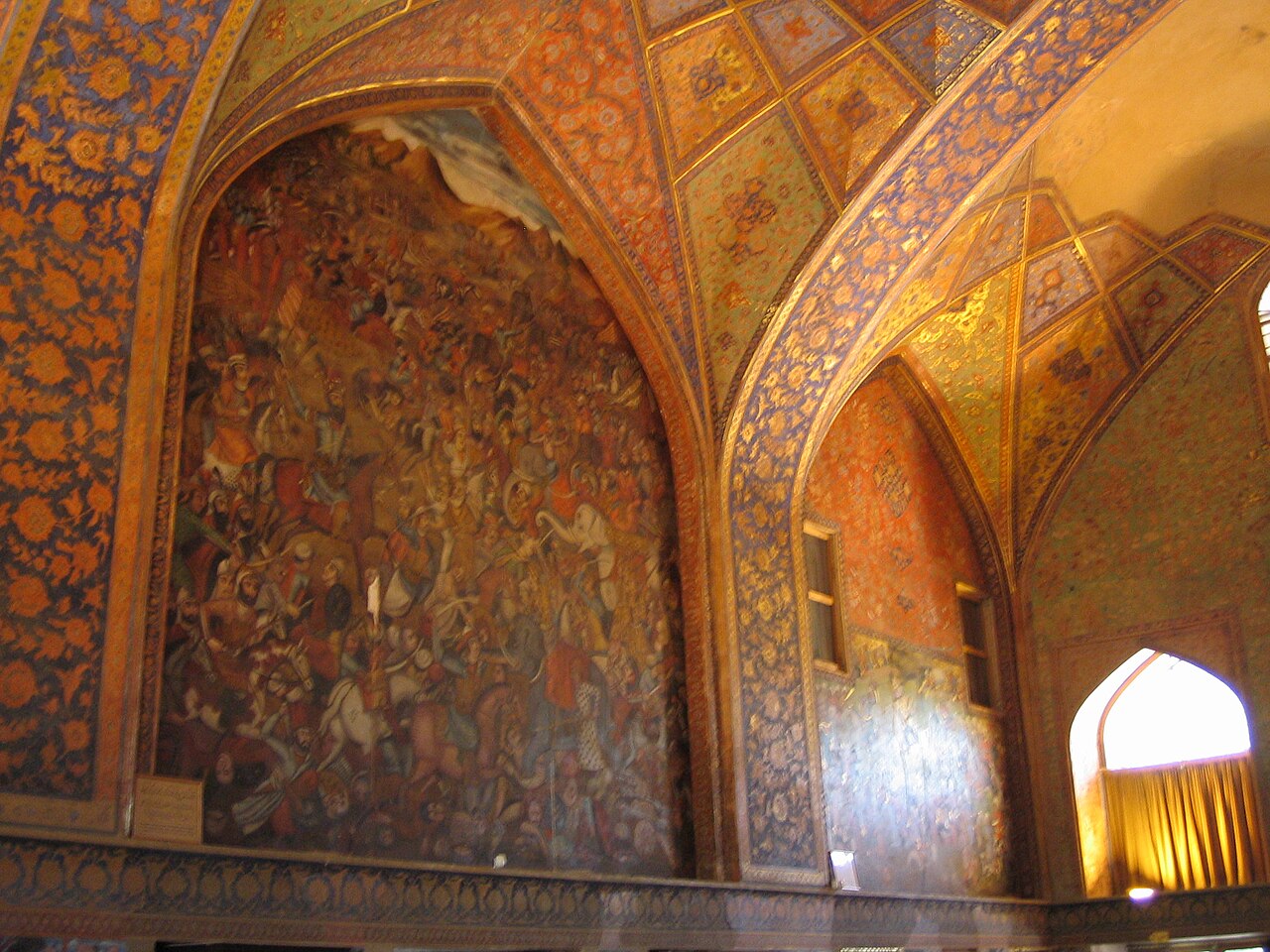

The six great paintings
Above the dado of the main hall, four large paintings fill niches in the upper walls, and two more cover the end walls. Each is a public statement about kingship.
The four Safavid scenes
- Shah Tahmasp I receives Humayun. The Mughal emperor, a fugitive, is welcomed at the Safavid court in 1544, an event told in Humayun’s exile in Persia.
- Shah Abbas I receives Vali Mohammad Khan, the Uzbek ruler of Turkistan, who sought refuge with the shah in 1611.
- Shah Abbas II receives an Uzbek ambassador.
- Shah Ismail I defeats the Uzbek Shaybani Khan, the victory of 1510 told in the battle of Marv.
Three of these show the shah as host, presiding over a feast with musicians, dancers and servants, while foreign rulers sit as his guests. The message is generosity and supremacy at once: kings from India and Central Asia come to the Safavid court as suppliants. Art historians such as Sussan Babaie read the paintings alongside the banquets that were held in the same hall, so that the living shah was surrounded by pictures of his ancestors doing what he was doing.
The style of three of the niche paintings shows European influence: single-point perspective, landscapes receding behind a window and modelling of faces with light and shade. The Ismail I painting does not. The paintings are generally assigned to the reign of Abbas II, with later repainting, but their exact dates are still debated.
The two Qajar battle scenes
The large paintings on the east and west walls are later work of the Qajar period. One shows Nader Shah’s victory over the Mughal emperor Mohammad Shah at Karnal in 1739, the battle told in the battle of Karnal and the sack of Delhi. The other shows Shah Ismail at Chaldiran in 1514, cutting down an Ottoman Janissary commander. Chaldiran was a Safavid defeat, but the painting turns it into a scene of personal heroism. Placing Nader, a non-Safavid conqueror, beside the Safavid kings shows how nineteenth-century painters treated the Iranian past as one royal story.
Whitewash, workshops and restoration
Under the Qajars the palace was not always treated as a monument. The French traveller Jane Dieulafoy found it in 1881 being used as a workshop for the tentmakers of the governor, Prince Zell-e Soltan. Smaller paintings in the side rooms had been covered with whitewash.
In the twentieth century Iranian and Italian teams restored the building. The Italian institute IsMEO carried out careful work on the structure and the wall paintings from the 1960s, and under the whitewash restorers found banquet scenes, landscapes and episodes from Persian poetry, among them Khosrow and Shirin and Yusof and Zoleykha. The palace is now a museum, and its garden is one of the nine gardens in the UNESCO listing of The Persian Garden.
Nearby, the smaller pavilion of Hasht Behesht, built under Shah Suleiman, shows how palace design developed after Chehel Sotoun.
Persian words from this page
| چهل ستون | Chehel Sotun | forty columns |
| تالار | tâlâr | columned porch, hall |
| نقاشی دیواری | naghâshi-ye divâri | wall painting |
| آینهکاری | âyeneh-kâri | mirror work |
| چالدران | Châldorân | Chaldiran |
| باغ | bâgh | garden |
Sources and further reading
- Encyclopaedia Iranica, “Čehel Sotūn” (Ingeborg Luschey-Schmeisser).
- Sussan Babaie, Isfahan and Its Palaces: Statecraft, Shi’ism and the Architecture of Conviviality in Early Modern Iran (Edinburgh, 2008).
- G. Zander (ed.), Travaux de restauration de monuments historiques en Iran (IsMEO, Rome, 1968), on the restoration of the building and its paintings.
- Sheila Canby, The Golden Age of Persian Art, 1501–1722 (London, 1999).
- UNESCO World Heritage Centre, The Persian Garden (2011).
Want to learn Persian? Get the free Starter Pack
Get the 14-page printable Starter Pack (all 32 letters, a 7-day reading plan, 100 core words and 20 survival phrases) and a short 5-email course. Free.
More in The Safavid Empire (1501–1736)
- Shah Ismail I
- The Qizilbash
- Twelver Shi’ism Becomes Iran’s State Religion
- The Battle of Marv and the Uzbeks
- The Battle of Chaldiran (1514)
- Shah Tahmasp I
- The Ottoman–Safavid War and the Peace of Amasya
- Humayun’s Exile in Persia
- Qazvin: The Second Safavid Capital
- Ismail II and Mohammad Khodabanda
- Shah Abbas the Great
- Shah Abbas’s Military Reforms and the Ghulams
- The Sherley Brothers in Persia
- Isfahan: “Half the World”
- The Building of Naqsh-e Jahan Square
- Shah Abbas Retakes the West: The Ottoman Wars of 1603–1618
- The Capture of Hormuz from the Portuguese (1622)
- New Julfa and the Armenian Merchants
- The Safavid Silk Trade and Europe
- Sheikh Baha’i
- Reza Abbasi
- Shah Safi and the Treaty of Zuhab
- Shah Abbas II
- The Fight for Kandahar
- Chehel Sotoun Palace and Its War Paintings
- Shah Suleiman
- European Travellers in Safavid Persia
- Shah Soltan Hoseyn
- Safavid Art: Carpets, Miniatures and Tiles
- Mulla Sadra and the School of Isfahan
- The Afghan Revolt and the Battle of Gulnabad
- The Siege and Fall of Isfahan (1722)
- Peter the Great’s Persian Campaign (1722–1723)
- Tahmasp II and Hotaki Rule (1722–1732)
- Women of the Safavid Court
- The Safavid Legacy