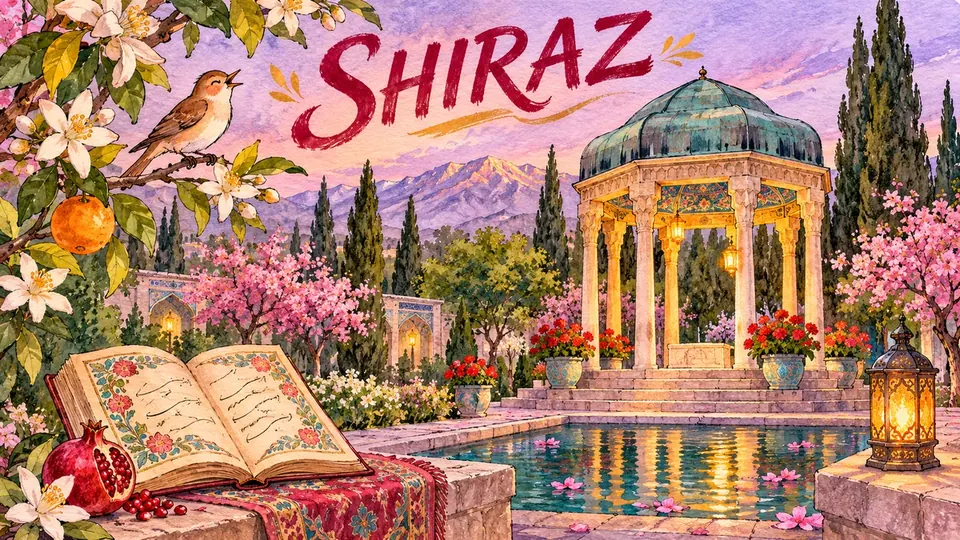
Shiraz (شیراز, Shirâz) is the capital of Fars province in south-west Iran, the city of the poets Saadi and Hafez and, under Karim Khan Zand in the 18th century, the capital of Iran. Iranians associate it with gardens, orange blossom and poetry. It had 1,565,572 inhabitants at the 2016 census and is the usual base for visiting Persepolis and Pasargadae.
| Persian name | شیراز (Shirâz) |
|---|---|
| Province | Fars (capital) |
| Population | 1,565,572 (city, 2016 census, Statistical Centre of Iran) |
| Elevation | About 1,500 m |
| Capital of | The Buyids of Fars (10th century) and the Zand dynasty (1760s–1794) |
| Famous residents | Saadi (13th century), Hafez (14th century) |
| Nearby | Persepolis and Naqsh-e Rostam (about 60 km), Pasargadae (about 130 km) |
An old name, a young centre
Fars is the original Persis, the homeland of the Achaemenid and Sasanian kings, but its ancient capitals lay elsewhere: Persepolis, Pasargadae, Istakhr and Firuzabad. A place called Tiraziš is named in Elamite administrative tablets of the Achaemenid period, and most scholars connect it with Shiraz. The city that grew into today’s Shiraz was founded or rebuilt by Arab commanders around 693 as a base for the conquest and control of Fars, and it soon replaced Istakhr as the main city of the province.
The Buyids and Adud al-Dawla
Shiraz first became a royal city under the Buyids in the 10th century. Their greatest ruler, Adud al-Dawla (died 983), built a palace, a library and a hospital here, and the Band-e Amir dam on the Kor river to the north-east.
The Salghurids, the Mongols and the poets
In the 12th and 13th centuries the Salghurid atabegs ruled Fars from Shiraz. When the Mongols arrived, the Salghurids submitted and paid tribute, and Shiraz escaped the destruction suffered by cities such as Neyshabur and Rey. This relative safety is one reason it became a centre of learning and poetry. Saadi came back to Shiraz from decades of travel and wrote the Bustan (1257) and Golestan (1258) under Salghurid patronage.
A century later Hafez (c. 1315–1390) lived through the struggles between the Injuids and Muzaffarids for the city and saw Timur’s armies arrive. He hardly ever left Shiraz, and his poems praise its gardens, the Roknabad stream and the Mosalla. Lines by both poets are collected in our posts on Hafez quotes and Saadi quotes.
Karim Khan Zand’s capital
After the chaos that followed Nader Shah’s death, Karim Khan Zand won control of most of Iran and ruled from Shiraz until his death in 1779. He refused the title of shah and called himself Vakil, usually translated as “regent” or “deputy of the people”.
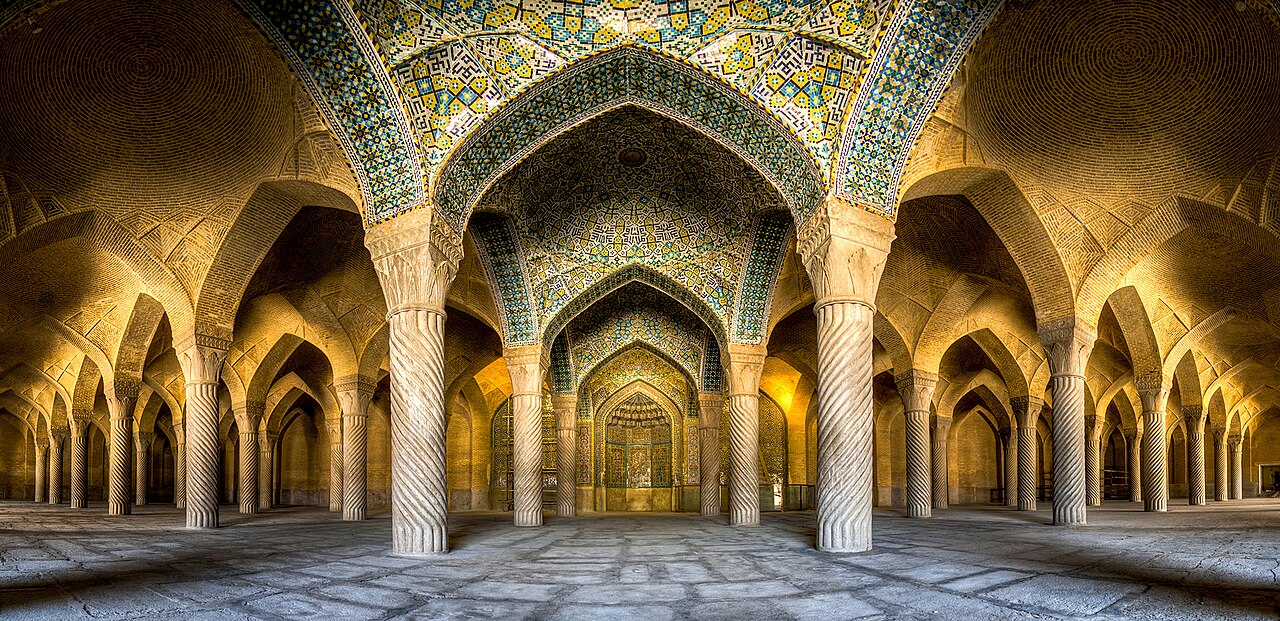
Karim Khan rebuilt the city as a capital. Most of the old centre visitors see today is his: the Arg citadel with its leaning corner tower, the vaulted Vakil Bazaar, the Vakil Bath and the Vakil Mosque, whose winter prayer hall has 48 carved stone columns. Our history page Shiraz under Karim Khan tells the story, and the Arg of Karim Khan page covers the citadel.

The Zand era ended in war. Agha Mohammad Khan Qajar defeated the last Zand ruler, Lotf Ali Khan, took Shiraz, had its walls pulled down and moved the capital to Tehran.
Qajar mansions and gardens
Under the Qajars Shiraz was a provincial capital run by local grandees, above all the Qavam family. Their legacy is a set of gardens and houses: the Narenjestan-e Qavam with its orange trees and mirrored porch, and the Eram Garden, now part of the UNESCO-listed Persian Garden. In 1876–1888 a member of the family, Mirza Hasan Ali Nasir al-Molk, built the mosque that bears his name, famous for its stained-glass windows that throw coloured light across the carpets in the early morning. See the Eram Garden and Nasir al-Molk Mosque pages.
Shrines and tombs
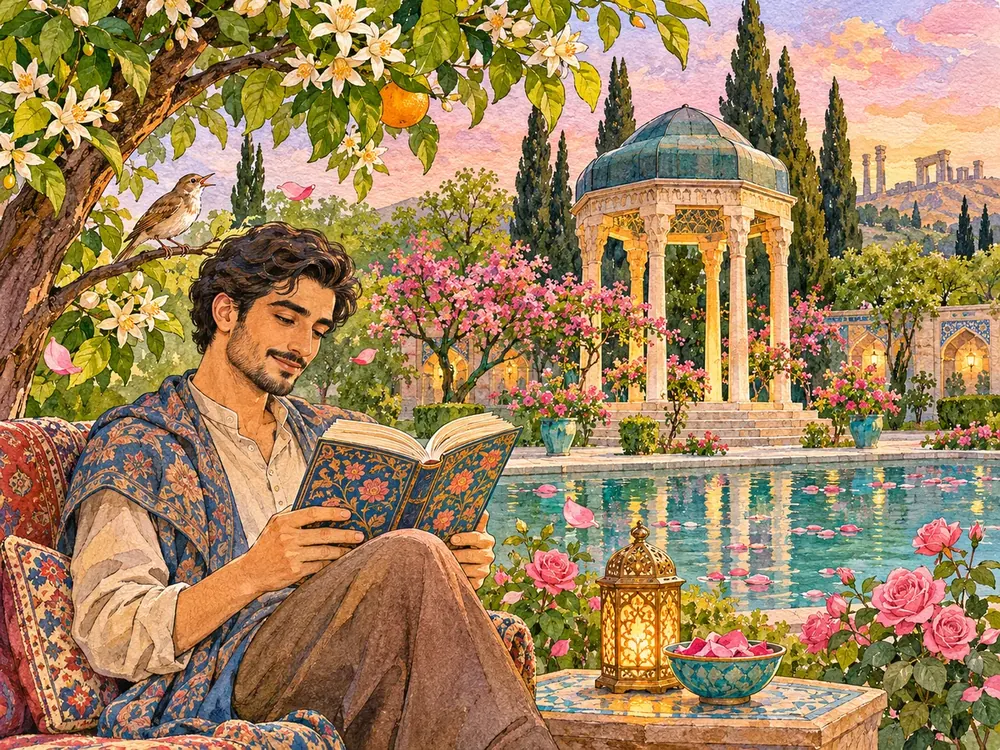
For many Iranians the reason to visit Shiraz is to stand at the tomb of Hafez. The present open pavilion in its garden was designed by the French architect André Godard and completed in 1935. People come at dusk, recite his poems, and open his Divan at random to ask it a question, a custom explained in our guide to fal-e Hafez. Saadi’s tomb lies in a quieter garden in the north-east of the city. See the Tomb of Hafez and Tomb of Saadi.
The most important religious site is Shah Cheragh, the shrine of Ahmad, a son of the seventh Shi’a imam and brother of Imam Reza, whose interior is covered in mirror mosaic.
Wine, roses and the Syrah question
Shiraz was famous for its wine for many centuries, and wine runs through the poetry of Hafez, whether read literally or mystically. Wine production ended after 1979. Many people believe that the Syrah grape, called Shiraz in Australia, was brought from here. DNA studies published in the late 1990s showed that Syrah is a cross of two old French varieties from the Rhône region, so the story is a legend. More on this in Wine in Iranian history.
Spring is the most celebrated season. In late March and April the city’s bitter-orange trees flower, and the scent, called bahâr-nârenj, fills the streets. The local dessert fâlude, frozen rice-starch noodles with lime juice or sour-cherry syrup, is a summer staple.
Shiraz as a base
Persepolis lies about 60 km north-east of the city, with the royal tombs of Naqsh-e Rostam a few kilometres beyond. Pasargadae, with the tomb of Cyrus, is about 130 km to the north. Most visitors do both in a long day or split them over two. Read our guide to visiting Persepolis and the existing posts on Persepolis and Pasargad. To the south and west lie the Sasanian sites of Firuzabad and Bishapur, covered on Sasanian sites of Fars.
Getting there and getting around
Shiraz is about 900 km south of Tehran by road. Its international airport has frequent flights to Tehran and other cities, and the city is on the rail network via Isfahan, although trains are slower than flying. Long-distance buses connect it with Isfahan, Yazd, Kerman and Bushehr. In town, the Zand-era centre around the Arg is easy to walk; taxis, ride-hailing apps and a metro line cover longer trips to the tombs and gardens. Check current entry and safety information with official sources and your own government’s travel advice.
Persian words from this page
| شیراز | Shirâz | Shiraz |
| حافظ | Hâfez | Hafez (“one who knows the Quran by heart”) |
| سعدی | Sa’di | Saadi |
| وکیل | vakil | deputy, regent; Karim Khan’s title |
| باغ | bâgh | garden |
| بهارنارنج | bahâr-nârenj | orange blossom |
| فالوده | fâlude | faloodeh, the frozen noodle dessert |
Sources and further reading
- Encyclopaedia Iranica, “Shiraz” (history and monuments).
- John R. Perry, Karim Khan Zand: A History of Iran, 1747–1779 (University of Chicago Press, 1979).
- A.J. Arberry, Shiraz: Persian City of Saints and Poets (University of Oklahoma Press, 1960).
- UNESCO World Heritage Centre, The Persian Garden (includes Eram Garden).
- Statistical Centre of Iran, National Population and Housing Census 2016 (1395).
Want to learn Persian? Get the free Starter Pack
Get the 14-page printable Starter Pack (all 32 letters, a 7-day reading plan, 100 core words and 20 survival phrases) and a short 5-email course. Free.
More in Cities of Iran
- Tehran: Iran’s Capital
- Mashhad
- Isfahan
- Shiraz
- Tabriz
- Yazd
- Kashan
- Kerman
- Hamadan
- Qom
- Ahvaz
- Rasht
- Kermanshah
- Urmia
- Ardabil
- Zanjan
- Qazvin
- Sanandaj
- Khorramabad
- Bandar Abbas
- Bushehr
- Zahedan
- Birjand
- Gorgan
- Sari
- Semnan
- Arak
- Ilam
- Yasuj
- Shahr-e Kord
- Bojnurd
- Karaj
- Abadan and Khorramshahr
- Kish Island
- Qeshm Island
- Hormuz Island
- Masuleh
- Abyaneh
- Kandovan
- Bam
- Neyshabur (Nishapur)
- Shush (Susa) Today