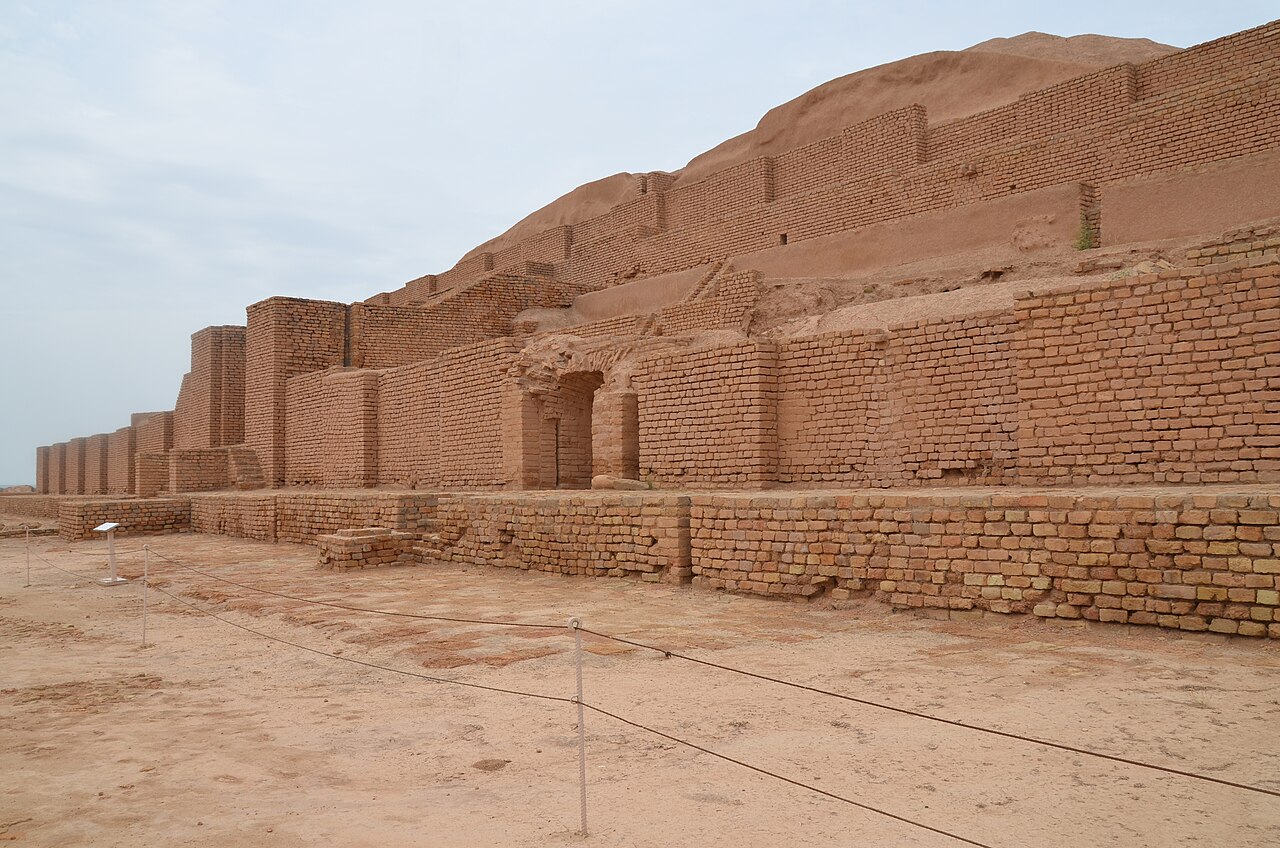
Chogha Zanbil is the ruined temple city built around 1250 BCE by the Elamite king Untash-Napirisha in the Khuzestan plain, about 40 km south-east of Susa. Its ziggurat, still about half its original height, is the best-preserved monument of its kind anywhere, and in 1979 it became the first site in Iran on the UNESCO World Heritage List. This page is a guide to walking the site; its history is told in Chogha Zanbil Ziggurat.
| Persian name | چغازنبیل (Choghâ Zanbil) |
|---|---|
| Ancient name | Al-Untash-Napirisha, “city of Untash-Napirisha” |
| Built | 14th or 13th century BCE; conventionally c. 1250 BCE |
| Ziggurat | About 105 m square at the base, originally about 53 m high |
| UNESCO | World Heritage List, 1979 |

The layout in brief
The city was planned as three enclosures, one inside the other. The outermost wall, several kilometres around, held palaces and open ground. The middle enclosure contained temples to a range of Elamite gods. In the centre stood the ziggurat with its own wall and a paved court. The king who built it, covered in the Middle Elamite kingdom, meant it as a new religious centre, but after his death building stopped and the town was never fully lived in. The Assyrian king Ashurbanipal damaged it in the campaigns that ended with the sack of Susa around 646 BCE. Sand and erosion then buried the lower stages, which is why they survived so well.
Walking the site
The ziggurat
Start at the ziggurat. Walk slowly round its base and you will see two kinds of brick: a core of sun-dried mud brick and a thick outer skin of baked brick. Every so often a band of bricks carries a line of cuneiform writing in the Elamite language, set facing outward at eye level. The texts are dedications to the god Inshushinak and the other gods of the site in the name of Untash-Napirisha, and they are one of the finest sights here: you can stand within arm’s length of a royal inscription more than 3,000 years old. More on the script is on our page on Elamite language and writing.
Look for the stairways and arched gateways on the sides of the building, and for the hollow channels in the brickwork that drained rain off the structure. Visitors are not allowed to climb the ziggurat. This protects the brick, and the view from ground level gives a better sense of its mass than a climb would.
The temple court and middle enclosure
Between the ziggurat and the inner wall, and in the middle enclosure, are the low brick foundations of temples. Here and there you can see paving, door sockets and the bases of altars. Some of these rooms yielded glazed tiles, knobs and figures of animals, now in museums in Tehran and Susa.
The royal quarter and tombs
In the eastern part of the outer enclosure the excavators found a group of palaces. Under one of them are vaulted brick chambers that held burials, some of them apparently cremations, which is rare in the ancient Near East. Not all of the area is open, but the vaults show the skill of Elamite brick builders. Nearby is a brick basin by the outer wall that is often explained as a reservoir for water brought by canal from the river.
Haft Tappeh
Most visitors combine Chogha Zanbil with Haft Tappeh, a short drive away, the remains of an Elamite city that was flourishing a little before Untash-Napirisha’s reign. Its small site museum shows finds from both places and gives a useful picture of what the temples once held.
Practical notes
- Chogha Zanbil is reached by car or taxi from Shush, which is also the base for the Susa archaeological site. Many travellers add Shushtar on the same day or the next.
- The site is in open, shadeless plain. Visit between November and March if you can; summer temperatures in Khuzestan are dangerous in the middle of the day. Early morning and late afternoon light is best for photographs.
- Bring water and a hat even in winter. Check current opening hours and tickets locally.
Persian words from this page
| چغازنبیل | Choghâ Zanbil | Chogha Zanbil |
| زیگورات | zigurât | ziggurat |
| ایلام | Ilâm | Elam |
| خشت | khesht | mud brick |
| آجر | âjor | baked brick |
| خط میخی | khatt-e mikhi | cuneiform script |
Sources and further reading
- UNESCO World Heritage Centre, Tchogha Zanbil.
- Roman Ghirshman, Tchoga Zanbil (Dur-Untash), 2 vols (Paris, 1966–1968), the excavation report.
- D. T. Potts, The Archaeology of Elam (2nd edn, Cambridge, 2016).
- Encyclopaedia Iranica, “Čoḡā Zanbīl”.
Want to learn Persian? Get the free Starter Pack
Get the 14-page printable Starter Pack (all 32 letters, a 7-day reading plan, 100 core words and 20 survival phrases) and a short 5-email course. Free.
More in Top Places to Visit in Iran
- Naqsh-e Jahan Square
- Shah (Imam) Mosque, Isfahan
- Sheikh Lotfollah Mosque
- Ali Qapu Palace
- Jameh Mosque of Isfahan
- Si-o-se Pol and Khaju Bridge
- Vank Cathedral
- Hasht Behesht Palace
- Naqsh-e Rostam
- Eram Garden, Shiraz
- Nasir al-Molk (Pink) Mosque
- Tomb of Hafez (Hafezieh)
- Tomb of Saadi (Saadieh)
- Shah Cheragh Shrine
- Arg of Karim Khan
- Fin Garden, Kashan
- Historic Houses of Kashan
- Jameh Mosque of Yazd
- Yazd Fire Temple and Towers of Silence
- Dowlatabad Garden and Windcatcher
- Amir Chakhmaq Complex
- Golestan Palace
- National Museum of Iran
- Treasury of National Jewels
- Tehran Grand Bazaar
- Milad Tower
- Imam Reza Shrine, Mashhad
- Tomb of Ferdowsi, Tus
- Tomb of Omar Khayyam, Neyshabur
- Tomb of Avicenna, Hamadan
- Ganjnameh Inscriptions, Hamadan
- Behistun (Bisotun): Visiting the Site
- Taq-e Bostan: Visiting the Site
- Tabriz Historic Bazaar
- Takht-e Soleyman
- Armenian Monastic Ensembles of Iran
- Sheikh Safi al-Din Shrine, Ardabil
- Dome of Soltaniyeh
- Alamut Castle
- Falak-ol-Aflak Castle
- Shushtar Historical Hydraulic System
- Chogha Zanbil: Visiting the Ziggurat
- Susa Archaeological Site
- Arg-e Bam
- Ganjali Khan Complex, Kerman
- Shazdeh Garden, Mahan
- Rayen Castle
- Dasht-e Lut (Lut Desert)
- Maranjab Desert and Caravanserai
- Varzaneh Desert
- Mount Damavand
- Hyrcanian Forests
- Lake Urmia
- Badab-e Surt Springs
- Ali Sadr Cave
- The Kaluts of Shahdad
- Qeshm Geopark
- Hormuz Island Colours
- Visiting Persepolis: A Day Trip from Shiraz
- Visiting Pasargadae
- Persian Caravanserais
- The Qanat of Gonabad
- Meymand Village
- Sasanian Sites of Fars: Firuzabad, Bishapur and Sarvestan
- Gonbad-e Qabus: Visiting the Tower
- Zayandeh Rud and Isfahan’s Bridges
- Tochal and Darband: Hiking Above Tehran
- Mount Sabalan
- Skiing in Iran: Dizin and Shemshak
- Golestan National Park