The Shushtar Historical Hydraulic System is a network of dams, canals, tunnels and watermills that has turned the Karun river into power and irrigation at Shushtar, in Khuzestan, since the Sasanian period. Its centrepiece today is the cluster of old mills where water pours in falls from rock-cut channels, and the whole system has been a UNESCO World Heritage Site since 2009.
| Persian name | سازههای آبی شوشتر (Sâzehâ-ye âbi-ye Shushtar) |
|---|---|
| Location | Shushtar, northern Khuzestan, on the Karun river |
| Main period | Sasanian (3rd century CE onward), with roots claimed for the Achaemenid period and many later repairs |
| Parts | Thirteen listed dams, bridges, canals and other structures |
| UNESCO | World Heritage List, 2009 |
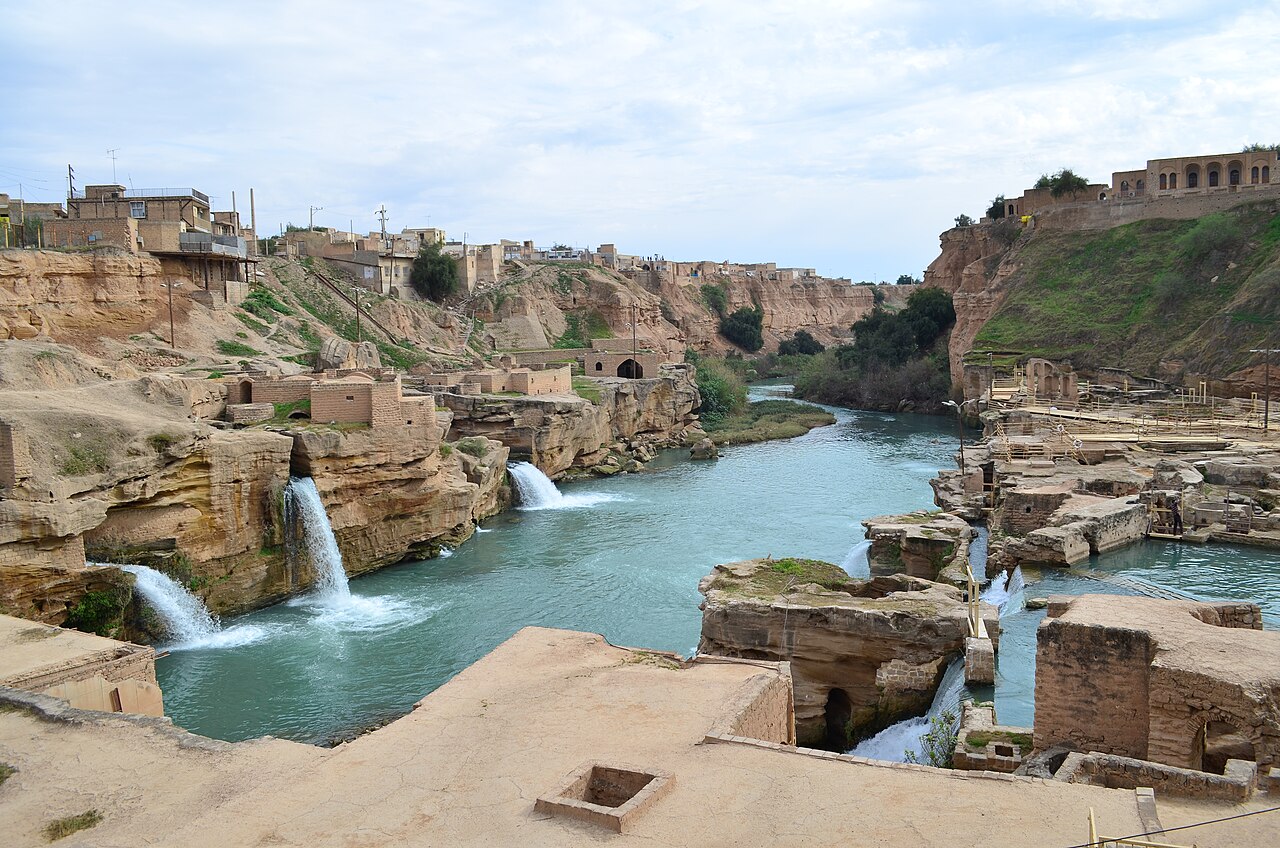

An island made by engineers
Shushtar stands on a rocky rise where the Karun leaves the foothills of the Zagros and enters the Khuzestan plain. Ancient engineers dug a second channel, the Gargar canal, which leaves the river above the town and rejoins it further south. The town thus sits on an island between the main river and the canal, and the water level in the canal could be controlled to drive mills and feed irrigation channels across the plain. Tradition credits the first works to the Achaemenid king Darius I; firm evidence is lacking, and most of what can be dated belongs to the Sasanian era and later.
The most famous structure, the Band-e Kaisar or “Caesar’s dam”, is linked with Roman prisoners taken by Shapur I after he defeated and captured the emperor Valerian in 260 (see the Battle of Edessa and Valerian). It was a weir about 500 metres long across the Karun that also carried a road bridge, and it is the easternmost structure of Roman type known. It stayed in use for centuries before breaking in the late 19th century. More on Sasanian engineering is on our page on Sasanian cities, palaces and bridges.
What to look at
The mills and waterfalls
The heart of a visit is the mills site (آسیابها و آبشارها) on the edge of the old town. Water from behind the Gargar bridge-dam enters three tunnels cut into the rock, drives the wheels of a series of mills built into the cliff, and then falls in white streams into a pool below. Walkways and terraces lead down between the mill houses, many with small rooms and grinding stones you can look into. Several mills worked into the 20th century. In spring, when the river is full, the falls are at their most impressive; in late summer the flow can be much reduced.
The Gargar bridge-dam and canals
Above the mills, the Gargar bridge-dam crosses the canal and raises the water. From the bridge you can see how water is split between channels: some to the mills, some sideways through canals such as the Bolayti to the east side of the complex, and the rest down the Gargar. Notice the different stones and repairs that show how often the works were rebuilt.
Band-e Kaisar and Band-e Mizan
Along the main Karun, on the west side of town, you can see the broken remains of Band-e Kaisar, with arches and piers still standing in the river. Nearby is the Band-e Mizan, the “measuring dam”, which divided the river between the Karun and the Gargar.
Salasel castle
On high ground over the river stand the remains of the Salasel castle, the old seat of government, which also controlled the water intakes beneath it. Little survives above ground, but it shows how power and water were linked in the town.
Why it matters
Iran is a dry country, and much of its history depends on moving water, whether by qanats under the plateau or by dams and canals like these on its rivers. UNESCO describes Shushtar as an exceptional example of a complete hydraulic system that combines civil engineering with water power, and the Karun irrigation it fed made northern Khuzestan one of the richest farming regions of the Sasanian empire.
Practical notes
- Shushtar is about an hour and a half by road north of Ahvaz, and is often combined in one trip with Susa and Chogha Zanbil.
- Khuzestan is extremely hot from May to September. The best months are roughly November to March.
- The mills are especially attractive in the evening, when they are lit. Check current opening hours and tickets locally.
Persian words from this page
| شوشتر | Shushtar | Shushtar |
| کارون | Kârun | Karun river |
| بند | band | dam, weir |
| آسیاب | âsyâb | mill |
| آبشار | âbshâr | waterfall |
| قیصر | Gheysar | Caesar |
Sources and further reading
- UNESCO World Heritage Centre, Shushtar Historical Hydraulic System.
- Encyclopaedia Iranica, “Band-e Qayṣar”.
- Touraj Daryaee, Sasanian Persia: The Rise and Fall of an Empire (London, 2009), on Shapur I and the Roman prisoners.
- Peter Christensen, The Decline of Iranshahr: Irrigation and Environments in the History of the Middle East, 500 B.C. to A.D. 1500 (Copenhagen, 1993).
Want to learn Persian? Get the free Starter Pack
Get the 14-page printable Starter Pack (all 32 letters, a 7-day reading plan, 100 core words and 20 survival phrases) and a short 5-email course. Free.
More in Top Places to Visit in Iran
- Naqsh-e Jahan Square
- Shah (Imam) Mosque, Isfahan
- Sheikh Lotfollah Mosque
- Ali Qapu Palace
- Jameh Mosque of Isfahan
- Si-o-se Pol and Khaju Bridge
- Vank Cathedral
- Hasht Behesht Palace
- Naqsh-e Rostam
- Eram Garden, Shiraz
- Nasir al-Molk (Pink) Mosque
- Tomb of Hafez (Hafezieh)
- Tomb of Saadi (Saadieh)
- Shah Cheragh Shrine
- Arg of Karim Khan
- Fin Garden, Kashan
- Historic Houses of Kashan
- Jameh Mosque of Yazd
- Yazd Fire Temple and Towers of Silence
- Dowlatabad Garden and Windcatcher
- Amir Chakhmaq Complex
- Golestan Palace
- National Museum of Iran
- Treasury of National Jewels
- Tehran Grand Bazaar
- Milad Tower
- Imam Reza Shrine, Mashhad
- Tomb of Ferdowsi, Tus
- Tomb of Omar Khayyam, Neyshabur
- Tomb of Avicenna, Hamadan
- Ganjnameh Inscriptions, Hamadan
- Behistun (Bisotun): Visiting the Site
- Taq-e Bostan: Visiting the Site
- Tabriz Historic Bazaar
- Takht-e Soleyman
- Armenian Monastic Ensembles of Iran
- Sheikh Safi al-Din Shrine, Ardabil
- Dome of Soltaniyeh
- Alamut Castle
- Falak-ol-Aflak Castle
- Shushtar Historical Hydraulic System
- Chogha Zanbil: Visiting the Ziggurat
- Susa Archaeological Site
- Arg-e Bam
- Ganjali Khan Complex, Kerman
- Shazdeh Garden, Mahan
- Rayen Castle
- Dasht-e Lut (Lut Desert)
- Maranjab Desert and Caravanserai
- Varzaneh Desert
- Mount Damavand
- Hyrcanian Forests
- Lake Urmia
- Badab-e Surt Springs
- Ali Sadr Cave
- The Kaluts of Shahdad
- Qeshm Geopark
- Hormuz Island Colours
- Visiting Persepolis: A Day Trip from Shiraz
- Visiting Pasargadae
- Persian Caravanserais
- The Qanat of Gonabad
- Meymand Village
- Sasanian Sites of Fars: Firuzabad, Bishapur and Sarvestan
- Gonbad-e Qabus: Visiting the Tower
- Zayandeh Rud and Isfahan’s Bridges
- Tochal and Darband: Hiking Above Tehran
- Mount Sabalan
- Skiing in Iran: Dizin and Shemshak
- Golestan National Park