The Persepolis Fortification tablets are an archive of tens of thousands of small clay tablets, most written in Elamite cuneiform, found in 1933 in the fortification wall of Persepolis. They are the day-to-day records of the royal administration in Fars between 509 and 493 BCE, under Darius I, and record food rations, wages, travel and offerings to the gods. Together with the later Treasury tablets, they are the largest body of Persian evidence for how the empire actually worked, and they show it from the inside rather than through Greek eyes.
| Fortification archive | 509–493 BCE (years 13 to 28 of Darius I) |
|---|---|
| Found | 1933, two rooms in the northeast fortification wall of the terrace |
| Size | About 15,000 to 18,000 original documents surviving as 20,000 or more tablets and fragments |
| Languages | Mostly Elamite; several hundred in Aramaic; single tablets in Old Persian, Greek, Babylonian and Phrygian |
| Treasury archive | 492–457 BCE; about 750 tablets and fragments, excavated in the late 1930s |
| Key edition | Richard Hallock, Persepolis Fortification Tablets (1969), 2,087 Elamite texts |

Discovery
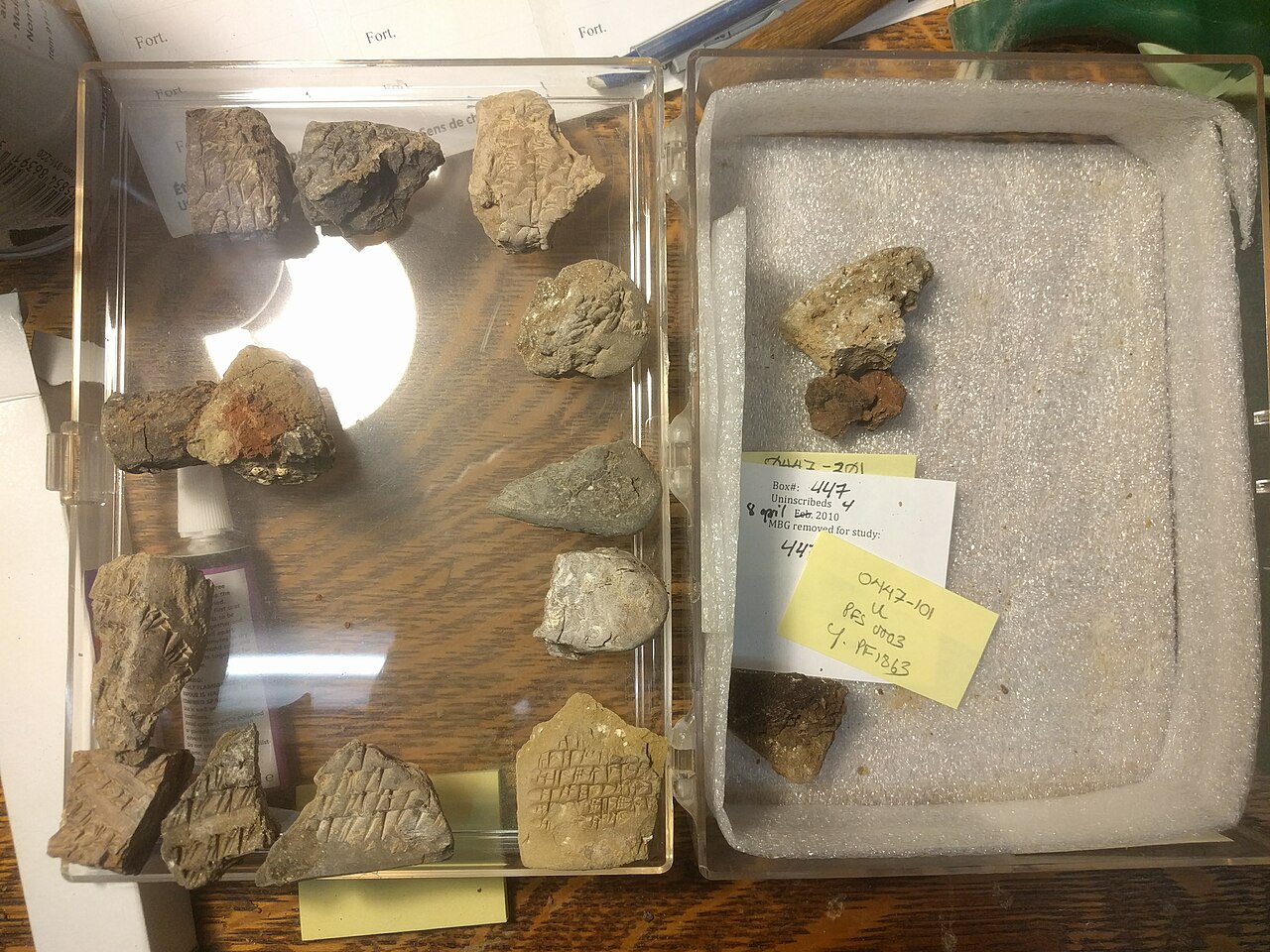
In March 1933 the Oriental Institute expedition at Persepolis, led by Ernst Herzfeld, was clearing the northeast corner of the terrace when it came upon two small rooms in the fortification wall packed with clay tablets. The tablets had probably fallen from shelves on an upper floor when the building collapsed. Some years later Erich Schmidt’s team found a smaller archive in the Treasury. The Iranian government lent the Fortification tablets to the University of Chicago for study, and they arrived there in 1936. Most are about the size of a matchbox or a palm, and many bear seal impressions.
What kind of documents they are
The tablets are not literature or royal propaganda. They are receipts, memos and accounts written by scribes of the institutional economy that ran Fars, the province around Persepolis. A typical text records that a certain amount of barley, flour, wine, beer, fruit or sheep was issued from a named storehouse to a named person or group, on the authority of an official, in a given month and year. Others are journals and annual accounts drawn up from many such receipts. The language of most of them is Elamite, the old language of the region, which the Persians had taken over as their language of administration in Fars. Many tablets carry notes in Aramaic, the common written language of the empire, and several hundred are written in Aramaic alone.
Workers and wages
Many of the texts concern workers called kurtash. They came from across the empire, from Egypt, Babylonia, Lydia, Ionia, Caria, Thrace and elsewhere, and worked in groups on building sites, in workshops and on estates, including the building works at Persepolis. They received monthly rations of grain and wine, in amounts that depended on their skills, sex and age. Some were probably deportees; others may have been sent from their provinces as labour service.
The tablets give an unusually detailed picture of working women. As the historian Maria Brosius showed, women appear as workers, as heads of work groups and as specialists. Less skilled women usually received smaller rations than men in the same group, but skilled women could receive the same as men. Mothers received extra rations after giving birth, and the tablets distinguish between births of boys and girls, with the larger allowance given for a boy.
Royal women and their estates
Women of the royal family appear in a role that Greek sources hardly hint at. A woman named Irtashduna, the Artystone whom Herodotus calls Darius’s favourite wife, held estates, had her own staff and travelled with them. Another, Irdabama, a wealthy woman with her own large workforce and estates, issued orders under her own seal. These texts are the main reason historians now see royal women as economic actors in their own right. See Women of the Achaemenid Court.
Travel on the royal roads
A large group of tablets records food issued to travellers at the way stations of the roads in and around Fars. Travellers carried a sealed document authorising their rations, issued by the king or a senior official, and the tablets often note where they came from and where they were going: Susa, Sardis, Egypt, Arachosia and India appear. One records wine for a man named Datiya, travelling from Sardis to the king in early 494 BCE, who may be Datis, the general who later led the Persian force at Marathon. These texts show the road network described in The Royal Road and the Persian postal system in actual use.
Officials and seals
The head of the administration in these years was Parnakka, a high noble, probably an uncle of Darius, who issued orders under his own seal. Thousands of different seals are impressed on the tablets, and they form one of the largest collections of ancient art from the Persian heartland. One seal stands out: it names Cyrus of Anshan, son of Teispes, the grandfather of Cyrus the Great, and was still being used generations later. It is a direct link to the early Persian kings described in Achaemenes, Teispes and the early Persian kings.
Gods and offerings
The tablets also record food and drink issued for religious offerings. They name Ahura Mazda, the god of the royal inscriptions, but also Elamite gods such as Humban and the gods of mountains and rivers, all supplied by the same administration. This evidence shows that the religion of the Persian heartland under Darius was more varied than the royal inscriptions suggest, and it is central to the debate described in Religion of the Achaemenid Kings.
The Treasury tablets
The smaller archive from the Treasury, published by George Cameron in 1948, covers the years 492 to 457 BCE, from late in the reign of Darius into that of Artaxerxes I. These texts record payments in silver to workers, often instead of part of their rations in kind, and many concern craftsmen working on the royal buildings. They show the gradual use of silver money in wages alongside the older ration system; see The Daric and the Achaemenid economy.
Study, a lawsuit and the return to Iran
Hallock’s edition of 1969 made about 2,000 of the Elamite texts available, but many thousands remained unpublished. In 2006 the Oriental Institute began the Persepolis Fortification Archive Project, led by Matthew Stolper, to record and photograph the whole archive. The work was given urgency by a lawsuit in American courts. Victims of a 1997 bombing in Jerusalem who had won a judgment against the government of Iran sought to seize Iranian property in the United States, including the tablets. In February 2018 the US Supreme Court ruled in Rubin v. Islamic Republic of Iran that the tablets could not be seized under the law they had relied on. The tablets have been returned to Iran in several batches since the 1940s, including 1,784 in 2019, with further returns in the 2020s.
Why they matter
Almost everything written about the Achaemenid Empire in antiquity was written by outsiders, mainly Greeks, and most of it is about war and the court. The tablets are a Persian record, produced by the empire’s own officials for their own use, and they show the empire as a working system of storehouses, roads, workers and accounts. Every new reading adds names, places and details to a picture that Greek writers never saw.
Persian words from this page
| لوح گلی | lowh-e geli | clay tablet |
| بایگانی | bâygâni | archive |
| جیره | jireh | ration |
| کارگر | kârgar | worker |
| ایلامی | Ilâmi | Elamite |
| آرامی | Ârâmi | Aramaic |
| مهر | mohr | seal |
Sources and further reading
- Richard T. Hallock, Persepolis Fortification Tablets, Oriental Institute Publications 92 (1969).
- George G. Cameron, Persepolis Treasury Tablets, Oriental Institute Publications 65 (1948).
- Maria Brosius, Women in Ancient Persia, 559–331 BC (1996).
- Wouter F. M. Henkelman, The Other Gods Who Are: Studies in Elamite-Iranian Acculturation Based on the Persepolis Fortification Texts (2008).
- Encyclopaedia Iranica, “Persepolis Elamite Tablets”.
Want to learn Persian? Get the free Starter Pack
Get the 14-page printable Starter Pack (all 32 letters, a 7-day reading plan, 100 core words and 20 survival phrases) and a short 5-email course. Free.
More in The Achaemenid Empire (550–330 BCE)
- Achaemenes, Teispes and the Early Persian Kings of Anshan
- Cyrus the Great: Birth, Legends and Rise to Power
- Cyrus Conquers Lydia: Croesus and the Battle of Thymbra
- The Persian Conquest of Ionia and Asia Minor
- Cyrus Takes Babylon (539 BCE)
- The Cyrus Cylinder
- Cyrus and the Return of the Jews
- The Death of Cyrus and the Massagetae
- Pasargadae: Cyrus’s Capital and Tomb
- The Tomb of Cyrus through History
- Cambyses II
- Cambyses Conquers Egypt: The Battle of Pelusium
- Bardiya and Gaumata: The Usurper Question
- Darius the Great Takes the Throne
- The Great Revolts of 522–521 BCE
- The Behistun Inscription
- The Persian Conquest of the Indus Valley
- Darius’s Scythian Campaign
- Darius’s Canal from the Nile to the Red Sea
- Darius’s Reforms: Satrapies, Taxes and Law
- The Royal Road and the Persian Postal System
- The Daric: Achaemenid Coinage and Economy
- The Ionian Revolt (499–493 BCE)
- The Greco-Persian Wars: An Overview
- Mardonius and the First Persian Expedition to Greece (492 BCE)
- The Battle of Marathon (490 BCE)
- The Death of Darius I and the Succession of Xerxes
- The Royal Tombs of Naqsh-e Rostam
- Xerxes I: King of Kings (486–465 BCE)
- Xerxes’ Invasion of Greece (480–479 BCE)
- The Battle of Thermopylae (480 BCE)
- The Battle of Artemisium (480 BCE)
- The Persian Capture of Athens (480–479 BCE)
- The Battle of Salamis (480 BCE)
- The Battle of Plataea and the End of the Invasion (479 BCE)
- The Palace of Darius at Susa
- Building Persepolis: How Darius and Xerxes Built Parsa
- The Persepolis Fortification and Treasury Tablets
- Herodotus and the Persians
- The Apadana Reliefs: Nations Bringing Gifts
- The Achaemenid Paradise Gardens
- The Persian Immortals and the Achaemenid Army
- The Achaemenid Navy
- Religion of the Achaemenid Kings
- Women of the Achaemenid Court
- Old Persian Language and Cuneiform
- Egypt under Persian Rule
- Babylon under Persian Rule
- Artaxerxes I
- The Peace of Callias
- Darius II and the Peloponnesian War
- Famous Satraps of the Persian Empire
- Artaxerxes II Mnemon
- Cyrus the Younger and the Battle of Cunaxa
- The King’s Peace (387 BCE)
- The Great Satraps’ Revolt
- Artaxerxes III and the Reconquest of Egypt
- Darius III, the Last Achaemenid King
- The Battle of the Granicus (334 BCE)
- The Battle of Issus (333 BCE)
- Alexander Takes Tyre, Gaza and Egypt (332 BCE)
- The Battle of Gaugamela (331 BCE)
- Ariobarzanes and the Battle of the Persian Gate
- The Burning of Persepolis (330 BCE)
- The Death of Darius III and Bessus
- The Legacy of the Achaemenid Empire