The Behistun inscription is a long text carved around 520 BCE by order of Darius I on a cliff at Mount Bisotun in western Iran, in three languages: Old Persian, Elamite and Babylonian. It tells how Darius became king and defeated his rivals, and it is the longest royal inscription of the Achaemenid Empire. In the 19th century it played the part for cuneiform that the Rosetta Stone played for Egyptian hieroglyphs.
| Date | c. 520–518 BCE, with additions after 519 |
|---|---|
| Place | Mount Bisotun, about 30 km east of Kermanshah, on the old road from Mesopotamia to Ecbatana |
| Height | About 66 m above the ground |
| Relief | About 5.5 m wide and 3 m high; Darius is shown life-size |
| Languages | Old Persian, Elamite, Babylonian (Akkadian); later copies in Aramaic |
| Persian name | کتیبه بیستون Katibe-ye Bisotun |
| UNESCO | World Heritage Site since 2006 |
A mountain on the royal road
The name Bisotun comes from Old Iranian Bagastana, “place of the gods”, which Greek writers turned into Bagistanon. The mountain rises straight from the plain beside a spring, on the main route that linked Babylon with the Median capital Ecbatana (modern Hamadan). Darius fought in Media during the revolts of 521 BCE, and the cliff, seen by every traveller on the road, was an obvious place to proclaim his victory. It was not a place to read it: the text is so high that no one on the ground could make out the words. After carving, the rock face below was cut away so the monument could not be reached or damaged.
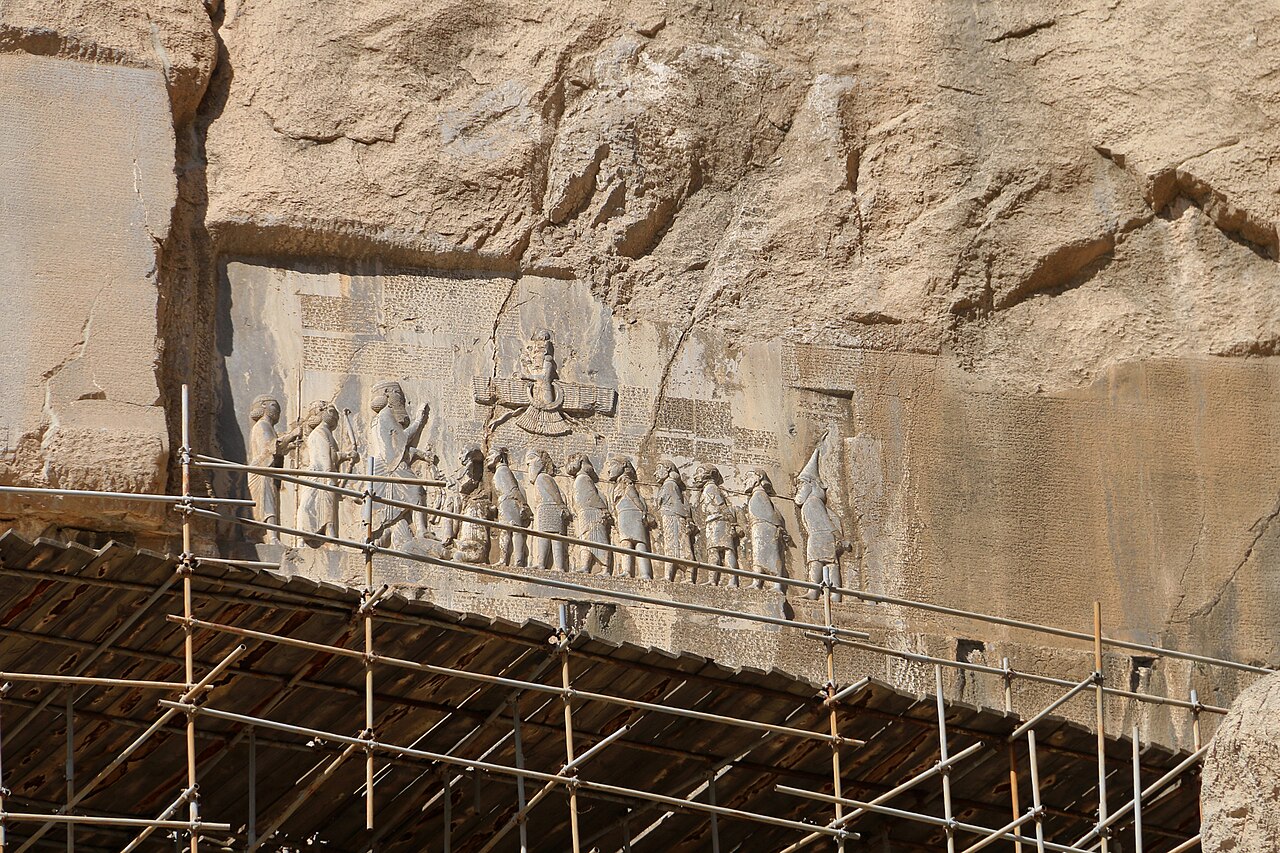

What the relief shows
In the centre stands Darius, holding a bow, with his left foot on the chest of a man lying on his back: Gaumata, the man he accused of impersonating Bardiya. Behind the king stand two Persian nobles, carrying his bow and spear. In front of him, roped together by the neck with their hands tied, stand the rebel kings, each identified by a short label. The last figure, a Scythian with a tall pointed cap, was squeezed in later, after a campaign of 519 BCE. Above the scene floats a figure in a winged ring, usually identified as Ahura Mazda, though some scholars read it as a symbol of royal glory.
The story behind the relief, with the rebels and their fates, is told on the Great Revolts of 522–521 BCE and Bardiya and Gaumata.
The text and its three versions
The inscription speaks in Darius’s voice. It opens with his titles and ancestry, back to Achaemenes, then tells of Cambyses, the false Bardiya, the killing of Gaumata, and the nineteen battles against the rebels, with dates, places and generals’ names. It ends with a curse on anyone who destroys the monument, a blessing on anyone who preserves it, and the names of the six nobles who helped him.
The three versions were not carved at once. Study of the rock suggests the Elamite text came first, beside the relief, followed by the Babylonian text on a projecting rock, and then the Old Persian, which runs to five columns beneath the relief. When the Scythian figure was added, part of the first Elamite text was destroyed and recarved elsewhere. The three versions differ in detail; the Babylonian and Elamite texts, for example, give casualty figures that the Old Persian does not always have.
Did Darius invent Old Persian writing?
In one passage Darius says he made “this form of writing” in Aryan, which had not existed before, and that it was sent to all the lands. Many scholars take this as a claim that the Old Persian cuneiform script was created at his command for this monument. Others argue for earlier use, pointing to short texts in the names of Cyrus at Pasargadae, which may themselves have been added under Darius. The question is open. More on the script is on Old Persian Language and Cuneiform.
Copies around the empire
Darius says he sent copies of the text to every land. Two finds bear this out. A fragmentary Babylonian version on a stone stela was found at Babylon, and an Aramaic translation on papyrus was found at Elephantine in Egypt, copied about a century later, in the reign of Darius II. The Aramaic text even has a passage from Darius’s tomb inscription at Naqsh-e Rostam, which suggests scribes treated it as a standard royal text.
Forgotten and remembered
Within a few generations no one in the region could read the inscription. The Greek historian Diodorus, drawing on Ctesias, attributed the carvings to the legendary Assyrian queen Semiramis. Later rulers added their own works at the foot of the mountain: a reclining figure of Herakles carved in 148 BCE under the Seleucids, Parthian royal reliefs, and much later a Safavid caravanserai. Local tradition linked the site with the story of Farhad, the lover who carved through a mountain for Shirin.
Henry Rawlinson and the decipherment
The text was opened to modern readers by Henry Creswicke Rawlinson, a British officer sent to train Persian troops in Kermanshah in the 1830s. Between 1835 and 1837 he climbed the cliff, standing on ladders on the narrow ledge, to copy the Old Persian text. Georg Friedrich Grotefend and others had already identified a few royal names in short inscriptions from Persepolis; Rawlinson’s long text, with its many proper names, made a full reading possible. He published his translation of the Old Persian version in the Journal of the Royal Asiatic Society in 1846 and 1847.
The Babylonian version, on an overhanging rock, was harder. In 1847 Rawlinson had it copied with the help of a young Kurdish man who swung across the rock face on ropes to make paper casts. Using the Old Persian as a key, Rawlinson, Edward Hincks, Jules Oppert and others worked out the Babylonian script, the same cuneiform used for Akkadian across Mesopotamia. In 1857 the Royal Asiatic Society gave copies of a newly found Assyrian text to four scholars separately; their translations agreed closely, which convinced the learned world that cuneiform could be read. That opened the archives of Babylon and Assyria.
Why it matters
For historians the inscription is the main Persian source for the crisis of 522 BCE, and a rare case where a Persian king’s own account can be set beside Herodotus. It is also a statement of royal ideology: the king as the chosen of Ahura Mazda, fighting the Lie. For linguists it is the longest Old Persian text and the key to three ancient languages. UNESCO inscribed Bisotun on the World Heritage List in 2006; practical information is on the Behistun visitor page and the city page for Kermanshah.
Persian words from this page
| کتیبه | katibe | inscription |
| خط میخی | khatt-e mikhi | cuneiform (“nail script”) |
| فارسی باستان | fârsi-ye bâstân | Old Persian |
| کوه | kuh | mountain |
| کرمانشاه | Kermânshâh | Kermanshah |
| فرهاد | Farhâd | Farhad |
Sources and further reading
- The Behistun inscription, text and translation in Rüdiger Schmitt, The Bisitun Inscriptions of Darius the Great: Old Persian Text (Corpus Inscriptionum Iranicarum, 1991).
- Amélie Kuhrt, The Persian Empire: A Corpus of Sources (2007).
- Encyclopaedia Iranica, “Bisotun”.
- UNESCO World Heritage Centre, Bisotun.
- H. C. Rawlinson, “The Persian Cuneiform Inscription at Behistun”, Journal of the Royal Asiatic Society 10 (1846–47).
Want to learn Persian? Get the free Starter Pack
Get the 14-page printable Starter Pack (all 32 letters, a 7-day reading plan, 100 core words and 20 survival phrases) and a short 5-email course. Free.
More in The Achaemenid Empire (550–330 BCE)
- Achaemenes, Teispes and the Early Persian Kings of Anshan
- Cyrus the Great: Birth, Legends and Rise to Power
- Cyrus Conquers Lydia: Croesus and the Battle of Thymbra
- The Persian Conquest of Ionia and Asia Minor
- Cyrus Takes Babylon (539 BCE)
- The Cyrus Cylinder
- Cyrus and the Return of the Jews
- The Death of Cyrus and the Massagetae
- Pasargadae: Cyrus’s Capital and Tomb
- The Tomb of Cyrus through History
- Cambyses II
- Cambyses Conquers Egypt: The Battle of Pelusium
- Bardiya and Gaumata: The Usurper Question
- Darius the Great Takes the Throne
- The Great Revolts of 522–521 BCE
- The Behistun Inscription
- The Persian Conquest of the Indus Valley
- Darius’s Scythian Campaign
- Darius’s Canal from the Nile to the Red Sea
- Darius’s Reforms: Satrapies, Taxes and Law
- The Royal Road and the Persian Postal System
- The Daric: Achaemenid Coinage and Economy
- The Ionian Revolt (499–493 BCE)
- The Greco-Persian Wars: An Overview
- Mardonius and the First Persian Expedition to Greece (492 BCE)
- The Battle of Marathon (490 BCE)
- The Death of Darius I and the Succession of Xerxes
- The Royal Tombs of Naqsh-e Rostam
- Xerxes I: King of Kings (486–465 BCE)
- Xerxes’ Invasion of Greece (480–479 BCE)
- The Battle of Thermopylae (480 BCE)
- The Battle of Artemisium (480 BCE)
- The Persian Capture of Athens (480–479 BCE)
- The Battle of Salamis (480 BCE)
- The Battle of Plataea and the End of the Invasion (479 BCE)
- The Palace of Darius at Susa
- Building Persepolis: How Darius and Xerxes Built Parsa
- The Persepolis Fortification and Treasury Tablets
- Herodotus and the Persians
- The Apadana Reliefs: Nations Bringing Gifts
- The Achaemenid Paradise Gardens
- The Persian Immortals and the Achaemenid Army
- The Achaemenid Navy
- Religion of the Achaemenid Kings
- Women of the Achaemenid Court
- Old Persian Language and Cuneiform
- Egypt under Persian Rule
- Babylon under Persian Rule
- Artaxerxes I
- The Peace of Callias
- Darius II and the Peloponnesian War
- Famous Satraps of the Persian Empire
- Artaxerxes II Mnemon
- Cyrus the Younger and the Battle of Cunaxa
- The King’s Peace (387 BCE)
- The Great Satraps’ Revolt
- Artaxerxes III and the Reconquest of Egypt
- Darius III, the Last Achaemenid King
- The Battle of the Granicus (334 BCE)
- The Battle of Issus (333 BCE)
- Alexander Takes Tyre, Gaza and Egypt (332 BCE)
- The Battle of Gaugamela (331 BCE)
- Ariobarzanes and the Battle of the Persian Gate
- The Burning of Persepolis (330 BCE)
- The Death of Darius III and Bessus
- The Legacy of the Achaemenid Empire