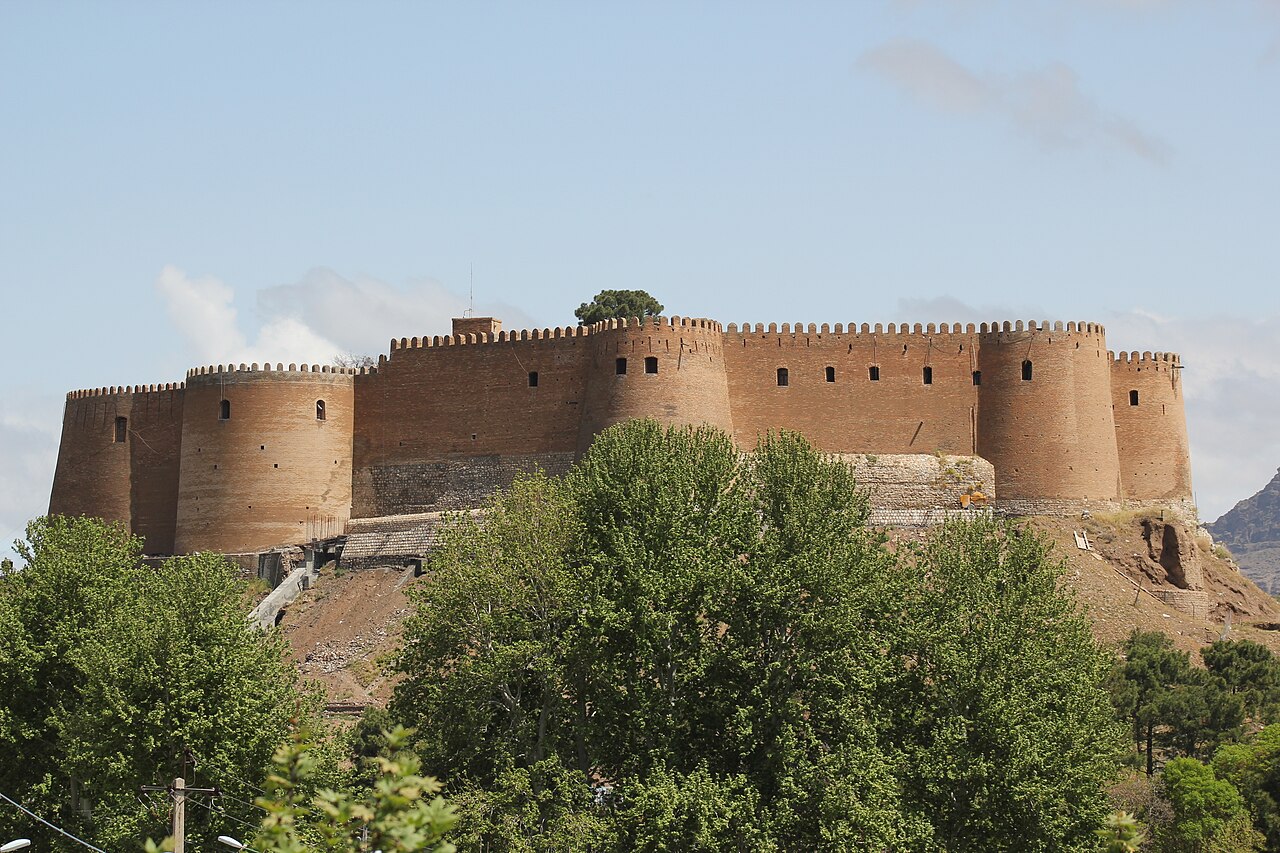
Falak-ol-Aflak is a massive fortress on a steep hill in the middle of Khorramabad, the capital of Lorestan province. Its foundations go back to the Sasanian period (224–651 CE); it served later dynasties as a stronghold and governor’s seat, was a prison until 1968, and then became a museum complex for the archaeology and ways of life of Lorestan.
| Persian name | قلعه فلکالافلاک, also دژ شاپورخواست (Dezh-e Shâpurkhâst) |
|---|---|
| Meaning | “Sky of skies”, the highest heaven |
| Origin | Sasanian, with many later rebuildings |
| Location | Centre of Khorramabad, Lorestan, beside the Khorramabad river |
| Size | Hill and walls rise about 40 m above the surrounding city |

From Shapur Khast to “sky of skies”
The fortress stands on the hill that early Islamic geographers knew as Shapur Khast, a name that links it with one of the Sasanian kings called Shapur. The Khorramabad river runs past the foot of the hill on two sides, which, with the steep slopes, gave natural protection. The site controlled the valley that carried traffic between the Mesopotamian lowlands and the Iranian plateau through the Zagros mountains.
What stands today is the result of many rebuildings. The castle was the residence of local rulers of Lorestan in the medieval period and later, and the building was repaired again and again in brick and stone. The romantic name Falak-ol-Aflak, “the sky of skies”, is relatively recent. In the Pahlavi period the fortress was used as a prison, as many old citadels in Iran were. In 1968 the prison closed, and the castle was restored and turned into a museum complex.
What to look at
The walls and towers
The castle is an irregular block of tall walls with round towers, built around two courtyards. Seen from the streets below, especially at night when the walls are floodlit, it looks like a single solid mass. Archaeologists have traced an outer double rampart with twelve towers around the present building; only two of these survive, to the north-west and south-west. Inside, the rooms around the courtyards are cool and dim. One feature that guides like to point out is the way the castle was ventilated: its height and position catch the wind, which helped keep the brick, stone and wooden structure dry.
The museums
The rooms house an archaeological museum and an anthropology museum. The archaeology rooms have shown objects from Lorestan’s long past, including the famous Lorestan bronzes: horse bits, weapons, standards and ornaments made by the people of the Zagros in the early first millennium BCE. The anthropology section uses figures and objects to show traditional life among the Lurs, with costumes, tools, music and nomadic tents.
Damage in 2026
During the 2026 war with the United States and Israel, an air strike on 8 March 2026 hit the castle. According to reports collected in the international press, it damaged several sections of the site and destroyed the museum displays, and five museum workers were injured; the site had been marked with the Blue Shield emblem that identifies protected cultural property. Visitors should check whether the castle and its museums have reopened and which parts can be visited.
Around Falak-ol-Aflak
The castle is a natural starting point for exploring Khorramabad. Within the city are the brick minaret of a vanished medieval mosque and the Gerdab-e Sangi, a round stone pool from the medieval water system. The caves of the Khorramabad valley, with evidence of human life going back tens of thousands of years, were added to the UNESCO World Heritage List in 2025; their deeper history is covered on our page on prehistoric Iran.
Practical notes
- The castle is in the city centre and easy to reach on foot or by taxi. The climb up the hill to the gate is short but steep.
- The walls are best photographed from across the river and in the evening when they are lit.
- Because of the 2026 damage, opening hours, access and tickets may differ from older guidebooks. Check current official information, and for safety follow your own government’s travel advice.
Persian words from this page
| فلکالافلاک | Falak-ol-Aflâk | sky of skies |
| خرمآباد | Khorramâbâd | Khorramabad |
| لرستان | Lorestân | Lorestan |
| دژ | dezh | fortress |
| برج | borj | tower |
| موزه | muze | museum |
Sources and further reading
- Encyclopaedia Iranica, “Lorestān” and “Khorramabad” (history and monuments of the province).
- Oscar White Muscarella, Bronze and Iron: Ancient Near Eastern Artifacts in the Metropolitan Museum of Art (New York, 1988), on Lorestan bronzes.
- UNESCO World Heritage Centre, The Prehistoric Sites of the Khorramabad Valley (inscribed 2025).
- Wikipedia, “Destruction of cultural heritage during the 2026 Iran war” (summary of reports on the March 2026 strike), consulted November 2026.
Want to learn Persian? Get the free Starter Pack
Get the 14-page printable Starter Pack (all 32 letters, a 7-day reading plan, 100 core words and 20 survival phrases) and a short 5-email course. Free.
More in Top Places to Visit in Iran
- Naqsh-e Jahan Square
- Shah (Imam) Mosque, Isfahan
- Sheikh Lotfollah Mosque
- Ali Qapu Palace
- Jameh Mosque of Isfahan
- Si-o-se Pol and Khaju Bridge
- Vank Cathedral
- Hasht Behesht Palace
- Naqsh-e Rostam
- Eram Garden, Shiraz
- Nasir al-Molk (Pink) Mosque
- Tomb of Hafez (Hafezieh)
- Tomb of Saadi (Saadieh)
- Shah Cheragh Shrine
- Arg of Karim Khan
- Fin Garden, Kashan
- Historic Houses of Kashan
- Jameh Mosque of Yazd
- Yazd Fire Temple and Towers of Silence
- Dowlatabad Garden and Windcatcher
- Amir Chakhmaq Complex
- Golestan Palace
- National Museum of Iran
- Treasury of National Jewels
- Tehran Grand Bazaar
- Milad Tower
- Imam Reza Shrine, Mashhad
- Tomb of Ferdowsi, Tus
- Tomb of Omar Khayyam, Neyshabur
- Tomb of Avicenna, Hamadan
- Ganjnameh Inscriptions, Hamadan
- Behistun (Bisotun): Visiting the Site
- Taq-e Bostan: Visiting the Site
- Tabriz Historic Bazaar
- Takht-e Soleyman
- Armenian Monastic Ensembles of Iran
- Sheikh Safi al-Din Shrine, Ardabil
- Dome of Soltaniyeh
- Alamut Castle
- Falak-ol-Aflak Castle
- Shushtar Historical Hydraulic System
- Chogha Zanbil: Visiting the Ziggurat
- Susa Archaeological Site
- Arg-e Bam
- Ganjali Khan Complex, Kerman
- Shazdeh Garden, Mahan
- Rayen Castle
- Dasht-e Lut (Lut Desert)
- Maranjab Desert and Caravanserai
- Varzaneh Desert
- Mount Damavand
- Hyrcanian Forests
- Lake Urmia
- Badab-e Surt Springs
- Ali Sadr Cave
- The Kaluts of Shahdad
- Qeshm Geopark
- Hormuz Island Colours
- Visiting Persepolis: A Day Trip from Shiraz
- Visiting Pasargadae
- Persian Caravanserais
- The Qanat of Gonabad
- Meymand Village
- Sasanian Sites of Fars: Firuzabad, Bishapur and Sarvestan
- Gonbad-e Qabus: Visiting the Tower
- Zayandeh Rud and Isfahan’s Bridges
- Tochal and Darband: Hiking Above Tehran
- Mount Sabalan
- Skiing in Iran: Dizin and Shemshak
- Golestan National Park