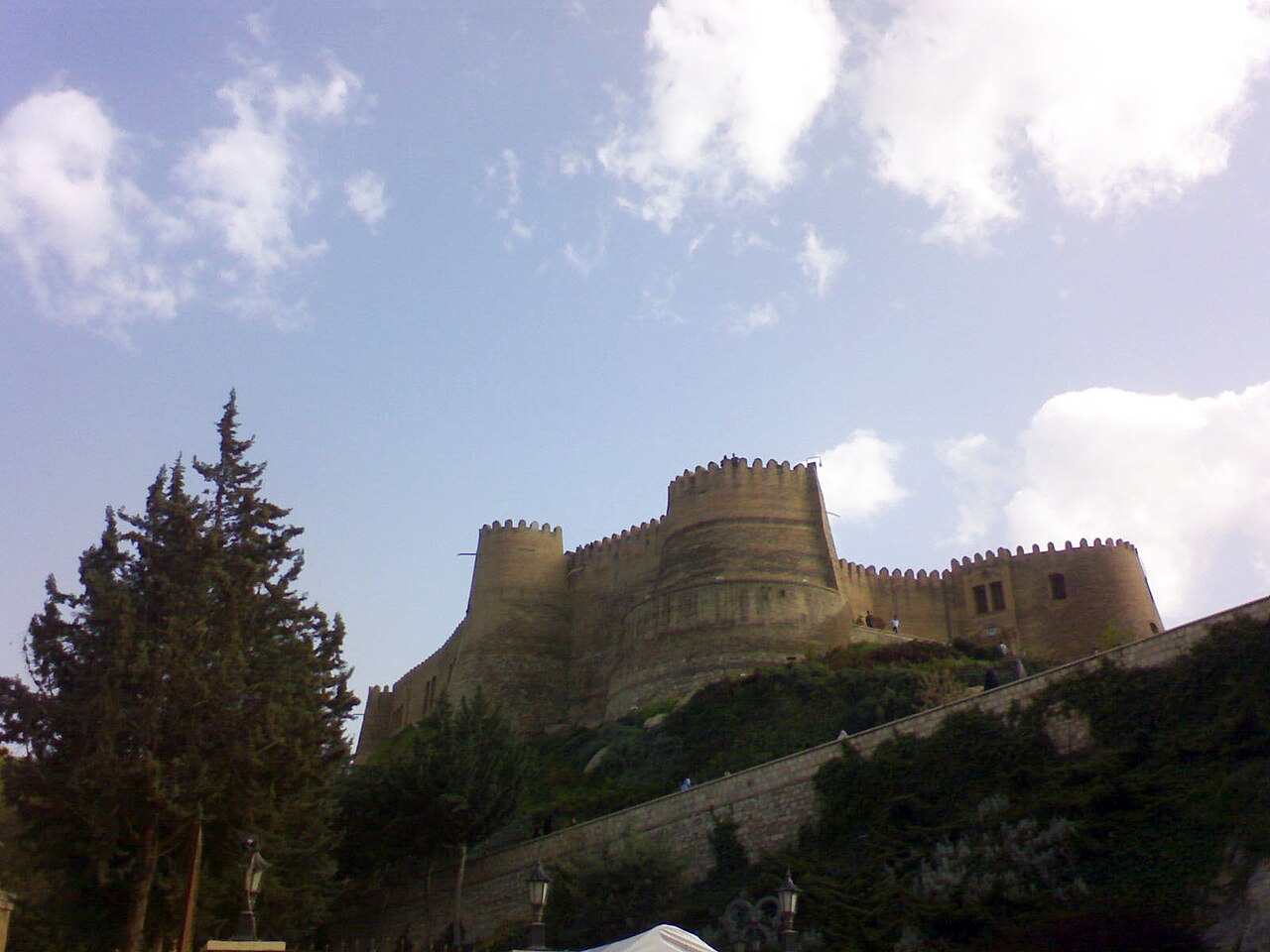
Khorramabad is the capital of Lorestan province in the Zagros mountains of western Iran, a city of about 370,000 people in a narrow valley overlooked by the Sasanian-era fortress of Falak-ol-Aflak. It is the main city of the Lurs, and the caves around it, which hold evidence of people living here for some 60,000 years, were added to the UNESCO World Heritage List in July 2025.
| Persian name | خرمآباد (Khorramâbâd) |
|---|---|
| Province | Lorestan (capital) |
| Population | 373,416 (city, 2016 census, Statistical Centre of Iran) |
| Elevation | About 1,150 m |
| Climate | Hot, dry summers; cool, wet winters |
| Main language | Lori (Khorramabadi Lori), with Persian |
| UNESCO site | Prehistoric Sites of the Khorramabad Valley (2025) |
| Distance | About 490 km south-west of Tehran; about 200 km south-east of Kermanshah |

Sixty thousand years in the valley
The limestone cliffs around Khorramabad are full of caves and rock shelters, and archaeologists have excavated them since the 1960s. Five of them, Yafteh, Ghamari, Kunji, Gilvaran and Gar Arjeneh, were listed together by UNESCO in 2025 as Iran’s first World Heritage Site from the Palaeolithic. Ghamari and Kunji preserve Middle Palaeolithic layers associated with Neanderthals; Yafteh, on the slopes north-west of the city, has Upper Palaeolithic tools of the Baradostian tradition, dated roughly 40,000 to 25,000 years ago, together with shell beads and perforated deer teeth, some of the earliest personal ornaments found in Iran.
Bronzes of Lorestan
From the 1920s onward, villagers in Lorestan dug up thousands of cast bronze objects from ancient graves: horse bits and harness rings, axe heads, daggers, “standard” finials shaped like a figure gripping two animals, and pins. Most date from the early first millennium BCE. Because so many were looted and sold without records, their makers and exact dates are still debated, and they are scattered in museums from Tehran to New York. The Lorestan museum inside Falak-ol-Aflak has a good collection. See the Luristan bronzes.
Falak-ol-Aflak
The fortress that dominates the city stands on a rocky hill above the Khorramabad river. Its brick and stone walls with round towers probably go back to the Sasanian period, when a town here was called Shapur-Khwast, and it was rebuilt many times. Its Persian name, فلکالافلاک, means “sky of skies”. Under the Pahlavis it served as a prison; it was later restored and now holds museums of archaeology and anthropology. A spring rises inside the walls, which explains how it could hold out against long sieges. Details for visitors are on the Falak-ol-Aflak Castle page.
Capital of the atabegs of Lesser Lur
In the Middle Ages, Lorestan was divided between Greater Lur, in the Bakhtiari country to the south-east, and Lesser Lur, around Khorramabad. From the late twelfth century the Khorshidi family ruled Lesser Lur as atabegs from Khorramabad, paying tribute to Seljuks, Mongols and Timurids, until Shah Abbas I ended their line in the 1590s. Several monuments survive from this period around the city:
- The brick minaret (Manar-e Ajori), a tall Seljuk-era tower in the old part of town.
- Gerdab-e Sangi, a large round stone water basin fed by a spring, from the same era.
- The stone inscription (Sang-neveshteh), a medieval decree carved on a stone slab setting out rules for land and water.
- Pol-e Shekasteh, “the broken bridge”, the ruins of a Sasanian bridge over the Khorramabad river.
The Lurs and their language
The Lurs are one of Iran’s larger peoples, living along the Zagros from Lorestan to Fars, and many were pastoral nomads until the twentieth century. Reza Shah’s campaigns of the 1920s and 1930s forced many tribes to settle, and Khorramabad grew as a garrison and market town. Lori is an Iranian language closely related to Persian, and Lori songs, sung to the kamancheh and sorna, are well known in Iran. A notable mourning custom in Lorestan is the chamar, a lament sung with drums at funerals. See the people of Iran.
In the city, Lori bread, kalaneh (a flatbread cooked with wild leek), and dishes of lamb and yoghurt are worth trying, and the market sells the honey and wild herbs of the mountains.
Lakes, waterfalls and gorges
Lorestan is one of the wettest and greenest parts of the Zagros, and its springs, rivers and waterfalls draw Iranian visitors every spring.
- Kio Lake, a spring-fed pond in a park in the city, popular on summer evenings.
- Bisheh waterfall, south of the city, beside the railway line through the Zagros, where water falls over a mossy cliff.
- Lake Gahar, a mountain lake in the Oshtorankuh range, reached by a hike of several hours from the road head.
The railway from Tehran to the Persian Gulf runs through the gorges south of Khorramabad, and the section towards Andimeshk passes some of the most dramatic mountain scenery of any Iranian railway.
Getting there
Khorramabad has an airport and is on the main road between Tehran and Khuzestan, so it is often visited between Hamadan or Kermanshah and Ahvaz. Spring is the best season, when the valleys are green and the waterfalls full. For opening hours, transport and safety, check current official information and your own government’s travel advice.
Persian words from this page
| خرمآباد | Khorramâbâd | Khorramabad |
| لرستان | Lorestân | Lorestan, “land of the Lurs” |
| لری | Lori | Lori language |
| فلک | falak | sky, heavens |
| غار | ghâr | cave |
| آبشار | âbshâr | waterfall |
| مفرغ | mafragh | bronze |
| مناره | manâreh | minaret |
Sources and further reading
- UNESCO World Heritage List, The Prehistoric Sites of the Khorramabad Valley (whc.unesco.org/en/list/1744), inscribed July 2025.
- Encyclopaedia Iranica, “Ḵorramābād” and “Lorestān”.
- Oscar White Muscarella, Bronze and Iron: Ancient Near Eastern Artifacts in the Metropolitan Museum of Art, 1988, on the Luristan bronzes and their looting.
- Marcel Otte and others, excavation reports on Yafteh Cave, published in the 2000s and 2010s.
- Statistical Centre of Iran, General Population and Housing Census 2016 (1395).
Want to learn Persian? Get the free Starter Pack
Get the 14-page printable Starter Pack (all 32 letters, a 7-day reading plan, 100 core words and 20 survival phrases) and a short 5-email course. Free.
More in Cities of Iran
- Tehran: Iran’s Capital
- Mashhad
- Isfahan
- Shiraz
- Tabriz
- Yazd
- Kashan
- Kerman
- Hamadan
- Qom
- Ahvaz
- Rasht
- Kermanshah
- Urmia
- Ardabil
- Zanjan
- Qazvin
- Sanandaj
- Khorramabad
- Bandar Abbas
- Bushehr
- Zahedan
- Birjand
- Gorgan
- Sari
- Semnan
- Arak
- Ilam
- Yasuj
- Shahr-e Kord
- Bojnurd
- Karaj
- Abadan and Khorramshahr
- Kish Island
- Qeshm Island
- Hormuz Island
- Masuleh
- Abyaneh
- Kandovan
- Bam
- Neyshabur (Nishapur)
- Shush (Susa) Today