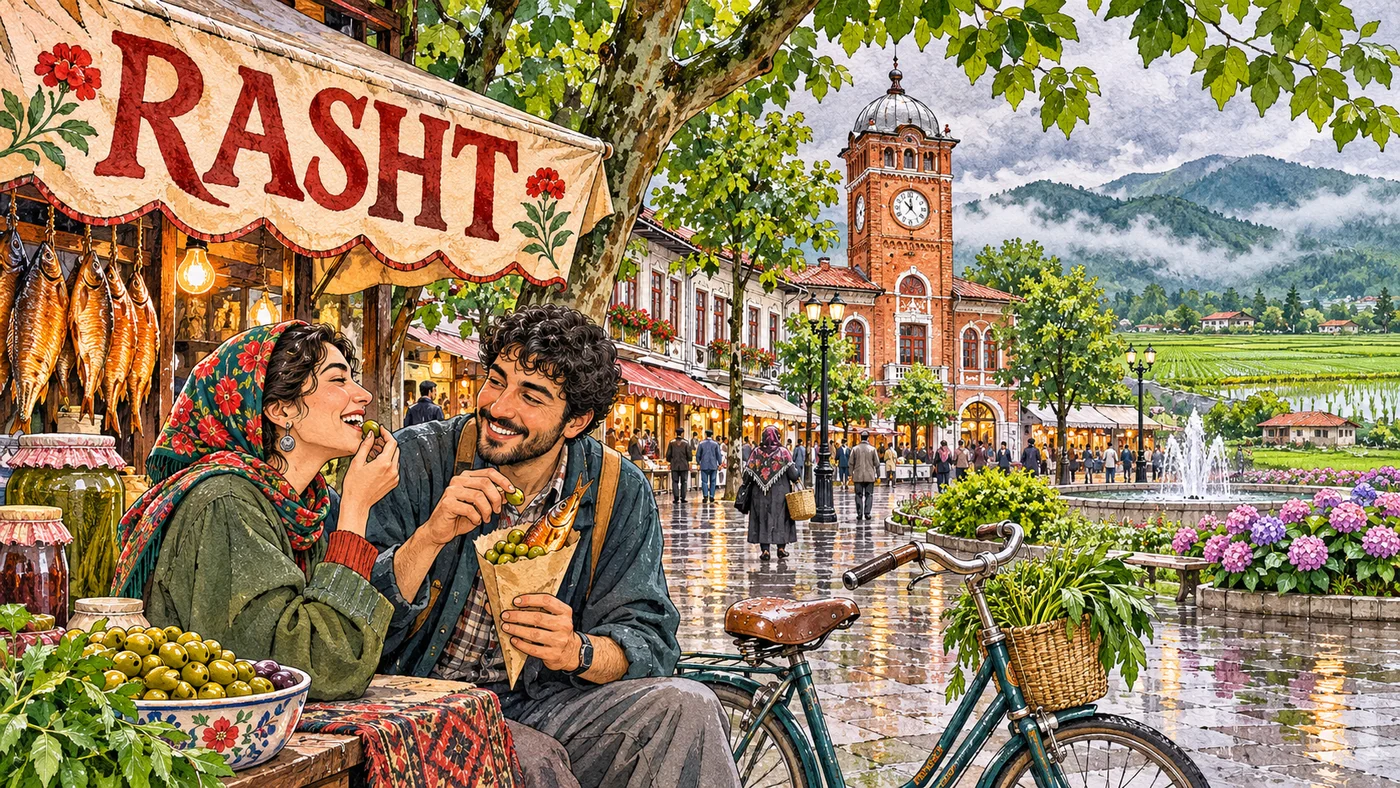
Rasht is the capital of Gilan province on Iran’s Caspian coast, a city of about 680,000 people on the wet, green plain between the Alborz mountains and the sea. It grew rich on silk from the seventeenth century, was the capital of a short-lived Soviet-backed republic in 1920, and in 2015 became the first Iranian city named a UNESCO Creative City of Gastronomy, which is why many Iranians travel there simply to eat.
| Persian name | رشت (Rasht) |
|---|---|
| Province | Gilan (capital) |
| Population | 679,995 (city, 2016 census, Statistical Centre of Iran) |
| Elevation | A few metres below to a few metres above sea level |
| Climate | Humid subtropical: mild, very wet autumns and winters, humid summers |
| Local language | Gilaki, alongside Persian |
| UNESCO | Creative City of Gastronomy (2015) |
| Distance | About 320 km north-west of Tehran; about 35 km south of the port of Bandar Anzali |

A late city built on silk
Rasht is young by Iranian standards. Encyclopaedia Iranica dates its growth to the fourteenth century, when life in Gilan shifted from the mountain valleys down to the rice-growing plain. It became the provincial capital after Shah Abbas I absorbed Gilan into the Safavid state at the end of the sixteenth century.
What made Rasht matter was silk. Gilan was the largest silk-producing region of Safavid Iran, and Shah Abbas turned the trade into a royal concern, selling raw silk to English, Dutch, Armenian and Russian buyers. Rasht was the collecting point, and its merchants traded through the Caspian to Astrakhan and the Volga. When the Safavid state collapsed, Peter the Great occupied Gilan in 1722; Russia handed the province back by the Treaty of Rasht in 1732, as Nader Shah’s power grew.
The nineteenth century brought both disaster and boom. A plague in 1830 and 1831 killed about half the population. Later in the century, European firms opened offices to buy cocoons and raw silk, a Russian company built a road to Qazvin in 1889, and Rasht became the main gateway between Iran and the Russian empire. Many of its first modern institutions, newspapers and theatres came in by this route.
Revolutionaries, Russians and the Jangalis
Gilan’s revolutionaries took Rasht in 1909, during the Constitutional Revolution, and joined the march on Tehran that deposed Mohammad Ali Shah. Russian troops occupied the city in 1911.
During and after the First World War, the forests of Gilan were the base of the Jangali (“forest”) movement of Mirza Kuchik Khan. After Bolshevik forces landed at Anzali in May 1920, a Persian Socialist Soviet Republic was proclaimed with Rasht as its capital. The alliance between Kuchik Khan and the Iranian communists soon broke down, Soviet support was withdrawn after the Russo-Persian treaty of February 1921, and Reza Khan’s troops entered Rasht that autumn. Kuchik Khan died in the mountains in December 1921. The story is told in full on the page about Mirza Kuchik Khan and the Jangali movement.
The city of rain
Iranians call Rasht شهر باران (shahr-e bârân), “the city of rain”. Moist air from the Caspian rises against the Alborz and falls as rain on the plain, which gets well over 1,000 mm a year, several times the national average and more than almost any other Iranian city. Autumn is the wettest season, and grey, drizzly weeks are normal in winter.
The rain explains the landscape around the city: rice paddies, tea gardens on the foothills towards Lahijan, and the Hyrcanian forests on the mountain slopes, which UNESCO listed in 2019. It also explains the old houses, with steep tiled or thatched roofs and wide verandas, quite unlike the flat roofs and courtyards of the plateau. For the coast as a whole, see the existing guide to the north of Iran (Shomal).
Why Rasht is a city of gastronomy
Gilani cooking is sour, herby and garlicky, built on rice, fresh greens, fish from the Caspian and its rivers, and sour fruits such as unripe grapes, sour plums and pomegranate. UNESCO’s 2015 designation recognised both the food and the markets and home kitchens that keep it going. A few dishes to look for:
Smoky aubergine and broad beans
Mirza ghasemi (میرزاقاسمی) is aubergine grilled over a flame, mashed with garlic, tomato and egg, eaten with bread or rice. Baghala ghatogh (باقالاقاتق) is a stew of the local long broad beans with dill, garlic and egg.
Sour sauces and fish
Torsh-e tareh is a sour stew of greens; Gilan’s version of fesenjan is sharper than the sweeter Tehran style. Smoked and salted fish, mahi dudi and mahi shur, are served with herb rice, especially at Nowruz. Zeytun parvardeh, olives marinated with pomegranate paste, walnuts and herbs, comes from the olive groves of Rudbar to the south.
For dishes from the rest of the country, see Persian food: dishes every visitor should try.
Bazaar and Municipality Square
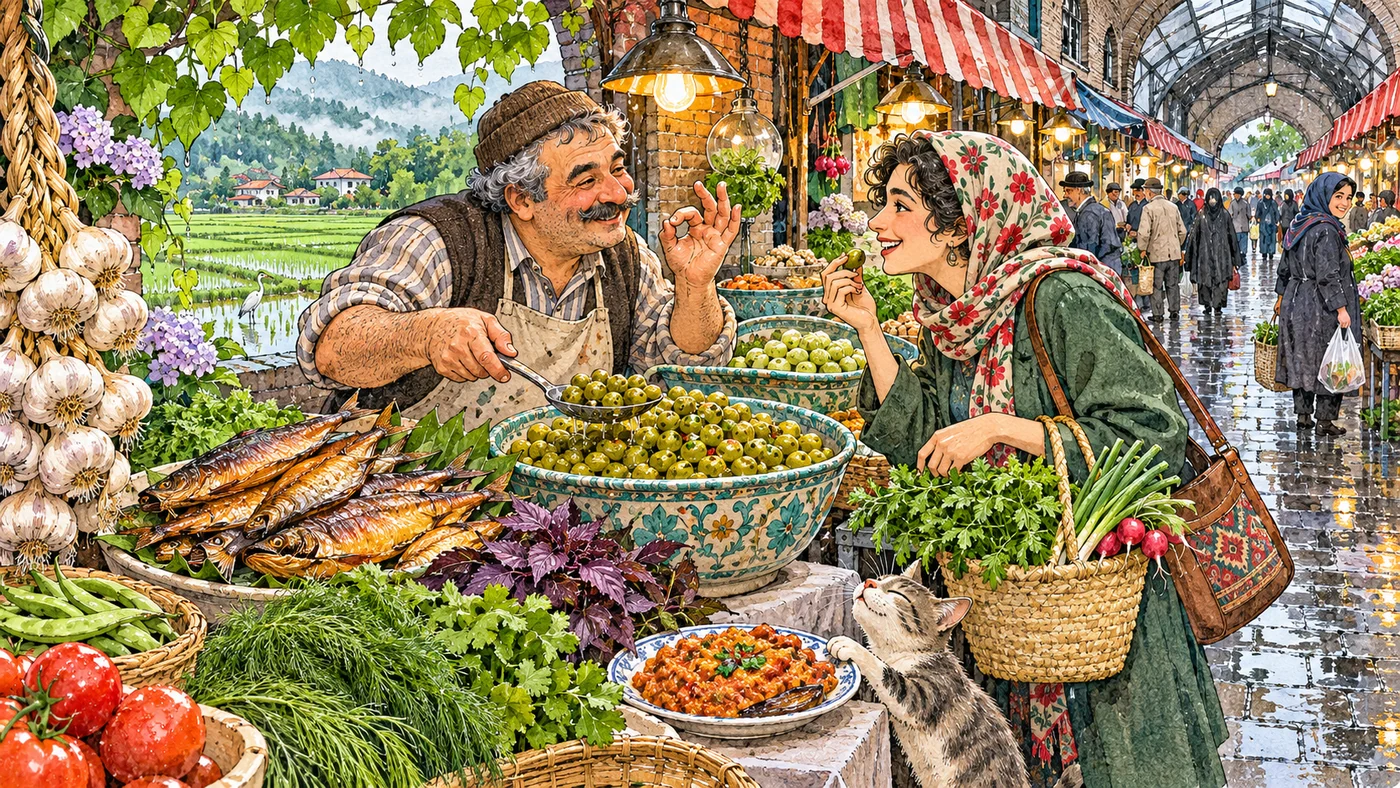
The Rasht bazaar is unusual for Iran: instead of a long vaulted roof, it is a grid of open lanes with canopies against the rain, packed with fish, herbs, pickles, citrus, local cheeses and the rice of the province. Iranica dates the bazaar’s Friday Mosque to the Zand period. Mornings are the best time, when fishmongers and farmers’ wives are selling.
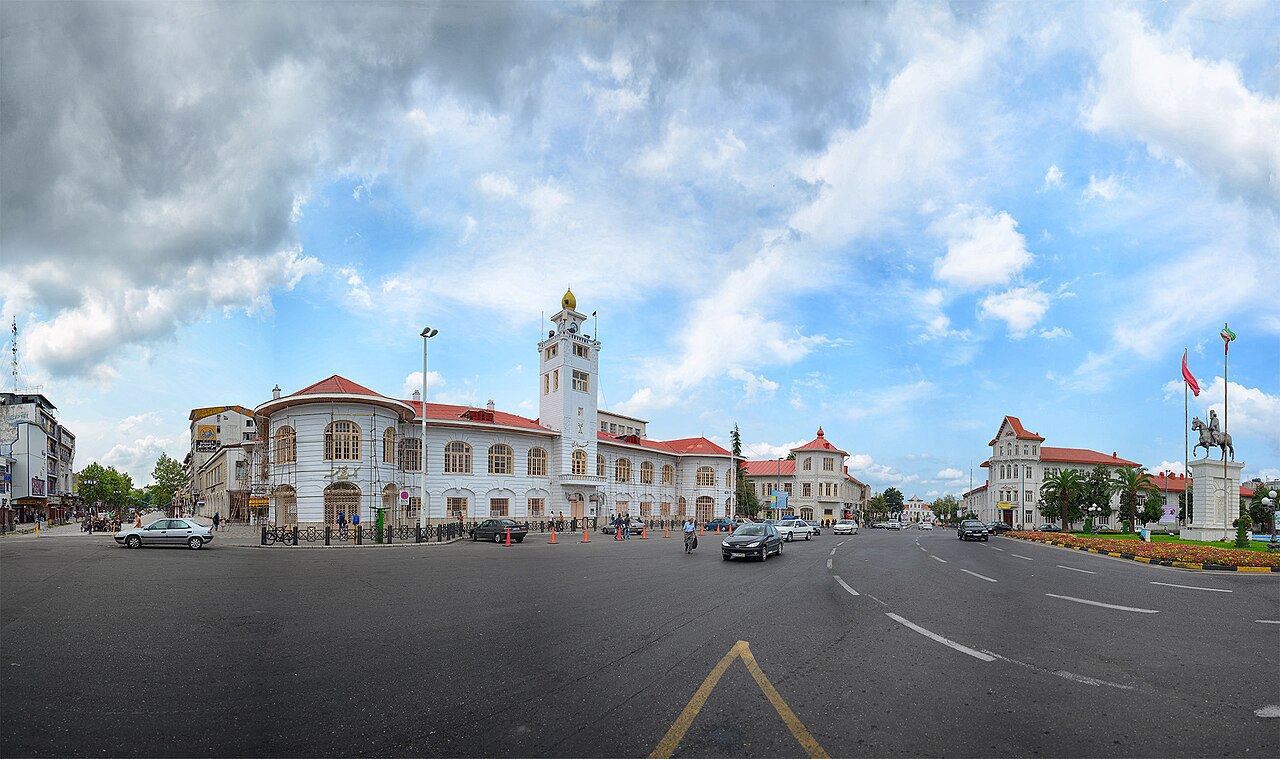
A short walk away is Shahrdari (Municipality) Square, the city’s centre, now largely pedestrian. Its landmarks are the municipality building with its clock tower and the former post office, both built in a European style under Reza Shah. Around them are Qajar and early Pahlavi houses, cafés and the street life that fills the square on dry evenings.
Gilaki and the people of Gilan
Many people in Rasht speak Gilaki, an Iranian language related to Persian but not mutually intelligible with it, as well as Persian. Gilaki has its own songs and poetry, and a learner will hear it in the bazaar. More on it is on the page about the languages of Iran.
Trips from Rasht
- Masuleh, the stepped mountain village where the roofs of one row of houses are the street of the next, about 60 km to the south-west.
- Bandar Anzali, the port on the Caspian, with its lagoon, wetland birds and fish market.
- Qal’eh Rudkhan, a brick fortress in the forest above Fuman, reached by a long climb on foot.
- The tea gardens and old town of Lahijan, about 40 km east.
Getting there
Rasht has an airport and is about four hours by road from Tehran through Qazvin and the Sefidrud valley. A railway now links it with Qazvin and Tehran. Rain gear is useful at any season except high summer. For transport schedules, visas and safety, check current official information and your own government’s travel advice.
Persian words from this page
| رشت | Rasht | Rasht |
| گیلان | Gilân | Gilan province |
| گیلکی | Gilaki | the Gilaki language |
| باران | bârân | rain |
| ابریشم | abrisham | silk |
| جنگل | jangal | forest |
| میرزاقاسمی | mirzâ ghâsemi | smoky aubergine dish |
| برنج | berenj | rice |
Sources and further reading
- Encyclopaedia Iranica, “Rasht i. The City” (iranicaonline.org).
- Encyclopaedia Iranica, “Jangali Movement” (iranicaonline.org).
- Encyclopaedia Iranica, “Gilān vii. History in the 19th century” (iranicaonline.org).
- Rudi Matthee, The Politics of Trade in Safavid Iran: Silk for Silver, 1600–1730, Cambridge University Press, 1999.
- UNESCO Creative Cities Network, Rasht, City of Gastronomy (2015).
- Statistical Centre of Iran, General Population and Housing Census 2016 (1395).
Want to learn Persian? Get the free Starter Pack
Get the 14-page printable Starter Pack (all 32 letters, a 7-day reading plan, 100 core words and 20 survival phrases) and a short 5-email course. Free.
More in Cities of Iran
- Tehran: Iran’s Capital
- Mashhad
- Isfahan
- Shiraz
- Tabriz
- Yazd
- Kashan
- Kerman
- Hamadan
- Qom
- Ahvaz
- Rasht
- Kermanshah
- Urmia
- Ardabil
- Zanjan
- Qazvin
- Sanandaj
- Khorramabad
- Bandar Abbas
- Bushehr
- Zahedan
- Birjand
- Gorgan
- Sari
- Semnan
- Arak
- Ilam
- Yasuj
- Shahr-e Kord
- Bojnurd
- Karaj
- Abadan and Khorramshahr
- Kish Island
- Qeshm Island
- Hormuz Island
- Masuleh
- Abyaneh
- Kandovan
- Bam
- Neyshabur (Nishapur)
- Shush (Susa) Today