The palace of Darius I at Susa, in today’s Khuzestan province, was the first great royal residence built by the new king after he seized the throne in 522 BCE. Work began within a few years of his accession. Its foundation charter lists the materials and craftsmen gathered from every corner of the empire, and its glazed brick friezes and giant bull capitals, now mostly in the Louvre, are among the best-known works of Achaemenid art.
| Built | From c. 518 BCE, under Darius I; restored by Artaxerxes II after a fire |
|---|---|
| Place | Susa (Shush), Khuzestan, south-west Iran |
| Main parts | Apadana (columned audience hall with 36 columns), residential palace with three courtyards, Darius Gate |
| Key text | The foundation charter of Darius (DSf), in Old Persian, Elamite and Babylonian |
| Excavated by | Marcel and Jane Dieulafoy (1884 to 1886), Jacques de Morgan and successors; Jean Perrot (1969 to 1979) |
| Persian name | کاخ داریوش در شوش (Kâkh-e Dâriush dar Shush) |
| Status | Part of the UNESCO World Heritage Site of Susa (2015) |
Why Susa
Susa had been the capital of Elam for some two thousand years before the Persians. It lay on the plain between the Zagros and Mesopotamia, close to the roads to Babylon and to the Persian homeland, and it was warm in winter. After crushing the revolts of 522 to 521 BCE, Darius needed a seat of government that suited the empire he was reorganising (see Darius’s reforms). Susa became the main administrative capital, the place where Greek envoys and exiles came to see the king, and the eastern end of the Royal Road from Sardis. Persepolis, begun a little later, was the ceremonial centre in Persis itself.
The foundation charter
Darius left an unusually detailed account of the building. The foundation charter, known to scholars as DSf, survives in several copies on clay tablets, stone and glazed bricks. It describes how the earth was dug down to bedrock and the hollow filled with packed gravel before the brick terrace was raised, and then names the sources of every material:
- cedar from Lebanon, brought by the Assyrians to Babylon and by Carians and Ionians on to Susa;
- yaka wood from Gandhara and Carmania;
- gold from Sardis and Bactria;
- lapis lazuli and carnelian from Sogdiana, and turquoise from Chorasmia;
- silver and ebony from Egypt, and ivory from Ethiopia, Sind and Arachosia;
- stone for the columns from a village in Elam called Abiradu.
The workers came from just as far. Babylonians moulded and baked the bricks; Ionians and Sardians cut the stone; Medes and Egyptians worked the gold and decorated the walls; Sardians and Egyptians did the woodwork. The charter ends with the king’s words that at Susa a splendid work was ordered and a splendid work was completed.
The text is both a building record and a statement of ideology: the whole empire, its peoples and its resources, contributed to the king’s house. The same idea appears in the reliefs of tribute bearers at Persepolis (see the Apadana reliefs).

The Apadana
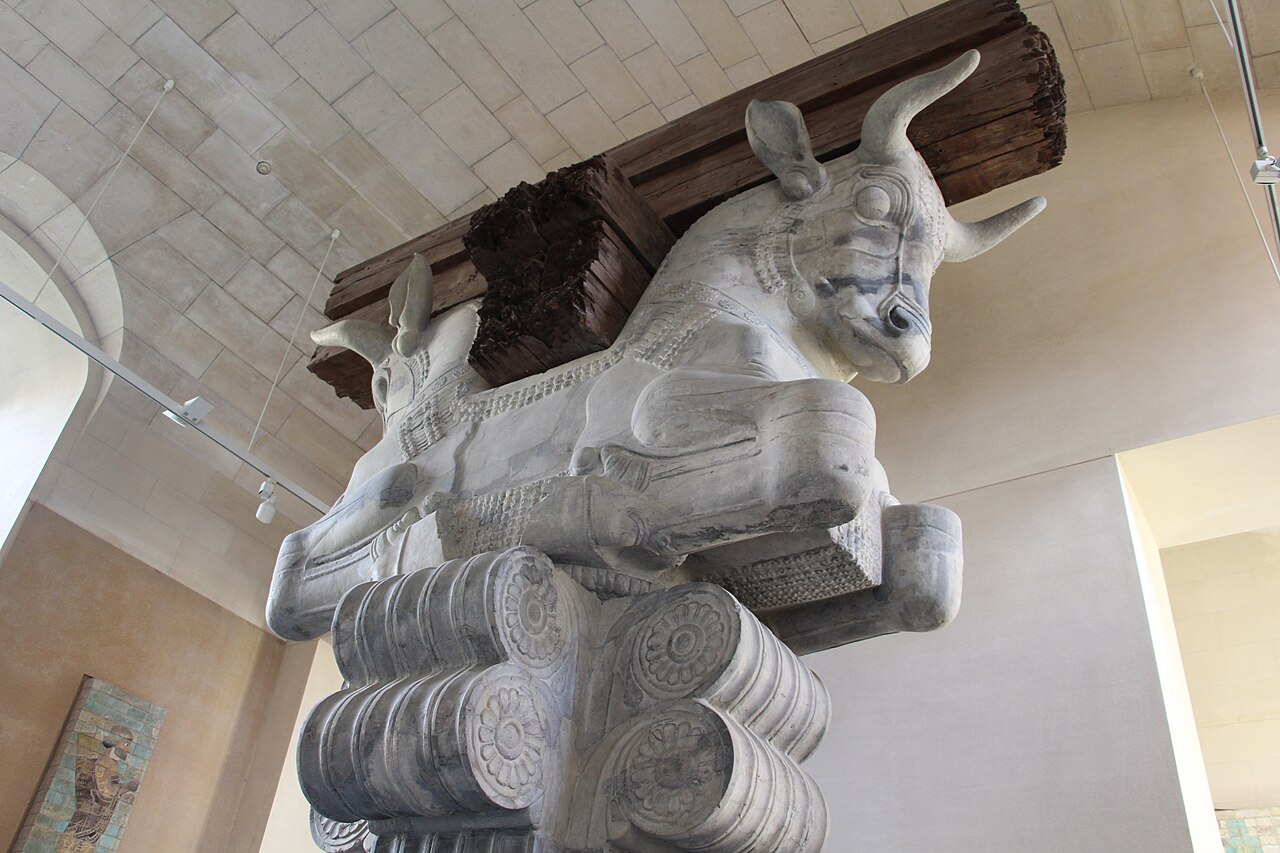
The northern part of the complex was a huge square hall with 36 columns in six rows of six, surrounded on three sides by porticoes. Its stone columns rose to around 20 metres and ended in capitals of two bulls joined back to back, whose necks carried the great roof beams of cedar. One of these capitals, reassembled by the Dieulafoys, is the centrepiece of the Persian rooms in the Louvre.
The hall did not survive unchanged. An inscription of Artaxerxes II on the column bases says that the hall built by his great-great-grandfather Darius burned in the time of his grandfather Artaxerxes I, and that he rebuilt it. Artaxerxes II also built a separate palace on the far bank of the Shaur river (see Artaxerxes II).
The residential palace
South of the Apadana lay the king’s residence, built on a Babylonian plan: three large courtyards in a row, surrounded by rooms and halls. The walls of the courtyards were faced with brightly coloured glazed bricks forming friezes of lions, winged bulls, griffins and sphinxes under winged discs, and the famous procession of spearmen and archers in rich robes. The Susa bricks were not of ordinary clay like the glazed bricks of Babylon’s Ishtar Gate, but of a hard siliceous material made largely of sand and lime, moulded in relief and glazed in white, yellow, green, blue and brown.
The archers may represent the royal guard or the Persian army in general. Their story is told on the Persian Immortals.
The Darius Gate and the Egyptian statue
The palace was entered through a monumental gatehouse to the east, inscribed by Xerxes as the work of his father. In 1972 the French mission under Jean Perrot found here a larger-than-life statue of Darius, carved in Egypt from Egyptian stone, with inscriptions in hieroglyphs and in cuneiform. Its base shows the peoples of the empire, each named in a frame. The head is lost. The statue is now in the National Museum of Iran in Tehran.
Rediscovery
The ruins of Susa were identified by the British geologist William Loftus in the 1850s. The real excavation began with the French engineer Marcel Dieulafoy and his wife Jane in 1884 to 1886, who sent the bull capital and thousands of glazed brick fragments to Paris. French missions led by Jacques de Morgan and then Roland de Mecquenem dug on a vast scale from 1897, with methods now regarded as destructive. Jean Perrot’s careful excavations of 1969 to 1979 finally established the plan of Darius’s palace and gate.
Susa in other traditions
Hebrew scripture remembers Susa as Shushan. The Book of Esther is set in “Shushan the palace” of King Ahasuerus, usually identified with Xerxes, and Nehemiah says he served Artaxerxes as cupbearer there. In 331 BCE Alexander took the treasure of Susa without a fight, and in 324 BCE he held there the mass weddings of his officers to Persian noblewomen (see Roxana and the weddings at Susa). For the site and the modern town, see Susa Archaeological Site and Shush (Susa) today.
Persian words from this page
| شوش | Shush | Susa |
| کاخ | kâkh | palace |
| آپادانا | âpâdânâ | Apadana, columned audience hall |
| ستون | sotun | column |
| سرستون | sarsotun | capital of a column |
| آجر لعابدار | âjor-e lo’âbdâr | glazed brick |
| خوزستان | Khuzestân | Khuzestan province |
Sources and further reading
- Darius I, Susa foundation charter (DSf), translated in Amélie Kuhrt, The Persian Empire: A Corpus of Sources from the Achaemenid Period (2007)
- Jean Perrot (ed.), The Palace of Darius at Susa: The Great Royal Residence of Achaemenid Persia (I.B. Tauris, 2013)
- Prudence O. Harper, Joan Aruz and Françoise Tallon (eds.), The Royal City of Susa: Ancient Near Eastern Treasures in the Louvre (Metropolitan Museum of Art, 1992)
- UNESCO World Heritage List, “Susa“
- Pierre Briant, From Cyrus to Alexander (2002), chapter 4
Want to learn Persian? Get the free Starter Pack
Get the 14-page printable Starter Pack (all 32 letters, a 7-day reading plan, 100 core words and 20 survival phrases) and a short 5-email course. Free.
More in The Achaemenid Empire (550–330 BCE)
- Achaemenes, Teispes and the Early Persian Kings of Anshan
- Cyrus the Great: Birth, Legends and Rise to Power
- Cyrus Conquers Lydia: Croesus and the Battle of Thymbra
- The Persian Conquest of Ionia and Asia Minor
- Cyrus Takes Babylon (539 BCE)
- The Cyrus Cylinder
- Cyrus and the Return of the Jews
- The Death of Cyrus and the Massagetae
- Pasargadae: Cyrus’s Capital and Tomb
- The Tomb of Cyrus through History
- Cambyses II
- Cambyses Conquers Egypt: The Battle of Pelusium
- Bardiya and Gaumata: The Usurper Question
- Darius the Great Takes the Throne
- The Great Revolts of 522–521 BCE
- The Behistun Inscription
- The Persian Conquest of the Indus Valley
- Darius’s Scythian Campaign
- Darius’s Canal from the Nile to the Red Sea
- Darius’s Reforms: Satrapies, Taxes and Law
- The Royal Road and the Persian Postal System
- The Daric: Achaemenid Coinage and Economy
- The Ionian Revolt (499–493 BCE)
- The Greco-Persian Wars: An Overview
- Mardonius and the First Persian Expedition to Greece (492 BCE)
- The Battle of Marathon (490 BCE)
- The Death of Darius I and the Succession of Xerxes
- The Royal Tombs of Naqsh-e Rostam
- Xerxes I: King of Kings (486–465 BCE)
- Xerxes’ Invasion of Greece (480–479 BCE)
- The Battle of Thermopylae (480 BCE)
- The Battle of Artemisium (480 BCE)
- The Persian Capture of Athens (480–479 BCE)
- The Battle of Salamis (480 BCE)
- The Battle of Plataea and the End of the Invasion (479 BCE)
- The Palace of Darius at Susa
- Building Persepolis: How Darius and Xerxes Built Parsa
- The Persepolis Fortification and Treasury Tablets
- Herodotus and the Persians
- The Apadana Reliefs: Nations Bringing Gifts
- The Achaemenid Paradise Gardens
- The Persian Immortals and the Achaemenid Army
- The Achaemenid Navy
- Religion of the Achaemenid Kings
- Women of the Achaemenid Court
- Old Persian Language and Cuneiform
- Egypt under Persian Rule
- Babylon under Persian Rule
- Artaxerxes I
- The Peace of Callias
- Darius II and the Peloponnesian War
- Famous Satraps of the Persian Empire
- Artaxerxes II Mnemon
- Cyrus the Younger and the Battle of Cunaxa
- The King’s Peace (387 BCE)
- The Great Satraps’ Revolt
- Artaxerxes III and the Reconquest of Egypt
- Darius III, the Last Achaemenid King
- The Battle of the Granicus (334 BCE)
- The Battle of Issus (333 BCE)
- Alexander Takes Tyre, Gaza and Egypt (332 BCE)
- The Battle of Gaugamela (331 BCE)
- Ariobarzanes and the Battle of the Persian Gate
- The Burning of Persepolis (330 BCE)
- The Death of Darius III and Bessus
- The Legacy of the Achaemenid Empire