The Samanid state, the last great Persian dynasty of Central Asia, collapsed between 992 and 1005. Its own Turkish generals had taken real power; Mahmud of Ghazni seized Khorasan in 999, and in October of the same year the Qarakhanid Turks entered Bukhara without a fight and carried off the last amir. The Oxus became the border between two Turkic powers, and the age of native Iranian dynasties in the east was over.
| Period | 992–1005 |
|---|---|
| Last ruling amirs | Nuh II (976–997), Mansur II (997–999), Abd al-Malik II (999) |
| Last claimant | Ismail al-Muntasir, killed 1005 |
| Main rivals | The Qarakhanids north of the Oxus; Sebuktigin and Mahmud of Ghazni to the south |
| Decisive year | 999: Mahmud wins near Merv; Nasr ibn Ali takes Bukhara |
| Result | Transoxiana to the Qarakhanids, Khorasan to the Ghaznavids |
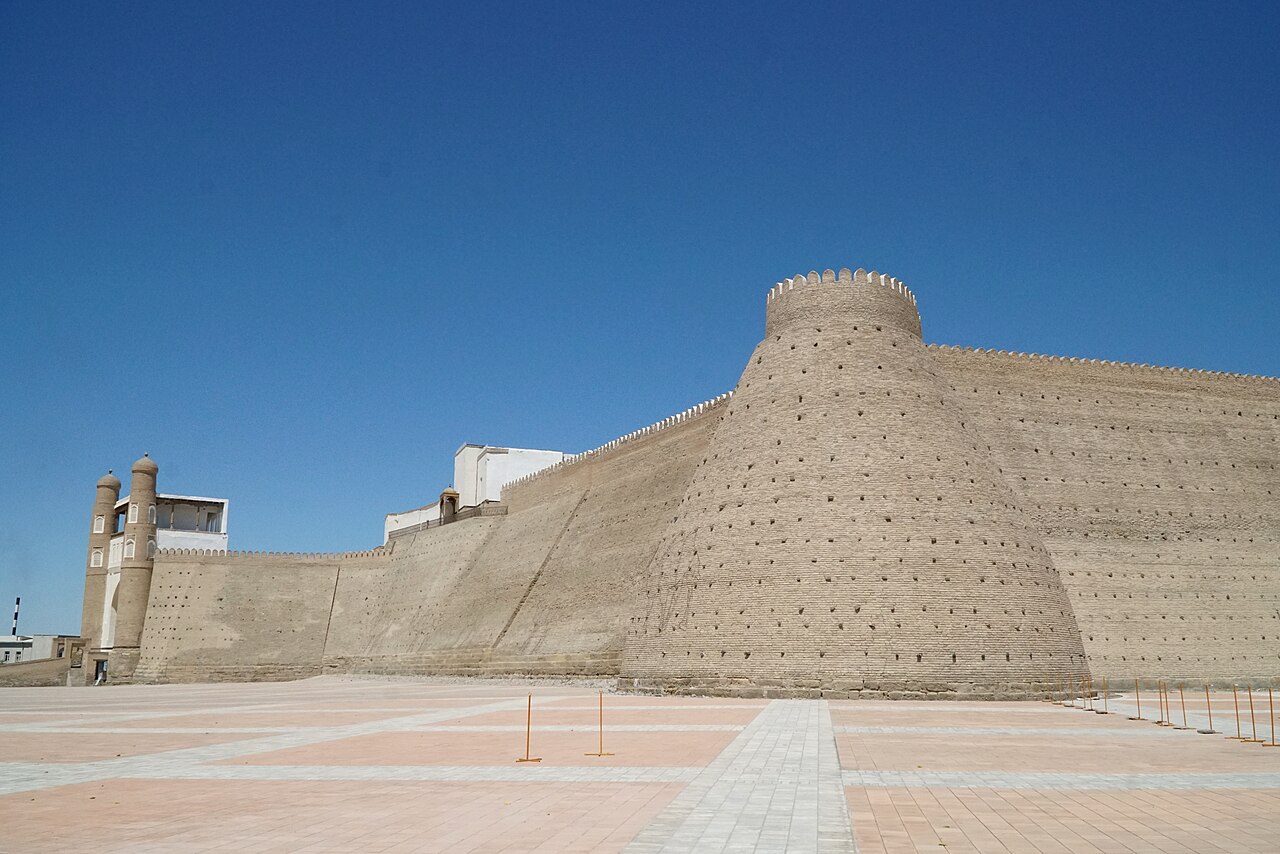

A state run by its generals
By the time Nuh II came to the throne in 976 as a boy of about thirteen, the Samanid amir was no longer master in his own house. The army was built around Turkish ghulams, slave soldiers bought on the steppe frontier and trained at court, and their commanders held the great governorships. Khorasan, the richest province, had passed into the hands of the Simjurid family, who behaved like hereditary lords. At court, viziers came and went. The longer background is told on the Samanid Empire; this page follows the last thirteen years.
992: the first fall of Bukhara
The danger came first from the north. The Qarakhanids, a Turkic dynasty that had converted to Islam in the mid-tenth century, ruled the steppe and the towns beyond the Syr Darya. In 992 their khan Harun Bughra Khan marched on Bukhara, encouraged by the rebel Simjurid governor Abu Ali. Nuh II fled, and the Qarakhanid entered the capital. But he fell ill, withdrew, and died on the way home, and Nuh returned.
The episode showed that the amir could not defend himself. He turned to the most capable of his distant vassals: Sebuktigin, the Turkish commander who governed Ghazna in the mountains of today’s Afghanistan. In 994 Sebuktigin and his son Mahmud defeated Abu Ali and his ally Fa’iq near Herat, and Mahmud was given command of the army of Khorasan. The rescue had a price: Khorasan now depended on the house of Ghazna.
997–999: blinding, a coup and the battle near Merv
Nuh II and Sebuktigin both died in 997. Nuh’s son Mansur II inherited a court split between factions. In February 999 two commanders, Fa’iq and Begtuzun, deposed Mansur and had him blinded, the usual way of disqualifying a ruler, and put his younger brother Abd al-Malik II on the throne.
Mahmud, who had just secured Ghazna after a short struggle with his brother, now had his pretext. He presented himself as the avenger of the lawful amir and marched into Khorasan. After a brief truce broke down, he defeated the coalition of Fa’iq, Begtuzun and the Simjurids near Merv in 999 and took all the land south of the Oxus. The Abbasid caliph al-Qadir recognised him as ruler of Khorasan and sent him the title Yamin al-Dawla, “Right Hand of the State”, from which his dynasty is sometimes called the Yaminids. Mahmud’s career from here is told on Mahmud of Ghazni.
October 999: the Qarakhanids take Bukhara
North of the river, Abd al-Malik tried to raise an army, but Fa’iq died and the population showed little will to fight. The Qarakhanid prince Nasr ibn Ali, known as the Ilig, advanced from Samarqand. Bukhara was occupied without resistance in October 999, and the amir and his family were taken as prisoners to Uzgend in the Ferghana valley. Abd al-Malik died in captivity. After about a century and a quarter of Samanid rule, Transoxiana belonged to a Turkic khan.
Ismail al-Muntasir’s last stand
One brother escaped. Ismail, a younger son of Nuh II, escaped from Qarakhanid captivity and fled to Khwarazm. Taking the title al-Muntasir, “the Victorious”, he spent five years trying to restore his family. He drove the Qarakhanids out of Bukhara and took Samarqand, then lost both; he captured Nishapur from Mahmud’s brother and was driven out by Mahmud; he allied with Oghuz Turks in the Zarafshan valley and won a victory over the Qarakhanids in 1004, only to be deserted in the next battle. Hunted on both sides of the Oxus, he took refuge with an Arab tribe near Merv, whose chief killed him in 1005. With him died the last attempt to revive the Samanid state.
- 976 Nuh II becomes amir as a boy
- 992 Bughra Khan briefly occupies Bukhara
- 994 Sebuktigin and Mahmud defeat the rebels near Herat
- 997 Deaths of Nuh II and Sebuktigin; Mansur II succeeds
- Feb 999 Mansur II blinded; Abd al-Malik II enthroned
- 999 Mahmud defeats the coalition near Merv and takes Khorasan
- Oct 999 Nasr ibn Ali enters Bukhara
- 1000–1005 Campaigns and death of Ismail al-Muntasir
Two Turkic powers on the Oxus
Mahmud and the Ilig Nasr at first agreed that the Oxus would divide their lands. The peace did not last. In 1006, while Mahmud was campaigning in India, the Qarakhanids invaded Khorasan; he hurried back and beat them near Balkh in 1008. The river held as the frontier. To the north, the Qarakhanids ruled Transoxiana for two centuries; to the south, the Ghaznavid Empire ruled Khorasan until the Seljuks took it in the 1040s.
What the fall meant
Historians often treat 999 as a turning point. From then until the Qajars, most rulers of Iran and Central Asia were of Turkic or Mongol origin, while Iranians filled the offices, wrote the histories and shaped court culture. Yet the Samanid legacy did not die with the dynasty. The Ghaznavid court made New Persian its literary language, and Ferdowsi, who had begun his epic under Samanid rule, finished it in 1010 and presented it to Mahmud; see Ferdowsi and the Shahnameh.
The collapse also scattered the scholars of Bukhara. The young Avicenna, who had read in the Samanid royal library, left for Khwarazm and then the courts of western Iran; see Avicenna.
The sources
The fullest account is al-Utbi’s Arabic chronicle al-Ta’rikh al-Yamini, written for Mahmud and naturally favourable to him. The Persian Zayn al-akhbar of Gardizi, from the mid-eleventh century, gives a shorter, drier version. The Russian historian V. V. Barthold pieced the story together in his classic Turkestan down to the Mongol Invasion.
Persian words from this page
| سامانیان | Sâmâniyân | the Samanids |
| بخارا | Bokhârâ | Bukhara |
| خراسان | Khorâsân | Khorasan |
| ماوراءالنهر | Mâvarâ’onnahr | Transoxiana, “what lies beyond the river” |
| جیحون | Jeyhun | the Oxus (Amu Darya) |
| غلام | gholâm | slave soldier; today “servant” |
| غزنه | Ghazne | Ghazna |
Sources and further reading
- Al-Utbi, al-Ta’rikh al-Yamini (early eleventh century).
- Gardizi, Zayn al-akhbar (c. 1050).
- V. V. Barthold, Turkestan down to the Mongol Invasion (English ed. 1928).
- R. N. Frye, “The Samanids”, in The Cambridge History of Iran, vol. 4 (1975).
- C. E. Bosworth, The Ghaznavids: Their Empire in Afghanistan and Eastern Iran, 994–1040 (Edinburgh, 1963).
- Encyclopaedia Iranica, articles “Samanids” and “Ilak-khanids”.
Want to learn Persian? Get the free Starter Pack
Get the 14-page printable Starter Pack (all 32 letters, a 7-day reading plan, 100 core words and 20 survival phrases) and a short 5-email course. Free.
More in The Iranian Intermezzo (821–1055)
- The Tahirids of Khorasan
- The Saffarids and Ya’qub the Coppersmith
- Amr ibn Layth and the Saffarid–Samanid War
- The Zaydi Alavids of Tabaristan
- The Samanid Empire
- Ismail Samani
- The Samanid Persian Renaissance
- Rudaki, Father of Persian Poetry
- Bal’ami and Early Persian Prose
- The End of the Samanids
- The Ziyarids and Qabus ibn Voshmgir
- Gonbad-e Qabus Tower
- The Daylamites: Mountain Warriors of Gilan
- The Buyid Dynasty
- Adud al-Dawla
- Culture under the Buyids
- The Kakuyids of Isfahan
- Al-Khwarizmi and Persian Mathematics
- Muhammad ibn Zakariya al-Razi
- Ferdowsi and the Shahnameh
- Avicenna (Ibn Sina)
- Al-Biruni