Rudaki (c. 858–941) was the court poet of the Samanid amir Nasr II in Bukhara and the first great poet of New Persian, which is why Persian speakers call him the father of Persian poetry. Later writers credited him with an enormous output, but only scattered poems survive; they are enough to show a poet of clear, musical and direct language whose lines are still learned by schoolchildren in Iran, Afghanistan and Tajikistan.
| Full name | Abu Abd Allah Ja’far ibn Muhammad Rudaki |
|---|---|
| Born | c. 858–860, Panjrud near Panjakent, in today’s Tajikistan |
| Died | 940 or 941, in his home village |
| Patron | Nasr II ibn Ahmad, Samanid amir (914–943) |
| Surviving work | Fragments and a few complete poems; estimates range from several hundred to about a thousand couplets |
| Persian name | رودکی (Rudaki) |
From Panjrud to Bukhara
Rudaki’s name comes from Rudak, the district of his birth in the Zarafshan valley east of Samarqand; his village is usually identified with today’s Panjrud. Almost nothing is known of his youth. The thirteenth-century anthologist Awfi says he knew the Qur’an by heart at eight, that he had a beautiful voice, and that he played the harp (chang) and the lute (barbat). That detail matters: early Persian court poetry was performed, often sung, before the ruler.
He rose to fame at the court of Nasr II, under the vizier Abu’l-Fadl Bal’ami, at the time when the Samanid court was making Persian a language of high culture, the movement described on the Samanid Persian renaissance. Rudaki became rich; later sources tell of his slaves, camels and gifts from the amir.

The scent of the Muliyan stream
The best-known story about Rudaki is told by Nizami Aruzi of Samarqand in his Chahar Maqala (“Four Discourses”), written about two centuries later. Nasr II, it says, went to spend a season near Herat and liked it so much that he stayed on year after year. His officers longed for their homes in Bukhara and paid Rudaki a large sum to bring the amir back. One morning Rudaki took up his harp and sang a poem that began:
بوی جوی مولیان آید همی
یاد یار مهربان آید همیBu-ye ju-ye Muliyân âyad hami,
yâd-e yâr-e mehrabân âyad hami.The scent of the Muliyan stream comes drifting here;
the memory of a loving friend comes drifting here.
The Ju-ye Muliyan was a stream lined with gardens and palaces in Bukhara. According to Nizami Aruzi, the amir was so moved that he jumped on his horse without even putting on his riding boots and set off for Bukhara, and the boots had to be sent after him. The anecdote may be embroidered, but the poem is genuine and is one of the most quoted in the language. Its rhyme on âyad hami, “keeps coming”, gives it the rocking, repeated movement of a song.
What survives of his work
Medieval authors reported that Rudaki wrote a vast quantity of verse: one later poet gave the impossible figure of 1,300,000 couplets. What has come down to us is far less, collected from anthologies, histories and especially from early dictionaries such as Asadi Tusi’s Lughat-e Fors, which quote single lines to illustrate rare words. Several kinds of poem are represented:
- Odes of praise (qasidas). The “Mother of Wine” ode, preserved in the Tarikh-e Sistan, praises the Saffarid ruler of Sistan, Abu Ja’far Ahmad, and describes winemaking as an image of birth and ripening.
- The ode on old age. A famous complaint opens with the poet saying that age has worn him down and taken every tooth he had, and looks back on a youth of pleasure and wealth.
- Short lyrics, quatrains and sayings on love, wine, the passing of time and the value of wisdom, many of them only two or four lines long.
- Kalila and Dimna in verse. Nasr II had Rudaki turn the animal fables of Kalila wa Dimna, then available in a Persian prose version, into rhyming couplets. Only fragments survive.
His style is the reason he is still read. The language is plain, the images are concrete, and the Arabic vocabulary is light, so that a modern reader of Persian can follow much of it after eleven centuries. The longer story of the tradition he started is told on a history of Persian poetry.
Was Rudaki blind?
Many medieval sources call him blind, and some, such as Awfi, say he was born blind. Yet his surviving verse is full of colour and visual detail, which has led readers to doubt blindness from birth. In 1956 the Soviet anthropologist Mikhail Gerasimov examined remains from a grave at Panjrud identified as Rudaki’s and concluded that the man had been blinded in later life, perhaps with a hot iron; he also made the facial reconstruction on which modern portraits are based. Both the identification of the grave and the reading of the bones have been questioned, so the safest statement is that Rudaki was blind at least in old age.
Disgrace and death
Rudaki’s fortunes fell with his patrons. The vizier Bal’ami lost office in the late 930s, and in the last years of Nasr II the court was shaken by a crisis over Isma’ili influence, which ended in Nasr’s abdication; this is described on the Samanid Empire. Some scholars link Rudaki’s fall to that crisis, though the evidence is indirect. He seems to have spent his last years in poverty in his native village and died there in 940 or 941. The ode on old age, with its memories of lost wealth, is often read in that light.
Rudaki today
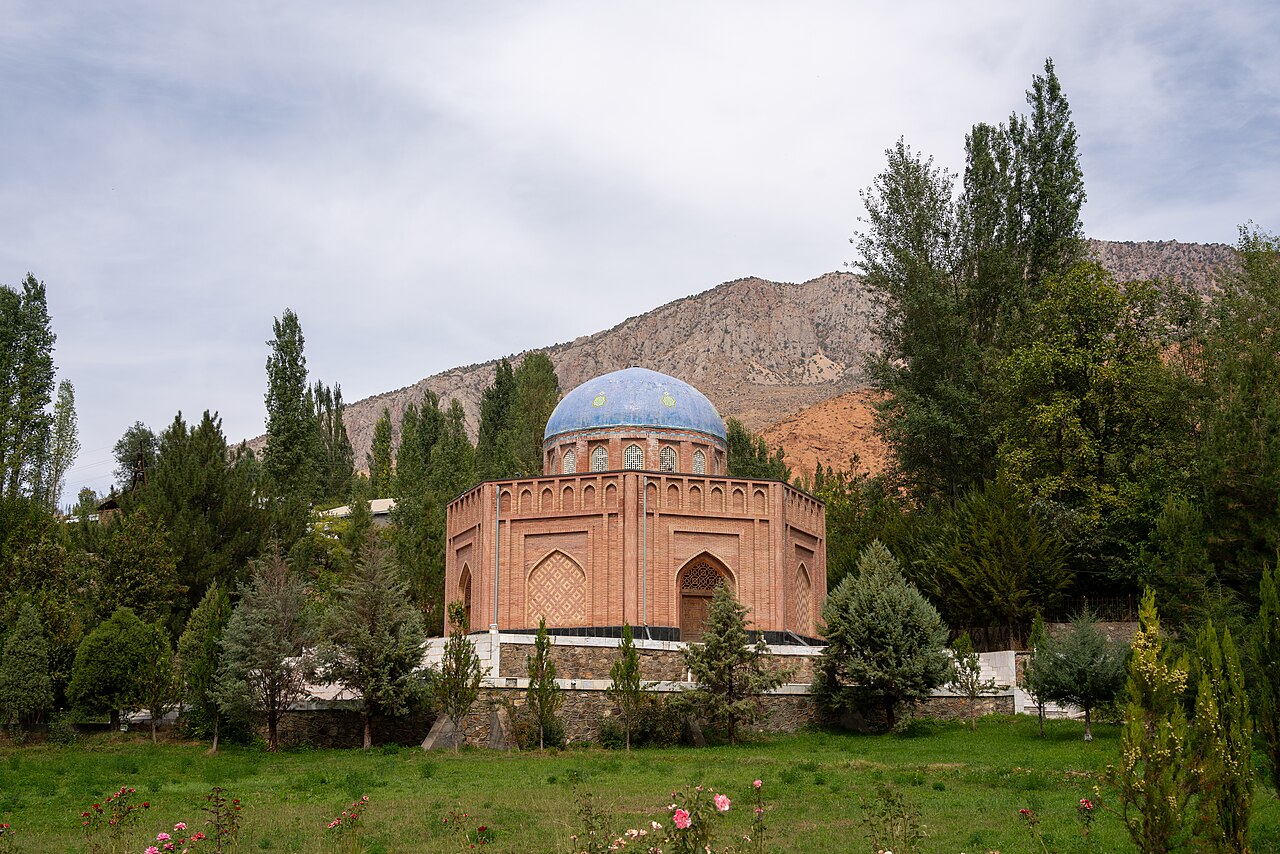
In Tajikistan, Rudaki is a national poet: a mausoleum was built over the grave at Panjrud for the 1,100th anniversary celebrations of 1958, the main avenue of Dushanbe bears his name, and his statue stands in a central park. In Iran he is studied at school as the first master of the classical tradition that leads to Ferdowsi, Saadi and Hafez. Readers who want to see how Iranians still live with poetry may enjoy the site’s guides to Fal-e Hafez, consulting Hafez’s poems and to the poet Baba Taher.
Persian words from this page
| بو | bu | scent, smell |
| جوی | juy | stream, channel |
| یار | yâr | friend, beloved |
| مهربان | mehrabân | kind, loving |
| یاد | yâd | memory |
| چنگ | chang | harp |
| شاعر | shâ’er | poet |
Sources and further reading
- Nizami Aruzi, Chahar Maqala (“The Four Discourses”), translated by E. G. Browne (1921).
- Muhammad Awfi, Lubab al-albab, entry on Rudaki.
- J. Rypka, History of Iranian Literature (1968).
- E. G. Browne, A Literary History of Persia, vol. 1 (1902).
- Encyclopaedia Iranica, “Rudaki”.
Want to learn Persian? Get the free Starter Pack
Get the 14-page printable Starter Pack (all 32 letters, a 7-day reading plan, 100 core words and 20 survival phrases) and a short 5-email course. Free.
More in The Iranian Intermezzo (821–1055)
- The Tahirids of Khorasan
- The Saffarids and Ya’qub the Coppersmith
- Amr ibn Layth and the Saffarid–Samanid War
- The Zaydi Alavids of Tabaristan
- The Samanid Empire
- Ismail Samani
- The Samanid Persian Renaissance
- Rudaki, Father of Persian Poetry
- Bal’ami and Early Persian Prose
- The End of the Samanids
- The Ziyarids and Qabus ibn Voshmgir
- Gonbad-e Qabus Tower
- The Daylamites: Mountain Warriors of Gilan
- The Buyid Dynasty
- Adud al-Dawla
- Culture under the Buyids
- The Kakuyids of Isfahan
- Al-Khwarizmi and Persian Mathematics
- Muhammad ibn Zakariya al-Razi
- Ferdowsi and the Shahnameh
- Avicenna (Ibn Sina)
- Al-Biruni