Abu Bakr Muhammad ibn Zakariya al-Razi (c. 865–925), known in Latin Europe as Rhazes, was a physician, alchemist and philosopher from Rey, near modern Tehran. He directed hospitals in Rey and Baghdad, filled a vast medical notebook with his own case histories, and wrote the first clear clinical account distinguishing smallpox from measles. Historians of medicine rank him among the greatest clinicians of the Middle Ages.
| Born | c. 865, Rey |
|---|---|
| Died | 925 in Rey, according to al-Biruni; some sources give 935 |
| Patrons | Abu Salih Mansur ibn Ishaq, Samanid governor of Rey; the Abbasid court in Baghdad |
| Main medical works | Al-Hawi (Continens); al-Kitab al-Mansuri (Liber ad Almansorem); On Smallpox and Measles |
| Other fields | Alchemy (Book of Secrets), philosophy (The Spiritual Medicine, The Philosophical Life) |
| Language | Arabic |
From Rey to Baghdad
Al-Razi’s name means “the man from Rey”, the old city south of today’s Tehran that was then one of the largest in Iran (see the historic city of Rey). Medieval biographers say he was first a musician who played the lute and an alchemist, and took up medicine only as an adult; how much of this is true is hard to know. He trained at the hospital in Baghdad, and his reputation grew fast.
He was called back to Rey by Mansur ibn Ishaq, a Samanid prince who governed the city, to run its hospital, and he dedicated two books to him. He then headed a hospital in Baghdad for the Abbasid court. A famous story says that when asked to choose the site for a new Baghdad hospital, he hung pieces of meat in different quarters and picked the place where they rotted most slowly. The tale is told by later writers, who link it with the hospital founded by Adud al-Dawla in 981, decades after al-Razi’s death, so it is best read as a legend about his method rather than an event. On that hospital, see Adud al-Dawla.

Al-Hawi: a physician’s notebook
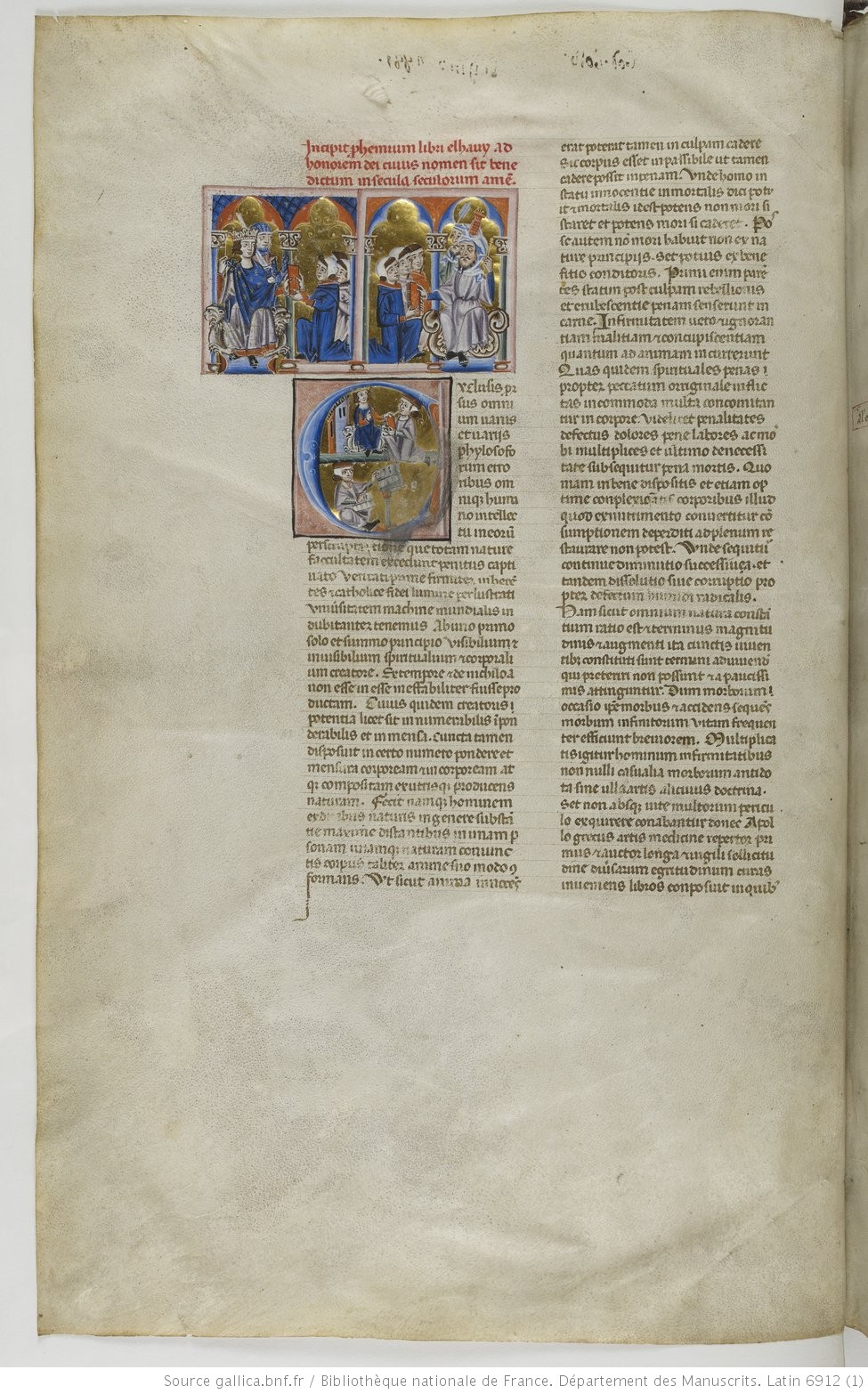
Al-Razi’s largest work, al-Hawi, “the Comprehensive”, was not really a book he finished. It was his working file: for each disease he copied what Greek, Indian, Persian and Arabic authorities had said, then added his own observations and cases. After his death his students put the notes in order, and the result filled more than twenty volumes in modern editions. In 1279 the Jewish physician Faraj ben Salim translated it into Latin for Charles of Anjou, king of Sicily, as the Continens, and it was printed in Europe several times.
What makes al-Hawi remarkable is the case material. Al-Razi records named patients, what he saw, what he gave them and what happened. In one passage he describes treating a group of patients with early signs of meningitis by bloodletting and leaving another group without it, then comparing the outcomes, an approach often cited as an early step toward controlled clinical comparison.
Smallpox and measles
His short treatise On Smallpox and Measles (Kitab fi’l-jadari wa’l-hasba) is the first known work to describe the two diseases clearly as separate conditions. He set out their symptoms, how they began and developed, and how to tell them apart early, and he gave advice on diet and care, including protecting the eyes and face. The treatise was translated into Latin and many European languages, and an English version was published in London as late as 1848.
The Book for Mansur and Doubts about Galen
Al-Kitab al-Mansuri, dedicated to Mansur ibn Ishaq, was a compact handbook in ten books, covering anatomy, hygiene, diet, skin diseases, poisons and therapy. In Latin as the Liber ad Almansorem, its ninth book, on treating diseases head to foot, was used for teaching in European universities into the sixteenth century.
Al-Razi deeply respected Galen, the Greek physician whose system dominated medicine, but he wrote a book called Doubts about Galen (al-Shukuk ‘ala Jalinus). In it he argued that a doctor must test even the greatest authority against experience, and pointed to places where Galen’s claims did not match what he himself had seen in patients.
Alchemy, chemistry and the alcohol question
In his Book of Secrets (Kitab al-asrar) al-Razi described chemical apparatus and procedures: furnaces, flasks, the alembic for distillation, sublimation and crystallisation. He classified substances into mineral, vegetable and animal, and sorted minerals into groups such as metals, salts and stones. Unlike many alchemists he wrote plainly, as a practical manual.
In Iran he is often credited with discovering alcohol. The claim should be treated with care. Al-Razi certainly used distillation, but historians find no clear evidence that he isolated strong alcohol from wine, and the earliest clear descriptions of that process come from other authors. The word itself comes from Arabic al-kuhl, which originally meant a fine powder used as an eye cosmetic, and took its modern meaning much later in Europe.
A free-thinking philosopher
Al-Razi was also a bold philosopher. He taught that there were five eternal principles: the Creator, the Soul, Matter, Time and Space. Opponents accused him of rejecting prophecy, and his views are known mainly through their hostile reports, notably a debate recorded by the Ismaili missionary Abu Hatim al-Razi. Two short ethical works do survive. The Spiritual Medicine treats bad habits and passions as illnesses of the soul, and The Philosophical Life defends his own way of living against critics.
Blindness, death and memory
In old age al-Razi went blind, probably from cataracts. According to a later story he refused an operation, saying he had seen enough of the world. He died in Rey; al-Biruni, who compiled a list of his writings, gives the year as 925. Biruni counted about 180 books and treatises by him.
In Iran he remains a national figure. A university in Kermanshah and the Razi Vaccine and Serum Research Institute, founded in the 1920s, bear his name, and his birthday, 27 August (5 Shahrivar), is marked as Pharmacy Day. For the scholars who followed him, see Avicenna, whose Canon replaced al-Razi’s books as the standard medical text, and science in Iranian history.
Persian words from this page
| زکریای رازی | Zakariyâ-ye Râzi | al-Razi, as Iranians call him |
| ری | Rey | Rey, his home city |
| پزشک | pezeshk | physician |
| بیمارستان | bimârestân | hospital |
| آبله | âble | smallpox |
| سرخک | sorkhak | measles |
| کیمیا | kimiyâ | alchemy |
| الکل | alkol | alcohol |
Sources and further reading
- Al-Razi, A Treatise on the Small-Pox and Measles, trans. W. A. Greenhill (London: Sydenham Society, 1848).
- Peter E. Pormann and Emilie Savage-Smith, Medieval Islamic Medicine (Edinburgh University Press, 2007).
- Encyclopaedia Iranica, article “Rāzi, Abu Bakr Moḥammad b. Zakariyā”.
- Peter Adamson, Al-Rāzī (Great Medieval Thinkers, Oxford University Press, 2021).
- Lenn E. Goodman, “al-Rāzī”, Encyclopaedia of Islam, 2nd edition.
Want to learn Persian? Get the free Starter Pack
Get the 14-page printable Starter Pack (all 32 letters, a 7-day reading plan, 100 core words and 20 survival phrases) and a short 5-email course. Free.
More in The Iranian Intermezzo (821–1055)
- The Tahirids of Khorasan
- The Saffarids and Ya’qub the Coppersmith
- Amr ibn Layth and the Saffarid–Samanid War
- The Zaydi Alavids of Tabaristan
- The Samanid Empire
- Ismail Samani
- The Samanid Persian Renaissance
- Rudaki, Father of Persian Poetry
- Bal’ami and Early Persian Prose
- The End of the Samanids
- The Ziyarids and Qabus ibn Voshmgir
- Gonbad-e Qabus Tower
- The Daylamites: Mountain Warriors of Gilan
- The Buyid Dynasty
- Adud al-Dawla
- Culture under the Buyids
- The Kakuyids of Isfahan
- Al-Khwarizmi and Persian Mathematics
- Muhammad ibn Zakariya al-Razi
- Ferdowsi and the Shahnameh
- Avicenna (Ibn Sina)
- Al-Biruni