Ismail ibn Ahmad, known as Ismail Samani (849–907), was the ruler who turned the Samanid family’s governorships into an empire. From Bukhara he unified Transoxiana in 888–892, defeated the Saffarid Amr ibn Layth in 900 and received Khorasan from the caliph. Later writers made him the model of a just Persian king, and modern Tajikistan honours him as a national founder.
| Born | 849, probably in Ferghana |
|---|---|
| Ruled | Bukhara from 874 or 875; all Samanid lands 892–907 |
| Died | November 907, Bukhara |
| Posthumous title | Amir-e Mazi, “the departed amir” |
| Monument | Samanid Mausoleum, Bukhara (10th century) |
| Persian name | اسماعیل سامانی (Esmâ’il-e Sâmâni) |
Governor of Bukhara
Ismail was a younger son of Ahmad ibn Asad, the Samanid governor of Ferghana. The family background, from Saman Khuda to the grant of Transoxiana to Ismail’s elder brother Nasr in 875, is on the Samanid Empire. Bukhara at that time was a disturbed city, troubled by raiders, and its notables asked Nasr for a governor. Nasr sent Ismail, then in his mid-twenties.
Narshakhi’s History of Bukhara, written a generation after Ismail’s death, tells how he restored order, came to terms with the local landowners and made Bukhara his own base. Bukhara, not Samarqand, would be the Samanid capital for the rest of the dynasty’s history.

War with his brother
Relations with Nasr soured over money: Bukhara’s taxes were supposed to go to Samarqand, and Ismail kept them. The brothers fought in the 880s, and in 888 Ismail defeated Nasr and took him prisoner. In the version Narshakhi gives, Ismail dismounted, kissed his brother’s hand and sent him back to Samarqand as nominal head of the family. Whether or not it happened quite like that, Nasr kept his title until his death in 892, and Ismail then ruled all of Transoxiana.
Campaigns of a frontier ruler
Talas, 893
The year after Nasr’s death Ismail led a campaign across the Syr Darya against the Turks of the steppe and took the town of Talas (Taraz, in today’s Kazakhstan). The chroniclers report enormous booty and many captives, and say that the town’s principal church was turned into a mosque. The campaign secured the northern frontier and fed the trade in Turkish slaves on which Samanid armies came to depend.
Balkh, 900
The decisive war was with the Saffarids. When the caliph granted Transoxiana to Amr ibn Layth, Ismail crossed the Oxus and defeated him near Balkh in 900; the battle and Amr’s fate are told on Amr ibn Layth and the Saffarid–Samanid War. The caliph rewarded Ismail with Khorasan. In the same year his army defeated and killed the Alid ruler of Tabaristan, Muhammad ibn Zayd, and in the following years Samanid control reached Rey and the Caspian provinces.
“I am the wall of Bukhara”
The best-known saying attributed to Ismail comes from Narshakhi. Bukhara’s oasis had been protected by long earthen walls, and the citizens were obliged to work on their upkeep each year. Ismail ended the duty, saying that as long as he lived, he would be the wall of Bukhara. The line expresses the ideal of the ruler as protector, and also a real policy: the Samanids fought their wars on the frontier so that the heart of Transoxiana could live in peace.
Two centuries later Nizam al-Mulk, the Seljuk vizier, used Ismail in his Siyasatnama (Book of Government) as an example of the just king who listens to the complaints of his subjects. By then Ismail had become less a historical figure than a model of Persian kingship in an Islamic setting.
The Samanid Mausoleum
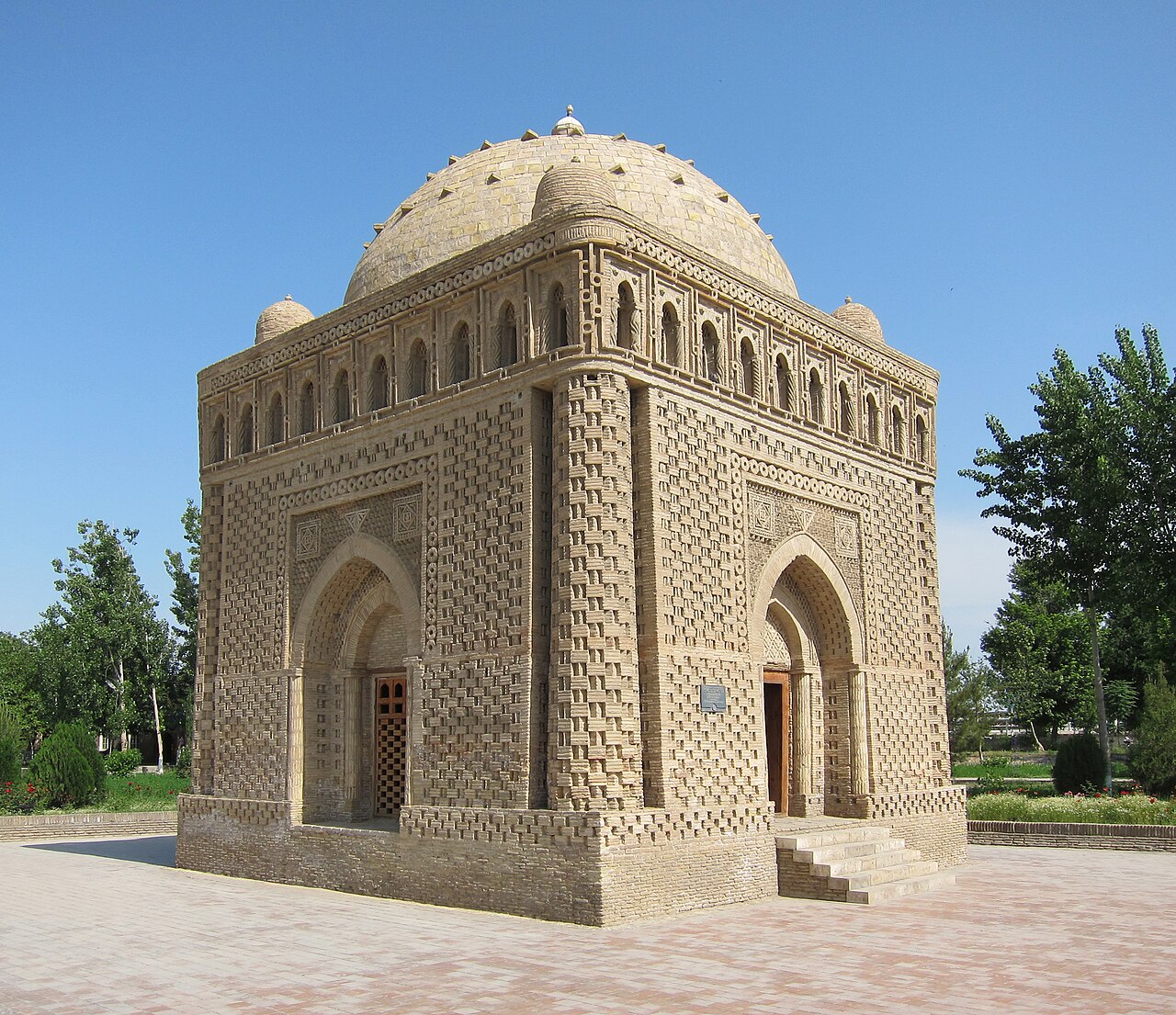
The small domed tomb in Bukhara known as the Samanid Mausoleum is the most famous building of the period. Tradition holds that it contains Ismail, and it probably also held his father Ahmad and his grandson Nasr II; the building is usually dated to the early tenth century, before 943, though scholars disagree on whether Ismail himself built it.
It is a cube of about ten metres a side, made entirely of fired brick, with a hemispherical dome set on squinches at the corners and four identical façades. The bricks are laid in basket-weave and other patterns so that the walls look woven, and the effect changes with the light through the day. It is one of the earliest surviving Islamic monuments in Central Asia and a key work in the history of Iranian brick architecture. It is part of the UNESCO World Heritage site of the Historic Centre of Bukhara. The wider story of Iranian building is on a history of Persian architecture.
- 849 Born, son of Ahmad ibn Asad
- 874 or 875 Sent to govern Bukhara
- 888 Defeats his brother Nasr
- 892 Sole ruler on Nasr’s death
- 893 Campaign to Talas
- 900 Defeats Amr ibn Layth near Balkh
- 907 Dies in Bukhara
Ismail in Tajikistan today
After independence in 1991, Tajikistan adopted the Samanids as the first Tajik state and Ismail as its founder. In 1998 the country’s highest mountain, formerly Communism Peak, was renamed Ismoil Somoni Peak; in 1999 a large statue of Ismail under a golden arch was unveiled in the centre of Dushanbe to mark 1,100 years of the Samanid state; and in 2000 the new currency was named the somoni. In Iran he is remembered more as a patron of the age that produced Rudaki and the early Shahnameh tradition, described on the Samanid Persian renaissance.
Persian words from this page
| اسماعیل | Esmâ’il | Ismail |
| امیر | amir | commander, prince |
| بخارا | Bokhârâ | Bukhara |
| دیوار | divâr | wall |
| آرامگاه | ârâmgâh | tomb, mausoleum |
| گنبد | gonbad | dome |
| آجر | âjor | fired brick |
Sources and further reading
- Narshakhi, The History of Bukhara, translated by R. N. Frye (1954).
- Nizam al-Mulk, The Book of Government or Rules for Kings, translated by H. Darke (1960).
- R. N. Frye, “The Samanids”, in The Cambridge History of Iran, vol. 4 (1975).
- Encyclopaedia Iranica, “Esmaʿil b. Ahmad b. Asad Samani”.
- UNESCO World Heritage Centre, Historic Centre of Bukhara.
Want to learn Persian? Get the free Starter Pack
Get the 14-page printable Starter Pack (all 32 letters, a 7-day reading plan, 100 core words and 20 survival phrases) and a short 5-email course. Free.
More in The Iranian Intermezzo (821–1055)
- The Tahirids of Khorasan
- The Saffarids and Ya’qub the Coppersmith
- Amr ibn Layth and the Saffarid–Samanid War
- The Zaydi Alavids of Tabaristan
- The Samanid Empire
- Ismail Samani
- The Samanid Persian Renaissance
- Rudaki, Father of Persian Poetry
- Bal’ami and Early Persian Prose
- The End of the Samanids
- The Ziyarids and Qabus ibn Voshmgir
- Gonbad-e Qabus Tower
- The Daylamites: Mountain Warriors of Gilan
- The Buyid Dynasty
- Adud al-Dawla
- Culture under the Buyids
- The Kakuyids of Isfahan
- Al-Khwarizmi and Persian Mathematics
- Muhammad ibn Zakariya al-Razi
- Ferdowsi and the Shahnameh
- Avicenna (Ibn Sina)
- Al-Biruni