Abu’l-Qasem Ferdowsi (c. 940–1020 or 1025), a landowner from Tus in Khorasan, spent some thirty years turning the old prose chronicles of the Iranian kings into the Shahnameh, the “Book of Kings”, an epic of about 50,000 couplets that he finished in 1010. It is the national epic of the Persian-speaking world and one of the founding texts of the New Persian language. This page is about how it was made; the stories inside it are introduced in our post on the Shahnameh.
| Poet | Abu’l-Qasem Ferdowsi of Tus |
|---|---|
| Born | c. 940, in the village of Paj (Bazh) near Tus, Khorasan |
| Died | c. 1020 or 1025, Tus; the sources give 411 or 416 AH |
| Written | c. 977–1010; a first version was finished c. 994–995 |
| Length | About 50,000 couplets (manuscripts differ) |
| Main source | The prose Shahnameh of Abu Mansur (957), based on the Sasanian Khwaday-namag |
| Oldest manuscript | Florence, dated 1217 |
A dehqan of Tus
Ferdowsi belonged to the dehqans, the old landowning gentry of Iran. Under Islamic rule they kept local power and, just as important, the memory of the pre-Islamic past: the stories of the kings, the heroes and the customs of Sasanian Iran. He was born around 940 near Tus, close to modern Mashhad, at the height of Samanid rule in Khorasan.
Very little about his life is certain. The best evidence is what he says in the poem itself: about his age, his poverty, his friends and patrons in Tus, and the death of his son, who died at thirty-seven when the poet was sixty-five, which he mourns in one of the most personal passages of the epic. Everything else comes from biographies written long after his death, which mix fact with legend.
The sources: from the Khwaday-namag to Abu Mansur
Ferdowsi did not invent his story. Its backbone was the Khwaday-namag, the “Book of Lords”, an official history of Iran compiled in Middle Persian at the Sasanian court; see Middle Persian language and literature. That book is lost, but Arabic and Persian versions circulated.
The most important for Ferdowsi was a prose Shahnameh in New Persian made at Tus in 957. Abu Mansur Muhammad ibn Abd al-Razzaq, the governor of Tus, ordered his minister to gather dehqans from across Khorasan who knew the old traditions and to compile them into one book. Only its preface survives, but scholars agree it was Ferdowsi’s chief source. The movement behind it is described on the Samanid Persian renaissance.
Ferdowsi also had a forerunner. The court poet Daqiqi had begun to put the same history into verse for the Samanids, but he was murdered, by his own slave according to Ferdowsi, after about a thousand couplets. Ferdowsi included those thousand couplets, on King Goshtasp and the coming of Zoroaster, in his own poem, naming Daqiqi as the author and gently criticising his style.
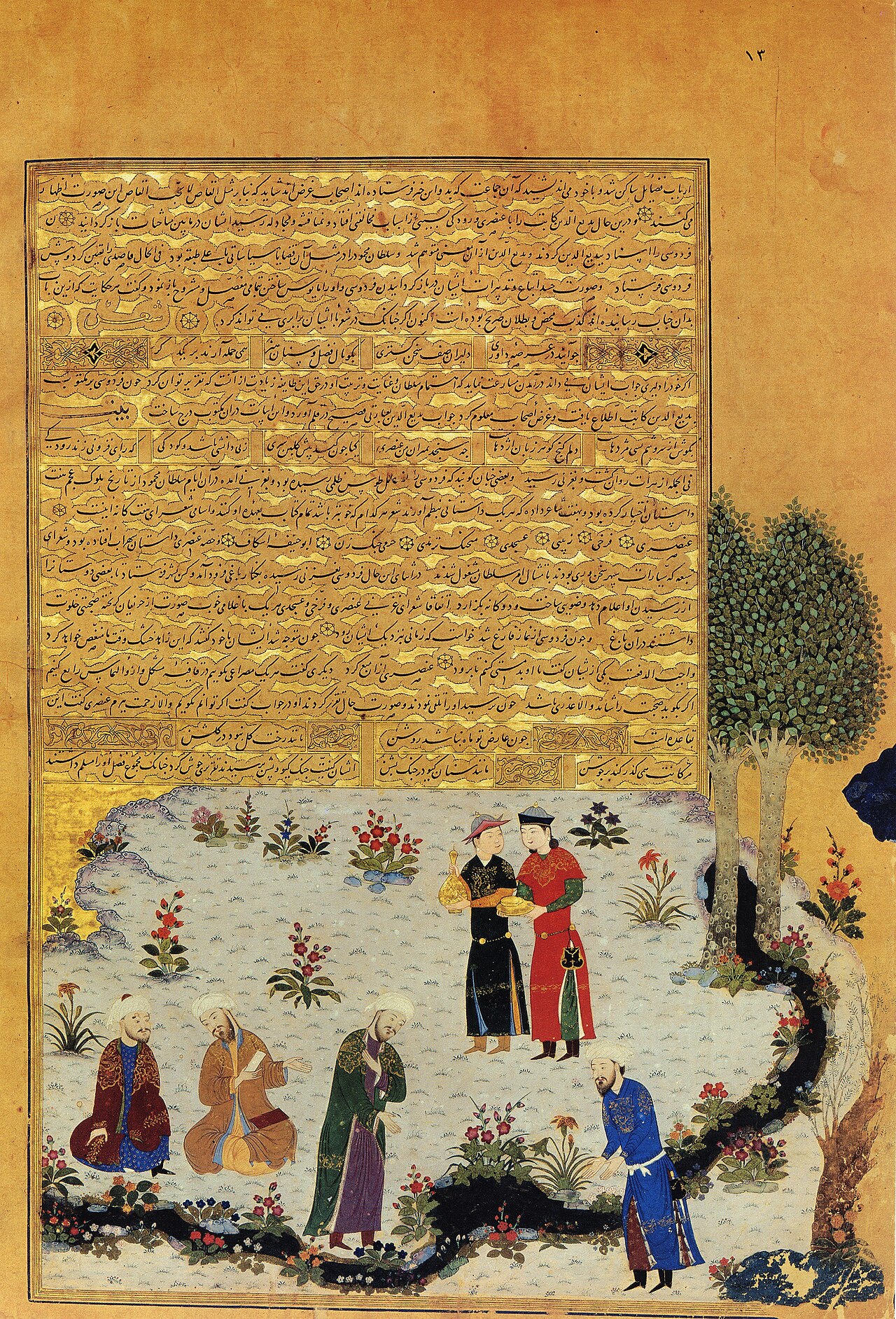

Thirty years of work
Ferdowsi probably began in the 970s, with the Samanid dynasty still in power. He wrote in the motaqareb metre, a simple, driving rhythm of eleven syllables, in rhyming couplets. The poem opens with a couplet every Iranian schoolchild knows:
به نام خداوند جان و خرد / کزین برتر اندیشه برنگذرد
“In the name of the Lord of life and wisdom, / beyond whom thought can rise no higher.”
The epic runs from the first man and king, Kayumars, through the age of heroes dominated by Rostam, to the historical Sasanian kings and the death of the last of them, Yazdegerd III, in 651. Its language is strikingly Persian, with few Arabic words compared with later poetry, which is one reason it became a model of the language.
Ferdowsi finished a first version around 994–995. By then the Samanid state was collapsing (see the end of the Samanids), and Khorasan passed to Mahmud of Ghazni. Ferdowsi revised and expanded the work, and the final version, dedicated to Mahmud, is dated to 1010. In the poem he speaks of having laboured for thirty, and elsewhere thirty-five, years, and of growing old and poor in the process.
The legend of Sultan Mahmud
The best-known story about Ferdowsi concerns his reward. It is first told in the Chahar Maqala (“Four Discourses”) of Nizami Aruzi, written around 1156, well over a century after the poet’s death:
- Ferdowsi took his book to Ghazni, where the vizier presented it to Mahmud.
- Courtiers turned the sultan against him, partly because Ferdowsi was a Shi’a and Mahmud a strict Sunni, and he was paid far less than he expected, in silver instead of gold.
- Insulted, Ferdowsi gave the money away to a bath attendant and a drinks seller, wrote a bitter satire on Mahmud and fled.
- Years later Mahmud repented and sent a rich gift to Tus. As the camels entered one city gate, Ferdowsi’s body was being carried out of another. His daughter refused the gift, and it was used to build a caravanserai.
Historians treat this as legend. The satire on Mahmud found in many manuscripts is mostly or entirely the work of later hands. The story does reflect real tensions: a poem that glorified the Iranian kings and their wars against Turan was a strange gift for a Turkish sultan, and religious difference may have played a part. But Mahmud was in fact a generous patron of poets, and there is no contemporary evidence of a quarrel. The sultan’s side of the story is on Mahmud of Ghazni.
Death, burial and tomb
Ferdowsi died in Tus around 1020 or 1025. According to Nizami Aruzi, a local preacher refused to let him be buried in the Muslim cemetery because he was a Shi’a, so he was buried in his own garden. The site became a place of pilgrimage. The present monument was built for the Ferdowsi millennium celebrations of 1934 and later rebuilt; see the Tomb of Ferdowsi, near Mashhad.
A text with many versions
No manuscript from Ferdowsi’s lifetime survives. The oldest dated copy, now in Florence, was made in 1217, two centuries after he finished. Over the centuries copyists added thousands of verses, changed words and inserted whole episodes, so manuscripts differ widely in length. Modern critical editions try to recover the original text; the most important is the eight-volume edition by Djalal Khaleghi-Motlagh, completed in 2008. Readers in English can use the verse-and-prose translation by Dick Davis.
Why it matters
The Shahnameh did two things at once. It preserved a version of Iran’s pre-Islamic history at a time when it might have faded, and it showed that New Persian could carry a work of epic scale. For a thousand years it has been copied, illustrated, memorised and performed; professional storytellers, the naqqals, still recite it in coffee houses, a tradition UNESCO added to its list of intangible heritage in need of urgent safeguarding in 2011. How its legends relate to real history is the subject of myth and history in the Shahnameh, and some of its best-loved lines are collected in Ferdowsi quotes.
Persian words from this page
| فردوسی | Ferdowsi | the poet |
| شاهنامه | Shâhnâme | Book of Kings |
| توس | Tus | Ferdowsi’s home town |
| دهقان | dehqân | landowner; today “farmer” |
| بیت | beyt | couplet |
| خرد | kherad | wisdom |
| نقال | naqqâl | storyteller who performs the Shahnameh |
Sources and further reading
- Ferdowsi, Shahnameh, ed. Djalal Khaleghi-Motlagh, 8 vols. (New York, 1988–2008).
- Ferdowsi, Shahnameh: The Persian Book of Kings, trans. Dick Davis (Viking/Penguin, 2006).
- Nizami Aruzi, Chahar Maqala, trans. E. G. Browne, Revised Translation of the Chahár Maqála (1921).
- Encyclopaedia Iranica, articles “Ferdowsi, Abu’l-Qāsem” and “Šāh-nāma”.
- A. Shapur Shahbazi, Ferdowsi: A Critical Biography (Mazda, 1991).
- UNESCO Intangible Cultural Heritage, “Naqqāli, Iranian dramatic story-telling” (2011).
Want to learn Persian? Get the free Starter Pack
Get the 14-page printable Starter Pack (all 32 letters, a 7-day reading plan, 100 core words and 20 survival phrases) and a short 5-email course. Free.
More in The Iranian Intermezzo (821–1055)
- The Tahirids of Khorasan
- The Saffarids and Ya’qub the Coppersmith
- Amr ibn Layth and the Saffarid–Samanid War
- The Zaydi Alavids of Tabaristan
- The Samanid Empire
- Ismail Samani
- The Samanid Persian Renaissance
- Rudaki, Father of Persian Poetry
- Bal’ami and Early Persian Prose
- The End of the Samanids
- The Ziyarids and Qabus ibn Voshmgir
- Gonbad-e Qabus Tower
- The Daylamites: Mountain Warriors of Gilan
- The Buyid Dynasty
- Adud al-Dawla
- Culture under the Buyids
- The Kakuyids of Isfahan
- Al-Khwarizmi and Persian Mathematics
- Muhammad ibn Zakariya al-Razi
- Ferdowsi and the Shahnameh
- Avicenna (Ibn Sina)
- Al-Biruni