The Samanids were a Persian dynasty that ruled Transoxiana and Khorasan, from their capital Bukhara, for most of the ninth and tenth centuries: as local governors from about 819, as rulers of the whole north-east from 900, until the Qarakhanid Turks took Bukhara in 999. Their state was rich, orderly and Sunni, loyal in name to the Abbasid caliph, and its court made New Persian a language of literature and government.
| Period | c. 819–999 (last resistance to 1005) |
|---|---|
| Capital | Bukhara; earlier seats at Samarqand |
| Greatest extent | Transoxiana, Khorasan, Sistan, Rey and Tabaristan at times, early 10th century |
| Religion | Sunni Islam, mainly the Hanafi school |
| Languages | Persian at court and in the chancery, Arabic for scholarship |
| Persian name | سامانیان (Sâmâniyân) |
Saman Khuda and his grandsons
The family traced itself to Saman Khuda, a landowner of the Balkh region who converted to Islam in the early eighth century and named his son Asad after the Umayyad governor of Khorasan. Later genealogists linked him to the Sasanian general Bahram Chubin, a claim that shows how the family wanted to be seen but cannot be checked.
The family’s fortune came from loyalty to al-Ma’mun. Asad’s four sons helped him during the revolt of Rafi ibn Layth in Samarqand (806–810), and in about 819 each was given a city: Nuh in Samarqand, Ahmad in Ferghana, Yahya in Shash (Tashkent) and Ilyas in Herat. They served under the Tahirid governors described on the Tahirids of Khorasan. In 875 the caliph granted Ahmad’s son Nasr the governorship of all Transoxiana directly, and Nasr sent his brother Ismail to govern Bukhara.

From Transoxiana to Khorasan
Ismail ibn Ahmad defeated his brother in 888 and became sole ruler after Nasr’s death in 892. In 900 he beat the Saffarid Amr ibn Layth near Balkh, a battle told on Amr ibn Layth and the Saffarid–Samanid War, and the caliph added Khorasan to his lands. Ismail’s life and the mausoleum linked to him are on Ismail Samani.
The rulers
- 892–907 Ismail ibn Ahmad
- 907–914 Ahmad ibn Ismail, murdered by his own slave guards
- 914–943 Nasr II, the high point of the court
- 943–954 Nuh I
- 954–961 Abd al-Malik I
- 961–976 Mansur I
- 976–997 Nuh II
- 997–999 Mansur II and Abd al-Malik II
How the state worked
The Samanids governed through two linked institutions: the court (dargah), with the ruler, his household and his guards, and the bureaucracy (divan), led by the vizier. The historian Narshakhi, writing in Bukhara in 943 or 944, describes the government offices that stood near the ruler’s palace on the Registan of Bukhara: departments for the vizier, the treasury, correspondence, the army, the postal and intelligence service, the police and more. It was a copy in miniature of the Abbasid system, run by Persian secretaries.
The great viziers were men of learning. Abu Abd Allah Jayhani wrote a geography of the known world, now lost but used by later authors. Abu’l-Fadl Bal’ami served Nasr II, and his son Abu Ali Bal’ami made the Persian version of al-Tabari’s history. Under Nasr II, who came to the throne as a boy, these ministers effectively ran the state.
Silver, slaves and the northern trade
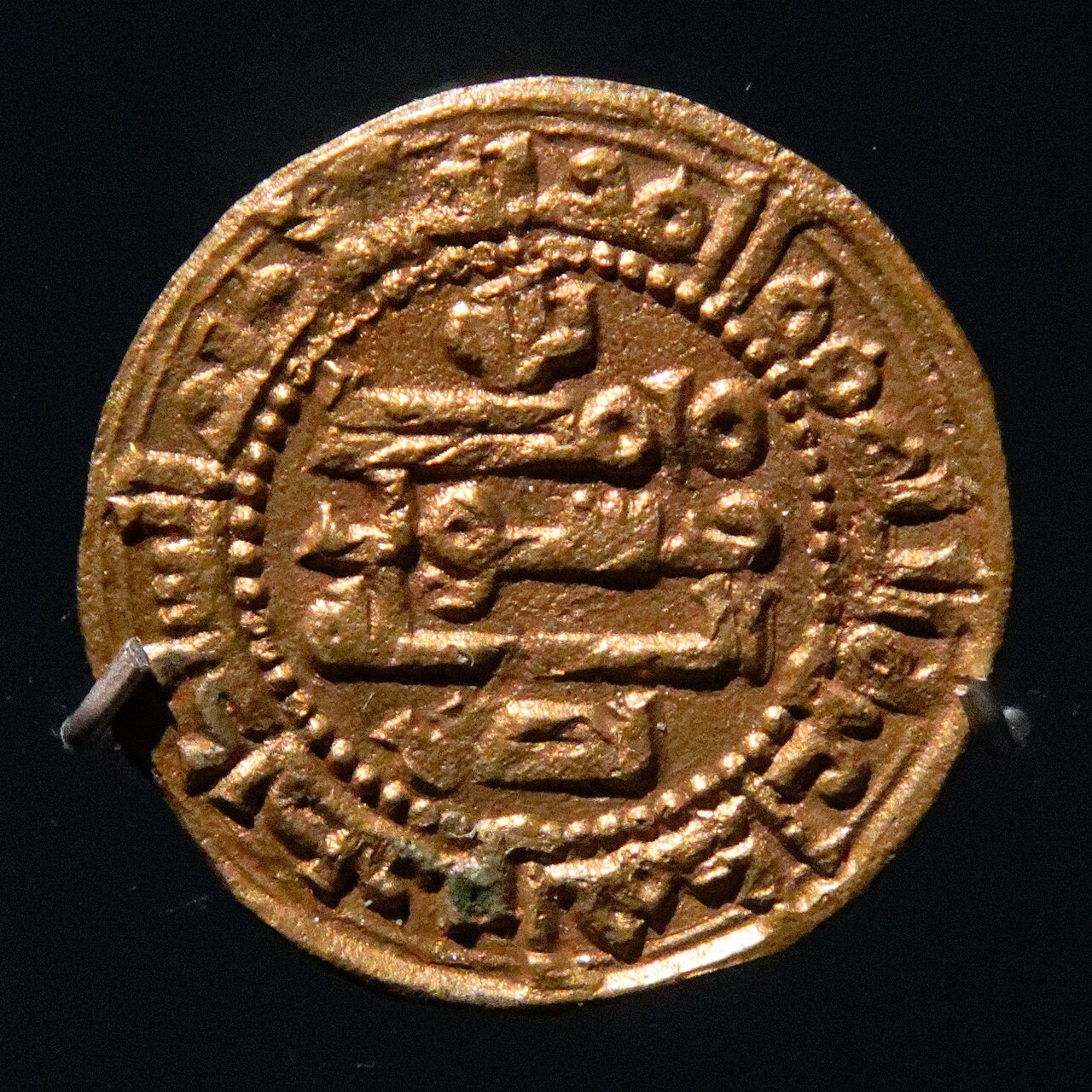
Transoxiana sat at the meeting point of the settled world and the Turkic steppe, and the Samanids grew rich on that position. Their mints poured out silver dirhams from the mines of the Hindu Kush and the Tashkent region. Merchants carried them north through Khwarazm to the Volga Bulgars and the Rus, and Samanid coins turn up by the tens of thousands in Viking-age hoards in Russia, Sweden and the Baltic island of Gotland. In 921 the Abbasid envoy Ibn Fadlan passed through Bukhara on his way to the Volga and met the young Nasr II and his vizier Jayhani.
The most profitable trade of all was in people. Turks captured or bought on the steppe frontier were sold as slaves, and the best of them were trained as soldiers (ghulams) for the Samanid guard and the armies of the caliphate.
Religion and the crisis of Nasr II
The Samanids were Sunni, and the scholars of Bukhara and Samarqand were among the most respected in the Islamic world; the theologian al-Maturidi worked in Samarqand under their rule. But late in the reign of Nasr II, Isma’ili missionaries won over courtiers and, the sources say, the amir himself. In about 943 the Turkish guards and the Sunni scholars combined against them. Nasr gave up power to his son Nuh I, and a purge of the Isma’ilis followed.
Slave generals and the end
The same Turkish ghulams who protected the dynasty eventually controlled it. From the 950s commanders such as Alptigin and the Simjurid family held Khorasan almost as their own; Alptigin’s successors founded the Ghaznavid state, covered on the Ghaznavid Empire. In 992 the Qarakhanid Turks briefly occupied Bukhara, and in 999 they took it for good, while Mahmud of Ghazni took Khorasan. The last prince, Ismail al-Muntasir, fought on until he was killed in 1005. The fall is told in detail on the end of the Samanids.
Why the Samanids are remembered
Iranians remember the Samanids above all for culture. Rudaki, the first great Persian poet, wrote for Nasr II; Bal’ami produced Persian prose history; Ferdowsi began the Shahnameh in the last years of Samanid rule; the young Avicenna read in Nuh II’s library in Bukhara. That flowering is the subject of the Samanid Persian renaissance and Rudaki. In Tajikistan, the Samanids are treated as the founders of the Tajik nation: the currency is the somoni and Ismail’s statue stands in the centre of Dushanbe.
Persian words from this page
| سامانیان | Sâmâniyân | the Samanids |
| بخارا | Bokhârâ | Bukhara |
| سمرقند | Samarqand | Samarqand |
| درگاه | dargâh | royal court |
| دیوان | divân | government office |
| وزیر | vazir | vizier, minister |
| غلام | gholâm | slave soldier (today: servant) |
Sources and further reading
- Narshakhi, The History of Bukhara, translated by R. N. Frye (1954).
- R. N. Frye, “The Samanids”, in The Cambridge History of Iran, vol. 4 (1975).
- R. N. Frye, Bukhara: The Medieval Achievement (1965).
- Ibn Fadlan, Ibn Fadlan and the Land of Darkness, translated by P. Lunde and C. Stone (2012).
- Encyclopaedia Iranica, “Samanids” (C. E. Bosworth).
Want to learn Persian? Get the free Starter Pack
Get the 14-page printable Starter Pack (all 32 letters, a 7-day reading plan, 100 core words and 20 survival phrases) and a short 5-email course. Free.
More in The Iranian Intermezzo (821–1055)
- The Tahirids of Khorasan
- The Saffarids and Ya’qub the Coppersmith
- Amr ibn Layth and the Saffarid–Samanid War
- The Zaydi Alavids of Tabaristan
- The Samanid Empire
- Ismail Samani
- The Samanid Persian Renaissance
- Rudaki, Father of Persian Poetry
- Bal’ami and Early Persian Prose
- The End of the Samanids
- The Ziyarids and Qabus ibn Voshmgir
- Gonbad-e Qabus Tower
- The Daylamites: Mountain Warriors of Gilan
- The Buyid Dynasty
- Adud al-Dawla
- Culture under the Buyids
- The Kakuyids of Isfahan
- Al-Khwarizmi and Persian Mathematics
- Muhammad ibn Zakariya al-Razi
- Ferdowsi and the Shahnameh
- Avicenna (Ibn Sina)
- Al-Biruni