The Ziyarids were a dynasty from Gilan who ruled Gorgan and Tabaristan, south-east of the Caspian Sea, from 931 to about 1090. Their founder Mardavij briefly held most of western Iran and dreamed of restoring the Persian empire; his later descendants were small princes who survived between larger powers, but they left two famous legacies: the tower of Gonbad-e Qabus and the Qabusnama, a book of advice still read today.
| Period | 931–c. 1090 |
|---|---|
| Origin | Gilite princely family of the south-west Caspian |
| Capital | Gorgan (Jurjan); Rey and Isfahan under Mardavij |
| Best-known rulers | Mardavij (931–935); Qabus ibn Voshmgir (977–981, 997–1012) |
| Monument | Gonbad-e Qabus, tomb tower dated 1006–1007 |
| Persian name | زیاریان (Ziyâriyân) |
Mardavij and the dream of empire
The Ziyarids came out of the fighting that followed the fall of the Alid state in Tabaristan, told on the Zaydi Alavids of Tabaristan. Mardavij ibn Ziyar was an officer of the Daylamite warlord Asfar ibn Shiruya. In 931 he turned on Asfar, who was killed, and within a few years Mardavij held Rey, Qazvin, Hamadan and Isfahan.
The Arabic chroniclers, especially Miskawayh, describe a ruler with open contempt for the Abbasid caliphate. Mardavij sat on a golden throne, wore a crown in the Sasanian manner and spoke of taking Baghdad and rebuilding the palace of the Persian kings at Ctesiphon. In January 935 he prepared a great celebration of the old Iranian fire festival of Sadeh at Isfahan, with bonfires on the hills around the city. Days later his Turkish slave guards, whom he treated harshly, murdered him in his bath.
His empire did not survive him. Several of his Turkish guards went on to careers in Iraq, and his former Daylamite officers, the brothers Ali, Hasan and Ahmad ibn Buya, took over most of western Iran. Their story is on the Buyid dynasty.

Voshmgir: a prince between two empires
Mardavij’s brother Voshmgir (935–967), whose name means “quail-catcher”, inherited a much smaller state. For thirty years he fought the Buyids for Rey and the Caspian provinces, often with Samanid help, and changed sides as the balance shifted. He was killed in 967 by a wild boar while hunting. Sons and grandsons would follow the same pattern for the rest of the dynasty’s history: survival by alliance with whichever great power was nearest.
Qabus ibn Voshmgir
Exile and return
Voshmgir’s son Qabus became ruler in 977 or 978. In 980 he gave refuge to the Buyid prince Fakhr al-Dawla, who was fleeing his brother Adud al-Dawla. Adud’s armies invaded, and in 981 Qabus lost Gorgan and Tabaristan and fled to Khorasan. He spent some seventeen years in exile, mostly at Nishapur, under Samanid protection. After the deaths of Adud and then Fakhr al-Dawla, he regained his lands in 997 or 998.
Scholar and tyrant
Qabus was one of the most cultivated princes of his age. He wrote elegant Arabic letters, later collected and admired as models of style, and verse in Arabic and Persian; he was also interested in astronomy. The scientist al-Biruni spent time at his court in Gorgan and dedicated to him, around 1000, his Chronology of Ancient Nations (al-Athar al-baqiya), a study of the calendars and festivals of many peoples; al-Biruni is the subject of his own page.
The sources also call Qabus suspicious and cruel. He executed officers on slight grounds, and in 1012 the army rose against him, put his son Manuchihr on the throne and imprisoned the old ruler in a fortress, where he died, some accounts say of cold after his cloak was taken away. Avicenna, travelling west in search of a patron, arrived in Gorgan to find that Qabus had just been overthrown, as he tells in his autobiography.
The tower of Gonbad-e Qabus
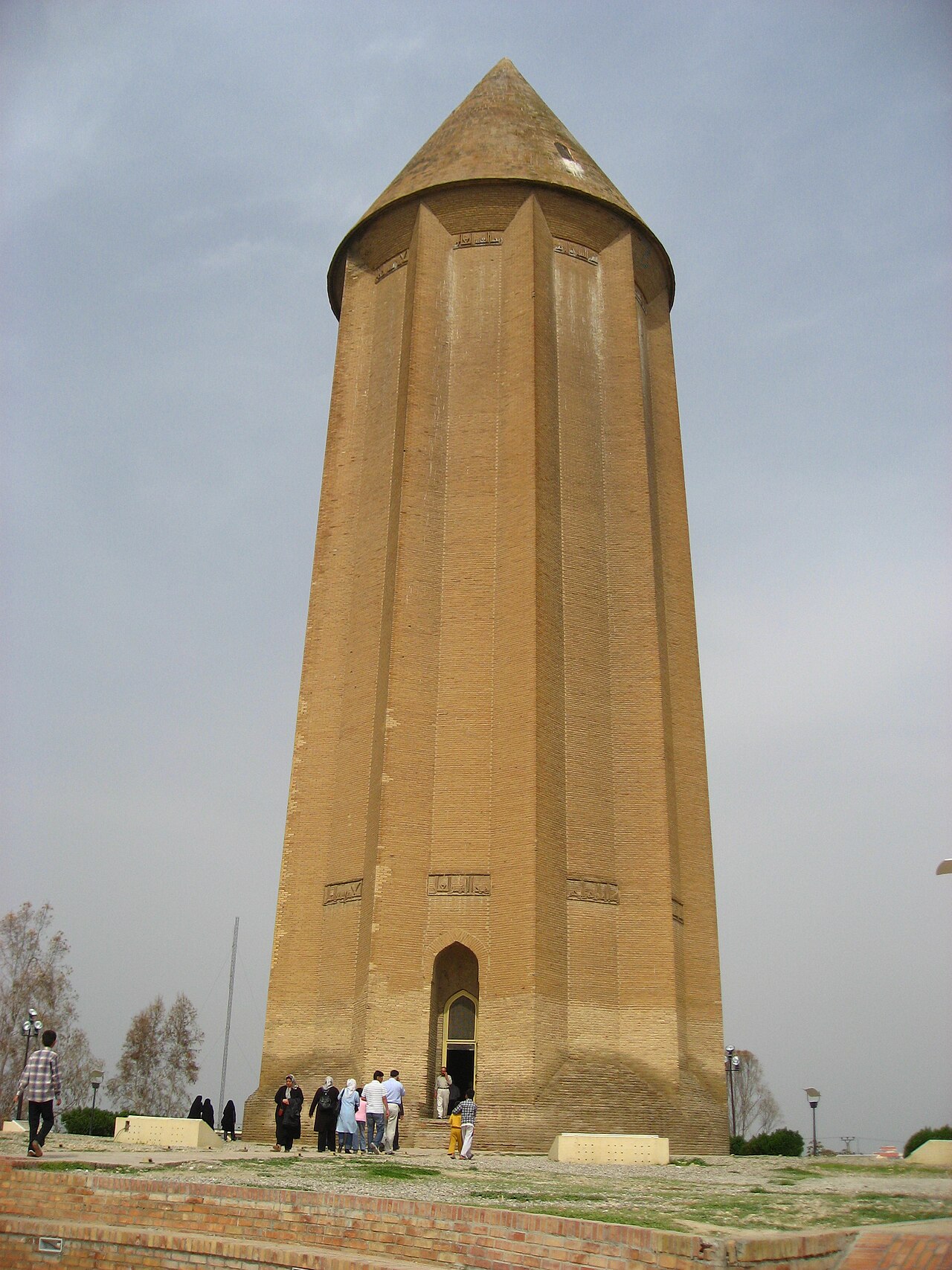
In 1006–1007, while still alive, Qabus built himself a tomb tower near Gorgan. Its Kufic inscription gives the date in both the lunar Islamic and the Iranian solar calendar. The tower is a tall fired-brick cylinder with ten triangular flanges running from base to top, crowned by a conical roof, and at about 53 metres including its plinth it is one of the tallest brick towers of the early Islamic world. According to later tradition, Qabus’s body was placed in a glass coffin hung from the roof. The building, now a UNESCO World Heritage site, is described in detail on Gonbad-e Qabus tower, with visiting information on Gonbad-e Qabus.
Manuchihr and the last Ziyarids
Manuchihr ibn Qabus (1012–1031) accepted the overlordship of Mahmud of Ghazni and married one of his daughters. His successors paid tribute in turn to the Ghaznavids and the Seljuks, and the line faded out in the late eleventh century, its last princes overshadowed by the Seljuks and the Isma’ili fortresses of the Alborz.
The Qabusnama, a prince’s advice to his son
The dynasty’s most lasting work was written near its end. In 1082–1083 the Ziyarid prince Kay Kavus ibn Iskandar, a grandson of Qabus, wrote a book of advice in Persian for his son Gilanshah and named it after his famous ancestor: the Qabusnama, “Book of Qabus”. Its forty-four chapters cover religion and duty to parents, but also how to eat and drink, how to play chess and backgammon, when to bathe, how to choose a horse or a wife, how to behave as a poet, a doctor, a merchant or a king’s companion, and how to be a farmer. The tone is practical and often frank, the voice of an old man who expects his son to lose the throne and want a trade. It is one of the best sources for daily life and manners in eleventh-century Iran and a classic of plain Persian prose.
- 931 Mardavij seizes power
- 935 Sadeh festival at Isfahan; Mardavij murdered
- 967 Voshmgir killed hunting
- 981 Qabus driven out by Adud al-Dawla
- c. 1000 Al-Biruni dedicates the Chronology to Qabus
- 1006–1007 Gonbad-e Qabus built
- 1012 Qabus deposed and killed
- 1082–1083 The Qabusnama written
The Ziyarid heartland is today’s Golestan province; see Gorgan.
Persian words from this page
| زیاریان | Ziyâriyân | the Ziyarids |
| مرداویج | Mardâvij | Mardavij |
| قابوس | Qâbus | Qabus |
| وشمگیر | Voshmgir | “quail-catcher” |
| گرگان | Gorgân | Gorgan |
| سده | Sade | Sadeh, the winter fire festival |
| قابوسنامه | Qâbusnâme | Book of Qabus |
Sources and further reading
- Kay Kavus ibn Iskandar, A Mirror for Princes: The Qabus Nama, translated by R. Levy (1951).
- Miskawayh, Tajarib al-umam, in H. F. Amedroz and D. S. Margoliouth, The Eclipse of the Abbasid Caliphate (1920–21).
- W. Madelung, “The Minor Dynasties of Northern Iran”, in The Cambridge History of Iran, vol. 4 (1975).
- Encyclopaedia Iranica, “Ziyarids” and “Qabus b. Wosmgir”.
- UNESCO World Heritage Centre, Gonbad-e Qābus.
Want to learn Persian? Get the free Starter Pack
Get the 14-page printable Starter Pack (all 32 letters, a 7-day reading plan, 100 core words and 20 survival phrases) and a short 5-email course. Free.
More in The Iranian Intermezzo (821–1055)
- The Tahirids of Khorasan
- The Saffarids and Ya’qub the Coppersmith
- Amr ibn Layth and the Saffarid–Samanid War
- The Zaydi Alavids of Tabaristan
- The Samanid Empire
- Ismail Samani
- The Samanid Persian Renaissance
- Rudaki, Father of Persian Poetry
- Bal’ami and Early Persian Prose
- The End of the Samanids
- The Ziyarids and Qabus ibn Voshmgir
- Gonbad-e Qabus Tower
- The Daylamites: Mountain Warriors of Gilan
- The Buyid Dynasty
- Adud al-Dawla
- Culture under the Buyids
- The Kakuyids of Isfahan
- Al-Khwarizmi and Persian Mathematics
- Muhammad ibn Zakariya al-Razi
- Ferdowsi and the Shahnameh
- Avicenna (Ibn Sina)
- Al-Biruni