The Samanid Persian renaissance is the name historians give to the burst of writing in New Persian at the Samanid courts of Bukhara and Khorasan in the tenth century. Within about seventy years, from the poetry of Rudaki in the 920s and 930s to the first verses of Ferdowsi in the 970s, Persian gained court poetry, prose history, a Qur’an commentary, geography and medicine, and became a language of culture alongside Arabic for the first time since the Arab conquest.
| Period | c. 910s–990s |
|---|---|
| Centres | Bukhara, Samarqand, Nishapur, Tus, Balkh, Merv |
| Patrons | Samanid amirs Nasr II, Mansur I and Nuh II; viziers Bal’ami and Jayhani; governors such as Abu Mansur of Tus |
| Key works | Rudaki’s poetry; prose Shahnameh of Abu Mansur (957); Bal’ami’s history (963); Persian Tafsir of Tabari; Hudud al-Alam (982) |
How New Persian took shape as a written language, its script and its first poets under the Tahirids and Saffarids, is explained on the birth of New Persian. This page looks at what the Samanid courts did with it, and why.
Why Persian, and why in Bukhara
The Samanids were loyal Sunnis who named the Abbasid caliph on their coins, so their support for Persian was not a revolt against Islam or the Arabs. Several practical reasons came together. Far from Baghdad, the eastern courts needed a public that understood what was said in praise of the ruler, and most of the soldiers, landowners and townspeople of Khorasan and Transoxiana spoke Persian, not Arabic. The old landowning class, the dehqans, kept alive stories of the Iranian kings and liked to hear them. And the Samanids, who claimed descent from the Sasanian general Bahram Chubin, gained prestige from presenting themselves as heirs of Iran’s kings.

Poetry at court
The leading poet was Rudaki, who served Nasr II (914–943) and is described on his own page, Rudaki, father of Persian poetry. Around him worked a circle whose names survive mostly in fragments quoted by later anthologists and dictionary makers:
- Shahid of Balkh, poet and philosopher, whose death Rudaki lamented in an elegy.
- Abu Shakur of Balkh, author of a long didactic poem, the Afarin-nama, finished in 947, of which only scattered lines remain.
- Rabi’a of Balkh, the earliest woman poet of New Persian whose verses survive, around whom later writers wove a tragic love story.
- Daqiqi, who began a verse epic of the Iranian kings for the Samanid court and had written about a thousand couplets on King Gushtasp and Zoroaster when he was murdered. Ferdowsi later included them in his Shahnameh, with acknowledgement.
These poets fixed the main forms of classical Persian verse, the qasida (praise ode), the masnavi (long poem in rhyming couplets) and the short lyric and quatrain, and the metres that Persian poetry used for the next thousand years.
Prose: history, scripture and science
The Shahnameh of Abu Mansur, 957
Abu Mansur Muhammad ibn Abd al-Razzaq, Samanid commander and governor of Tus, ordered his minister to gather dehqans who knew the old traditions and to compile a prose book of the kings of Iran. The book is lost, but its preface survives and is one of the oldest pieces of Persian prose. It became a main source for Ferdowsi, born near Tus, whose work is the subject of Ferdowsi and the Shahnameh.
Bal’ami and the Persian Tabari
In 963 the amir Mansur I commissioned his vizier Abu Ali Bal’ami to render al-Tabari’s great Arabic history into Persian. Bal’ami shortened, rearranged and added to it, producing one of the most copied Persian books of the Middle Ages; see Bal’ami and early Persian prose. In the same reign a team of scholars translated al-Tabari’s Qur’an commentary. Its preface says that the religious scholars of Transoxiana were first asked whether it was lawful to explain the Qur’an in Persian, and agreed that it was, a decision that opened Persian to religious learning.
Geography and medicine
The Hudud al-Alam (“The Limits of the World”), written in 982 by an unknown author for the Farighunid prince of Guzgan, a Samanid vassal, is the oldest surviving geography in Persian and describes lands from China to Spain. A physician of Bukhara, Akhawayni, wrote a handbook of medicine in Persian, the Hidayat al-muta’allimin, for students. Such books show Persian being used to teach, not just to entertain.
Arabic did not disappear
The renaissance was bilingual. Bukhara was also a great centre of Arabic letters: the anthologist al-Tha’alibi, writing soon after 1000, called it the meeting place of the finest Arabic writers of the age. The physician al-Razi dedicated his medical compendium, the Kitab al-Mansuri, to Mansur ibn Ishaq, the Samanid governor of Rey. The young Avicenna, in his autobiography, describes being admitted to the library of Nuh II in Bukhara, with rooms of book chests arranged by subject, where he read books he never saw again. Science and philosophy remained largely in Arabic, while Persian took over poetry, history and much of government.
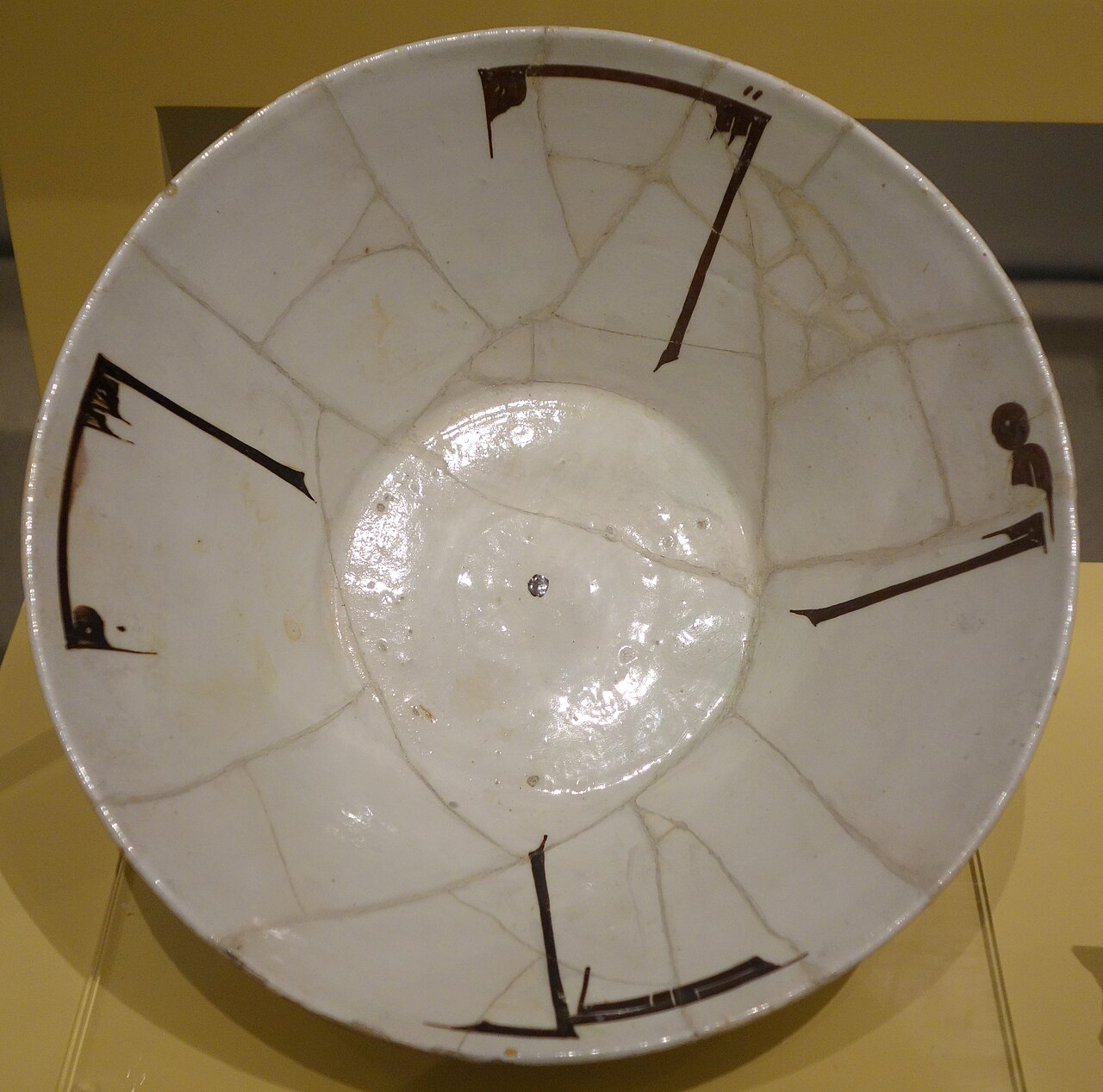
The decorated pottery of Nishapur and Samarqand, like the bowl above, sums up this mix: elegant Arabic script in black on white, carrying proverbs about learning and generosity, made for a Persian-speaking urban public.
How historians judge the “renaissance”
The word is modern and partly misleading. Nothing was reborn in the strict sense: the language, its script and its poetic forms were new, and Middle Persian literature was not revived but replaced. Richard Frye, who wrote of the Samanid “golden age”, stressed instead the creation of an Islamic culture in Persian, and that view is now common. It also explains the movement’s lasting effect. Because Persian had been made a language of Islamic learning and courtly prestige under a Sunni dynasty, later Turkic rulers such as the Ghaznavids and Seljuks adopted it too, and Persian spread with them to India and Anatolia. The longer arc is traced on a history of Persian poetry and a history of the Persian language.
Persian words from this page
| دهقان | dehqân | landowner (today: farmer) |
| شاهنامه | Shâhnâme | Book of Kings |
| قصیده | qaside | praise ode |
| مثنوی | masnavi | poem in rhyming couplets |
| تفسیر | tafsir | Qur’an commentary |
| دقیقی | Daqiqi | Daqiqi, the poet |
Sources and further reading
- R. N. Frye, The Golden Age of Persia: The Arabs in the East (1975).
- G. Lazard, “The Rise of the New Persian Language”, in The Cambridge History of Iran, vol. 4 (1975).
- J. Rypka, History of Iranian Literature (1968).
- V. Minorsky (trans.), Hudud al-Alam: The Regions of the World (1937).
- W. E. Gohlman, The Life of Ibn Sina (1974), Avicenna’s autobiography.
- Encyclopaedia Iranica, “Samanids” and “Persian Literature: Classical”.
Want to learn Persian? Get the free Starter Pack
Get the 14-page printable Starter Pack (all 32 letters, a 7-day reading plan, 100 core words and 20 survival phrases) and a short 5-email course. Free.
More in The Iranian Intermezzo (821–1055)
- The Tahirids of Khorasan
- The Saffarids and Ya’qub the Coppersmith
- Amr ibn Layth and the Saffarid–Samanid War
- The Zaydi Alavids of Tabaristan
- The Samanid Empire
- Ismail Samani
- The Samanid Persian Renaissance
- Rudaki, Father of Persian Poetry
- Bal’ami and Early Persian Prose
- The End of the Samanids
- The Ziyarids and Qabus ibn Voshmgir
- Gonbad-e Qabus Tower
- The Daylamites: Mountain Warriors of Gilan
- The Buyid Dynasty
- Adud al-Dawla
- Culture under the Buyids
- The Kakuyids of Isfahan
- Al-Khwarizmi and Persian Mathematics
- Muhammad ibn Zakariya al-Razi
- Ferdowsi and the Shahnameh
- Avicenna (Ibn Sina)
- Al-Biruni