Abu Rayhan al-Biruni (973–c. 1050) was a scholar from Khwarazm who wrote on astronomy, mathematics, geography, mineralogy, pharmacology, calendars and the cultures of other peoples. Taken to Ghazni by Sultan Mahmud in 1017, he travelled in north-western India, learned Sanskrit and wrote a study of Indian religion and science that has no equal in the Middle Ages. He also measured the size of the Earth with remarkable accuracy.
| Born | 973, Kath, capital of the old kingdom of Khwarazm |
|---|---|
| Died | After 1050, Ghazni |
| Languages | Khwarezmian (native), Persian, Arabic, Sanskrit; also some Greek, Syriac and Hebrew sources through translation or helpers |
| Patrons | Qabus of Gorgan; the Ma’munid Khwarazmshahs; Mahmud and Mas’ud of Ghazni |
| Major works | The Chronology of Ancient Nations (c. 1000); India (c. 1030); al-Qanun al-Mas’udi; Kitab al-Tafhim; books on gems and on drugs |
Khwarazm and the wandering years
Al-Biruni was born in 973 in Khwarazm, the oasis on the lower Oxus whose people spoke their own Iranian language. His name probably means “from the outskirts”, that is, from outside the walls of the town of Kath. He was trained in astronomy by Abu Nasr Mansur ibn Iraq, a mathematician of the old ruling family of Khwarazm.
In 995 that family was overthrown by the rival Ma’munid rulers of Gurganj, and the young scholar had to leave. For several years he moved between courts. He spent time in Rey, where he saw the giant sextant of the astronomer al-Khujandi (see culture under the Buyids), and at Gorgan under the Ziyarid prince Qabus, whose tomb is Gonbad-e Qabus. Around 1000 he dedicated his first major book to Qabus.
The Chronology of Ancient Nations
Al-Athar al-baqiya, “The Remaining Traces of Past Centuries”, is a study of how different peoples count time: the calendars, eras and festivals of the Persians, Sogdians, Khwarezmians, Greeks, Jews, Christians, Arabs and others, with tables and the astronomy behind them. Much of what we know about the Iranian festivals of the early Islamic period, such as Nowruz, Mehregan and Sadeh, comes from it. See the history of the Iranian calendar and Nowruz through history.
Arguing with Avicenna
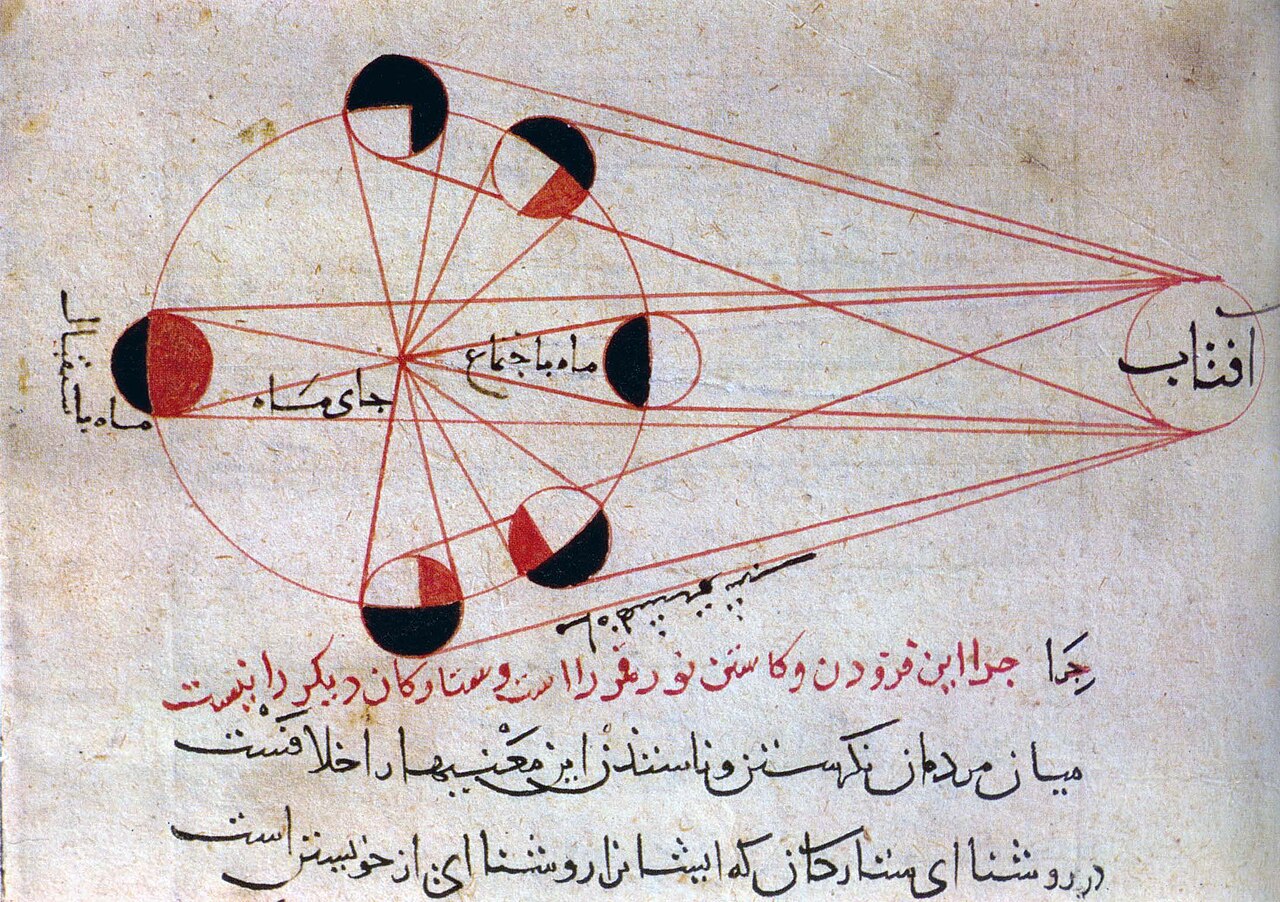
From around 1004 al-Biruni was back in Khwarazm, serving the Ma’munid rulers as scholar and diplomat. As a young man he had also exchanged letters with the even younger Avicenna, putting to him a series of sharp questions about Aristotle’s physics: whether the heavens could be heavy or light, whether other worlds could exist, how heat and light behave. Avicenna’s replies, and Biruni’s impatient answers to them, survive and show two very different minds, the observer and the system-builder.

At the court of Mahmud
In 1017 Mahmud of Ghazni conquered Khwarazm and carried off its scholars to Ghazni, al-Biruni among them. His position there was uneasy. He served as court astronomer and astrologer, but he was in a sense a captive, and he complained of hardship in the early years. Yet Mahmud’s campaigns into India gave him the chance of his life. He went with the army or followed it into the Punjab, met Indian scholars, learned Sanskrit and read their books in the original. The sultan’s career is told on Mahmud of Ghazni.
A book about India
Around 1030 he finished his Tahqiq ma li’l-Hind, usually called simply India. In eighty chapters he described Hindu religion and philosophy, the caste system, laws and customs, literature, weights and measures, geography, astronomy and calendars. He quoted Sanskrit texts at length, translated parts of them, and compared Indian ideas with Greek philosophy and with Sufism.
What makes the book remarkable is its method. Al-Biruni tried to present Indian thought as Indians themselves understood it, and to judge it fairly. He was critical, sometimes sharply, of what he saw as superstition, but he applied the same standard to Greek and Muslim errors, and he was frank about the violence of Mahmud’s raids and the hostility they caused. He also translated Indian works into Arabic, among them the Yoga Sutras of Patanjali. The German scholar Eduard Sachau’s English translation, Alberuni’s India (1888), is still widely read. For the longer story, see Iran and India through history.
Measuring the Earth
Al-Biruni’s best-known experiment was carried out in India, near the fort of Nandana in today’s Pakistan. He first measured the height of a hill using trigonometry. Then, from its summit, he measured how far the horizon dipped below the horizontal. From these two values he calculated the radius of the Earth. His result is within about one percent of the modern figure for the mean radius, though historians note that a measurement of the dip so small must have involved some luck as well as skill.
Astronomy, gems and drugs
- Al-Qanun al-Mas’udi, dedicated to Mahmud’s son Mas’ud, was a full treatise on astronomy. In it and elsewhere Biruni discussed whether the Earth turns on its axis and concluded that astronomical observation alone could not decide the question.
- Kitab al-Tafhim (1029), an introduction to geometry, arithmetic, astronomy and astrology in question-and-answer form, exists in both Arabic and Persian versions, and is one of the earliest scientific books in Persian.
- The book on precious stones gives careful measurements of the specific gravity of many minerals and metals.
- The book on drugs (Kitab al-Saydana), written in old age, lists medicinal substances with their names in many languages.
Most of his works were in Arabic, which he considered the best language for science. In one preface he remarked, half in jest, that he would rather be criticised in Arabic than praised in Persian; but he wrote the Tafhim in Persian too, and his work belongs to the same world as al-Khwarizmi and the scholars of the Iranian courts.
Later years and memory
Al-Biruni outlived Mahmud and continued working under Mas’ud and his successors. He died in Ghazni some time after 1050; the exact year is unknown. A crater on the Moon carries his name, and he is claimed with pride today in Uzbekistan, where Khwarazm lies, in Iran and in Afghanistan. For his place in the long history of Iranian science, see science in Iranian history.
Persian words from this page
| ابوریحان بیرونی | Abu Reyhân Biruni | al-Biruni |
| بیرون | birun | outside (the root of his name) |
| خوارزم | Khârazm | Khwarazm |
| غزنین | Ghaznin | Ghazni |
| هند | Hend | India |
| ستارهشناسی | setâre-shenâsi | astronomy |
| التفهیم | al-Tafhim | his introduction to astronomy |
Sources and further reading
- Al-Biruni, The Chronology of Ancient Nations, trans. C. Edward Sachau (London, 1879).
- Al-Biruni, Alberuni’s India, trans. Edward C. Sachau, 2 vols. (London, 1888).
- Al-Biruni, The Book of Instruction in the Elements of the Art of Astrology, trans. R. Ramsay Wright (London, 1934).
- Encyclopaedia Iranica, article “Bīrūnī, Abū Rayḥān” (several parts).
- S. Frederick Starr, Lost Enlightenment: Central Asia’s Golden Age from the Arab Conquest to Tamerlane (Princeton, 2013).
- C. E. Bosworth, The Ghaznavids (Edinburgh, 1963).
Want to learn Persian? Get the free Starter Pack
Get the 14-page printable Starter Pack (all 32 letters, a 7-day reading plan, 100 core words and 20 survival phrases) and a short 5-email course. Free.
More in The Iranian Intermezzo (821–1055)
- The Tahirids of Khorasan
- The Saffarids and Ya’qub the Coppersmith
- Amr ibn Layth and the Saffarid–Samanid War
- The Zaydi Alavids of Tabaristan
- The Samanid Empire
- Ismail Samani
- The Samanid Persian Renaissance
- Rudaki, Father of Persian Poetry
- Bal’ami and Early Persian Prose
- The End of the Samanids
- The Ziyarids and Qabus ibn Voshmgir
- Gonbad-e Qabus Tower
- The Daylamites: Mountain Warriors of Gilan
- The Buyid Dynasty
- Adud al-Dawla
- Culture under the Buyids
- The Kakuyids of Isfahan
- Al-Khwarizmi and Persian Mathematics
- Muhammad ibn Zakariya al-Razi
- Ferdowsi and the Shahnameh
- Avicenna (Ibn Sina)
- Al-Biruni