Avicenna, in Persian Ebn-e Sina or Pur-e Sina (980–1037), was a physician and philosopher from Bukhara who became the most influential thinker of the medieval Islamic world. His Canon of Medicine was the standard medical textbook in the Middle East and Europe for some six centuries, and his Book of Healing shaped philosophy from Iran to Paris. He wrote much of it on the move, serving a series of princes in Iran, and died in Hamadan, where his tomb stands today.
| Full name | Abu Ali al-Husayn ibn Abd Allah ibn Sina |
|---|---|
| Born | c. 980, Afshana near Bukhara (Samanid Transoxiana) |
| Died | 1037 (428 AH), Hamadan |
| Patrons | Samanid Nuh II; the Khwarazmshah Abu’l-Hasan Ali; Buyid rulers of Rey and Hamadan; Ala al-Dawla of Isfahan |
| Major works | The Canon of Medicine (al-Qanun fi’l-tibb); The Book of Healing (al-Shifa’); Pointers and Reminders; Daneshnameh-ye Ala’i (in Persian) |
| Title in Iran | Sheykh-or-Ra’is, “the leading master” |
A prodigy of Bukhara
Most of what we know about Avicenna’s youth comes from a short autobiography he dictated to his pupil al-Juzjani, who completed the story after his death. His father was a Samanid official from Balkh and his mother came from a village near Bukhara. The boy knew the Qur’an by heart at ten, learned Indian arithmetic from a local greengrocer, and by sixteen was studying medicine, which he found “not one of the difficult sciences”.
One story from the autobiography is often told. He read Aristotle’s Metaphysics forty times, he says, until he knew it by heart and still did not understand it. Then a bookseller in the market pressed on him a cheap little book by al-Farabi explaining its aims, and suddenly everything became clear. In gratitude he gave alms to the poor.
At seventeen he helped treat the Samanid amir Nuh II and was rewarded with access to the royal library of Bukhara, where he read books he says he never saw again. He later claimed that by eighteen he had mastered every science, and that afterwards he only deepened what he already knew.
Years of wandering
The fall of the Samanids in 999 (see the end of the Samanids) cost Avicenna his place at court. He moved to Gurganj, capital of Khwarazm, where the Ma’munid Khwarazmshah kept a circle of scholars that also included al-Biruni. Around 1012 he left again “by necessity”, in his words. A later legend says he fled to avoid being sent to Mahmud of Ghazni, who was collecting scholars; the story cannot be confirmed.
He crossed Khorasan hoping to join Qabus, the scholar-prince of Gorgan, but arrived to find him deposed and dead. In Gorgan al-Juzjani became his pupil and companion for the rest of his life. From there he went to Rey, around 1014, where he treated the Buyid prince Majd al-Dawla for melancholy, and then to Hamadan.
Vizier and prisoner in Hamadan
In Hamadan Avicenna cured the Buyid ruler Shams al-Dawla of colic and was made his vizier. Political life was dangerous: the army mutinied, demanded his execution and plundered his house, and he went into hiding until the ruler needed him again. Throughout, he kept writing. Al-Juzjani describes evenings when students gathered in his house to read from the Book of Healing and the Canon, followed by music and wine.
After Shams al-Dawla’s death, Avicenna secretly wrote to Ala al-Dawla, the Kakuyid ruler of Isfahan. The letters were discovered, and he was imprisoned for four months in the fortress of Fardajan outside Hamadan. When Ala al-Dawla took Hamadan he was freed, and around 1024 he slipped away to Isfahan, dressed as a Sufi, with al-Juzjani, his brother and two servants.

Isfahan and death
The years in Isfahan, from about 1024 to 1037, were the calmest of his life. He served Ala al-Dawla as adviser and physician, went with him on campaigns, and wrote for him the Daneshnameh-ye Ala’i, the first major book of philosophy in Persian. The court is described on the Kakuyids of Isfahan. In 1037, accompanying the prince on campaign, he was struck by a severe attack of the colic that had troubled him for years. His own treatment failed, and he died at Hamadan at about fifty-seven.
The Canon of Medicine
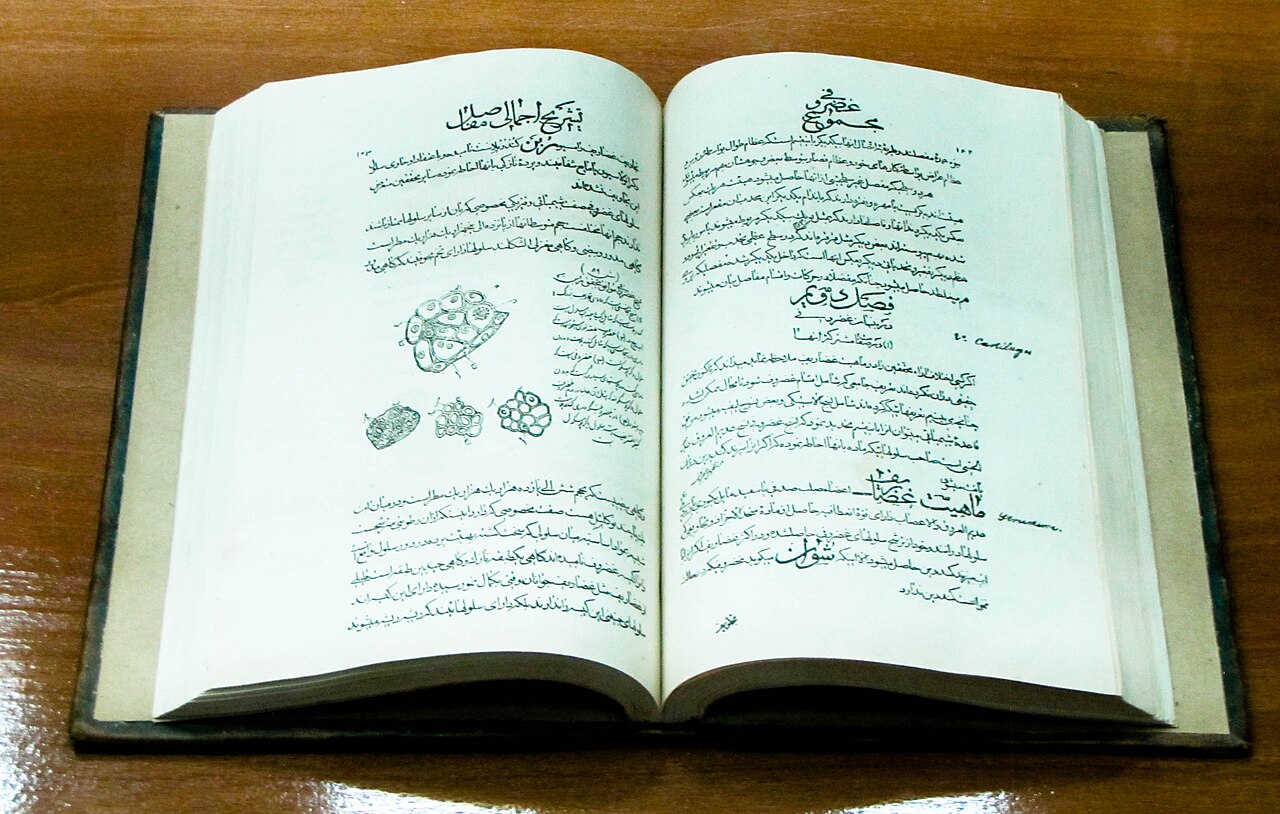
The Canon (al-Qanun fi’l-tibb) set out to organise the whole of medicine in one work. It has five books:
- General principles: anatomy, the humours, causes and signs of disease, hygiene and general therapy.
- Simple drugs, arranged alphabetically, with rules for testing whether a drug really works.
- Diseases of each part of the body, from head to foot.
- Diseases that affect the whole body, such as fevers, and matters like wounds, poisons and cosmetics.
- Compound medicines.
Avicenna combined the Greek medicine of Galen with Aristotle’s philosophy and the experience of physicians writing in Arabic, among them al-Razi. What readers valued was its order: everything had a place and a reason. Gerard of Cremona translated it into Latin in the twelfth century; it was printed dozens of times after 1473 and remained part of the medical curriculum at some European universities into the seventeenth century. In parts of the Muslim world and South Asia it is still used in traditional medicine.
Philosopher of being
For philosophers Avicenna’s greatest work is the Book of Healing (al-Shifa’), a huge encyclopedia of logic, natural science, mathematics and metaphysics, together with its shorter versions and his late Pointers and Reminders. Among his best-known ideas:
- Essence and existence. What a thing is and the fact that it exists are different; in everything except God, existence must be given from outside.
- The Necessary Existent. From this he built a proof of God as the one being whose essence is to exist.
- The “flying man”. He asks the reader to imagine a man created in mid-air, unable to see or touch anything, even his own body. Such a man would still know that he exists, which Avicenna took as evidence that the soul is distinct from the body.
His influence was enormous in both directions. In Latin translation he shaped thirteenth-century scholastics such as Thomas Aquinas. In the Islamic world al-Ghazali attacked his views in The Incoherence of the Philosophers, but later thinkers, including Nasir al-Din Tusi and Mulla Sadra, built on him.
Avicenna in Hamadan and in Iran today
Avicenna was buried in Hamadan. The present mausoleum was completed in 1952 to a design by the architect Houshang Seyhoun, whose tall concrete tower recalls the brick Gonbad-e Qabus; see the Tomb of Avicenna and Hamadan. In Iran his birthday, 1 Shahrivar (23 August), is celebrated as Doctors’ Day.
Persian words from this page
| ابن سینا | Ebn-e Sinâ | Avicenna |
| پورسینا | Pur-e Sinâ | “son of Sina”, his Persian name |
| شیخالرئیس | Sheykh-or-Ra’is | his honorific |
| قانون | Qânun | the Canon; also “law” |
| شفا | Shefâ | healing, the Book of Healing |
| دانشنامه | dâneshnâme | encyclopedia, “book of knowledge” |
| همدان | Hamedân | Hamadan |
Sources and further reading
- W. E. Gohlman (ed. and trans.), The Life of Ibn Sina (SUNY Press, 1974): the autobiography and al-Juzjani’s biography.
- Dimitri Gutas, Avicenna and the Aristotelian Tradition (2nd ed., Brill, 2014).
- Jon McGinnis, Avicenna (Great Medieval Thinkers, Oxford University Press, 2010).
- Encyclopaedia Iranica, article “Avicenna” (several parts, on his life, philosophy and medicine).
- Peter E. Pormann and Emilie Savage-Smith, Medieval Islamic Medicine (Edinburgh University Press, 2007).
- Stanford Encyclopedia of Philosophy, “Ibn Sina [Avicenna]”.
Want to learn Persian? Get the free Starter Pack
Get the 14-page printable Starter Pack (all 32 letters, a 7-day reading plan, 100 core words and 20 survival phrases) and a short 5-email course. Free.
More in The Iranian Intermezzo (821–1055)
- The Tahirids of Khorasan
- The Saffarids and Ya’qub the Coppersmith
- Amr ibn Layth and the Saffarid–Samanid War
- The Zaydi Alavids of Tabaristan
- The Samanid Empire
- Ismail Samani
- The Samanid Persian Renaissance
- Rudaki, Father of Persian Poetry
- Bal’ami and Early Persian Prose
- The End of the Samanids
- The Ziyarids and Qabus ibn Voshmgir
- Gonbad-e Qabus Tower
- The Daylamites: Mountain Warriors of Gilan
- The Buyid Dynasty
- Adud al-Dawla
- Culture under the Buyids
- The Kakuyids of Isfahan
- Al-Khwarizmi and Persian Mathematics
- Muhammad ibn Zakariya al-Razi
- Ferdowsi and the Shahnameh
- Avicenna (Ibn Sina)
- Al-Biruni