Abu Ali Muhammad Bal’ami was a Samanid vizier who in 963 produced the Tarikhnama, a Persian version of al-Tabari’s great Arabic history of the world. It is the oldest substantial work of New Persian prose to survive, and together with a handful of other tenth-century books it shows Persian becoming a language of history, religion and science, not only of poetry.
| Author | Abu Ali Muhammad Bal’ami, known as Amirak or Bal’ami the Younger (died 974, or between 992 and 997) |
|---|---|
| Office | Vizier of the Samanid amirs Abd al-Malik I and Mansur I |
| Work | Tarikhnama, also called Tarikh-i Bal’ami |
| Date | Commissioned in 963 (352 AH) by Mansur I, at Bukhara |
| Based on | Al-Tabari, History of Prophets and Kings (Arabic, completed c. 915) |
| Language | New Persian (Dari) in Arabic script |
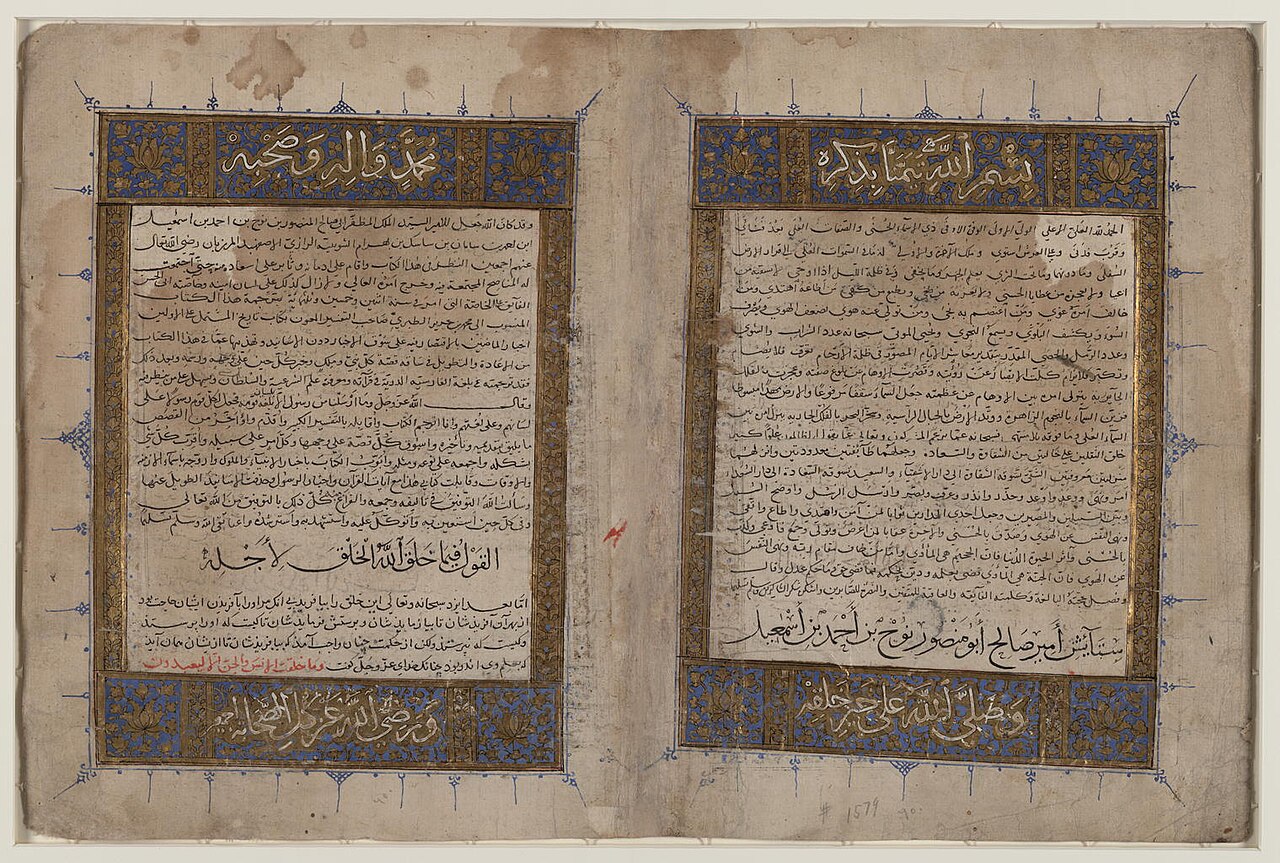

A family of viziers
The Bal’amis were a leading family of Samanid officials from the Merv region. Abu’l-Fadl Bal’ami, the father, was chief minister to the amir Nasr II for many years and is remembered as a patron of the poet Rudaki (see Rudaki, father of Persian poetry). His son Abu Ali, called Amirak, “the little amir”, followed him into the vizierate late in the reign of Abd al-Malik I (954–961) and kept the post under Mansur I.
His end is uncertain, and the sources disagree. The historian Gardizi says he died in office in 974. Al-Utbi, writing a generation later, says he was dismissed, recalled to serve Nuh II, and retired in 992, dying some time before 997. Both versions appear in modern reference works.
Why translate al-Tabari?
Muhammad ibn Jarir al-Tabari, an Iranian from Amol in Tabaristan who worked in Baghdad, had finished his vast Arabic History of Prophets and Kings early in the tenth century. It ran from the Creation through the Persian kings and the prophets to the Abbasid caliphs, and it quoted chains of witnesses for each report. It was the standard history of the Muslim world.
In 963 the amir Mansur I ordered his vizier to put it into Persian. The reasons were partly practical: many Samanid officers and subjects in Khorasan and Transoxiana read Arabic poorly or not at all. They were also political. The Samanids claimed descent from the Sasanian general Bahram Chobin, and a history in Persian that gave the old kings of Iran their due supported the dynasty’s image as heirs of Iranian monarchy and loyal Sunni Muslims at the same time. The broader movement this belongs to is described on the Samanid Persian renaissance.
A translation that became a new book
Bal’ami called his work a translation, but it is better described as a free adaptation. He dropped al-Tabari’s long chains of transmitters and most alternative versions, which shortened the text enormously. He rearranged material, explained things a Persian reader would not know, and in several places says outright that he has corrected al-Tabari. He also added stories from other sources, some of which survive nowhere else, especially on the pre-Islamic kings of Iran.
The result has a different point of view from its model. Al-Tabari wrote from Baghdad; Bal’ami wrote from Bukhara, and his history leans toward Khorasan and the Iranian past. The historian Andrew Peacock, who has studied the many manuscripts, argues that the book was reshaped again and again by later copyists, so that “Bal’ami” is really a living text with many versions rather than one fixed work.
A medieval bestseller
The Tarikhnama was one of the most copied Persian books of the Middle Ages. Well over a hundred manuscripts survive, some lavishly illustrated in the fourteenth century. It was translated into Turkish and even back into Arabic, and it reached European scholars through a nineteenth-century French translation by Hermann Zotenberg, the Chronique de Tabari (1867–1874).
What early Persian prose sounds like
Readers of modern Persian can follow Bal’ami with some effort, which is itself remarkable for a text over a thousand years old. His prose is plain and direct: short sentences joined by “and” (و), few rhetorical flourishes, and a vocabulary with far fewer Arabic loanwords than Persian prose of the Seljuk and later periods. Some forms look old-fashioned today, such as the verbal prefix همی (hami) where modern Persian uses می (mi). Later writers came to prize ornate, Arabic-heavy prose; the simple Samanid style is now admired again as the classical model. For the language’s long development, see a history of the Persian language.
The other first books of Persian prose
Bal’ami was not alone. Within about a century, Persian prose covered most fields of learning:
- The preface to the Shahnameh of Abu Mansur (957). A prose book of the kings of Iran compiled at Tus for the governor Abu Mansur. Only its preface survives, the oldest dated piece of New Persian prose; the book itself was a source for Ferdowsi’s Shahnameh.
- The Persian Tafsir of al-Tabari. Also commissioned by Mansur I, this translation of al-Tabari’s Qur’an commentary opens with the report that the scholars of Transoxiana were asked whether explaining the Qur’an in Persian was lawful, and agreed that it was.
- Hudud al-‘alam (982). An anonymous geography of the known world, written for a local prince in Guzgan in northern Afghanistan. It was translated into English by Vladimir Minorsky in 1937.
- Al-Abniya ‘an haqa’iq al-adwiya. A book on medicinal substances by Abu Mansur Muwaffaq of Herat. Its copy in Vienna, made in 1056 by the poet Asadi Tusi, is the oldest dated manuscript of any New Persian work.
- Hidayat al-muta’allimin fi’l-tibb. A medical handbook by Akhawayni of Bukhara, one of the first Persian textbooks of medicine.
Arabic remained the language of most science, philosophy and law: Avicenna and al-Biruni wrote mainly in Arabic, though both also wrote in Persian. But after the tenth century a Persian reader could find history, scripture, geography and medicine in his own language, and that change began in the offices of viziers like Bal’ami.
Persian words from this page
| بلعمی | Bal’ami | the vizier’s family name |
| تاریخ | târikh | history |
| تاریخنامه | Târikhnâme | book of history (Bal’ami’s title) |
| نثر | nasr | prose |
| ترجمه | tarjome | translation |
| وزیر | vazir | vizier, minister |
| تفسیر | tafsir | Qur’an commentary |
Sources and further reading
- Encyclopaedia Iranica, article “Amīrak Bal’amī” (Dj. Khaleghi-Motlagh).
- A. C. S. Peacock, Mediaeval Islamic Historiography and Political Legitimacy: Bal’ami’s Tarikhnama (Routledge, 2007).
- H. Zotenberg (trans.), Chronique de Abou-Djafar-Mohammed-ben-Djarir-ben-Yezid Tabari, traduite sur la version persane d’Abou-Ali Mohammed Bel’ami (Paris, 1867–1874).
- V. Minorsky (trans.), Hudud al-‘Alam, “The Regions of the World” (1937).
- R. N. Frye, “The Samanids”, in The Cambridge History of Iran, vol. 4 (1975).
- Ehsan Yarshater and Charles Melville (eds.), Persian Historiography, A History of Persian Literature vol. 10 (2012).
Want to learn Persian? Get the free Starter Pack
Get the 14-page printable Starter Pack (all 32 letters, a 7-day reading plan, 100 core words and 20 survival phrases) and a short 5-email course. Free.
More in The Iranian Intermezzo (821–1055)
- The Tahirids of Khorasan
- The Saffarids and Ya’qub the Coppersmith
- Amr ibn Layth and the Saffarid–Samanid War
- The Zaydi Alavids of Tabaristan
- The Samanid Empire
- Ismail Samani
- The Samanid Persian Renaissance
- Rudaki, Father of Persian Poetry
- Bal’ami and Early Persian Prose
- The End of the Samanids
- The Ziyarids and Qabus ibn Voshmgir
- Gonbad-e Qabus Tower
- The Daylamites: Mountain Warriors of Gilan
- The Buyid Dynasty
- Adud al-Dawla
- Culture under the Buyids
- The Kakuyids of Isfahan
- Al-Khwarizmi and Persian Mathematics
- Muhammad ibn Zakariya al-Razi
- Ferdowsi and the Shahnameh
- Avicenna (Ibn Sina)
- Al-Biruni