Abaqa (r. 1265–1282) and his son Arghun (r. 1284–1291) were the Ilkhans who turned Hulagu’s conquests into a lasting state. Abaqa defended its borders against the Golden Horde, the Chagatai khans and the Mamluks, and moved the capital to Tabriz; Arghun seized the throne from his Muslim uncle Ahmad Tegüder and tried to centralise the treasury. Both were non-Muslim rulers of a mostly Muslim country who governed through Persian ministers and sought alliances with Christian Europe against Egypt.
| Abaqa | Born 1234; reigned 1265–1282; died at Hamadan |
|---|---|
| Ahmad Tegüder | Abaqa’s brother, a Muslim convert; reigned 1282–1284 |
| Arghun | Abaqa’s son; reigned 1284–1291 |
| Capital | Tabriz, with summer and winter camps in Azerbaijan |
| Leading ministers | Shams al-Din Juvayni (to 1284); Sa’d al-Dawla (1289–1291) |
| Religion | Both Buddhist in sympathy; Abaqa married a Byzantine princess |
| Successors | Gaykhatu (1291–1295), Baydu (1295), Ghazan (1295–1304) |
Abaqa takes over, 1265
When Hulagu died in 1265 the Ilkhanate was at war on two fronts and its legal status was unclear. His son Abaqa was chosen by the princes and commanders, and waited for confirmation from the Great Khan Kublai in China before holding a formal enthronement, a sign that the Ilkhans still saw themselves as part of a single Mongol empire. Abaqa made Tabriz his main city, a choice that lasted for the rest of the dynasty and made Tabriz one of the great trading cities of Asia (see Tabriz under the Ilkhans).
Abaqa also inherited a marriage alliance. A bride had been sent from Constantinople for Hulagu, Maria, an illegitimate daughter of the Byzantine emperor Michael VIII Palaiologos. Hulagu died before she arrived and she married Abaqa instead. Known as Despina Khatun, she supported the Christians of the Ilkhanate.
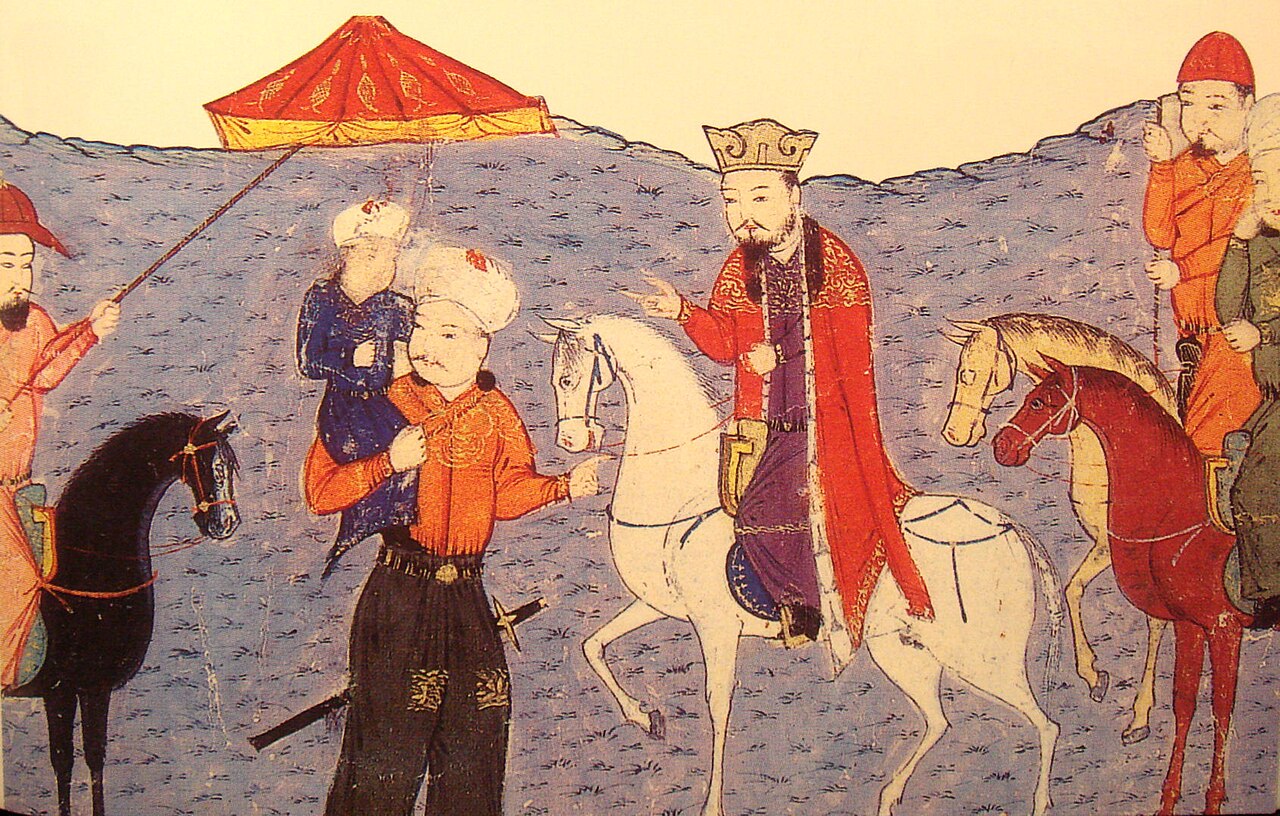

Wars on every border
Abaqa’s reign was spent mostly defending what Hulagu had won. In the Caucasus the Golden Horde invaded in the 1260s; Abaqa held the line of the Kura river and fortified the passes. In the east, the Chagatai khan Baraq crossed the Amu Darya into Khorasan in 1270. Abaqa met him near Herat in July 1270 and routed him, a victory that secured eastern Iran for the Ilkhans.
In the west, the war with the Mamluks that had begun at Ain Jalut went badly. In 1277 Sultan Baybars invaded Anatolia and defeated a Mongol army at Elbistan. Abaqa came in person to restore control. In 1281 he sent a large army into Syria under his brother Möngke Temür, which was defeated by Sultan Qalawun at the Second Battle of Homs. Abaqa was planning a new campaign when he died at Hamadan in April 1282. Some sources blame heavy drinking.
The Juvayni brothers and Persian government
Under Abaqa the civil government was run by Shams al-Din Juvayni, chief minister since Hulagu’s time, and his brother Ata-Malik, governor of Baghdad and author of the History of the World Conqueror. They were patrons of poets and scholars; Saadi of Shiraz addressed works to Shams al-Din. But their wealth and power made them targets. Ata-Malik was accused of embezzlement in the early 1280s and narrowly escaped death, and the rivalries at court between Mongol commanders and Persian officials set the pattern for the Ilkhanate’s politics.
Ahmad Tegüder, the first Muslim Ilkhan
Abaqa’s brother Tegüder, who had become a Muslim and took the name Ahmad, was chosen as Ilkhan in 1282. He wrote to the Mamluk sultan Qalawun announcing his conversion and proposing peace, letters that survive in Mamluk sources. His policy alarmed many Mongol commanders and princes, and Abaqa’s son Arghun, governor of Khorasan, rebelled. Ahmad’s support collapsed, and he was executed in August 1284. Historians debate whether religion or ordinary succession politics mattered more; most now stress the second.
Arghun, 1284 to 1291
Arghun began his reign by settling scores. Shams al-Din Juvayni, accused of having poisoned Abaqa, was executed in 1284. Arghun was a Buddhist who built temples and was interested in alchemy and in drugs said to prolong life. In 1289 he appointed as vizier Sa’d al-Dawla, a Jewish physician from Abhar who had shown his skill at recovering revenues in Baghdad. Sa’d al-Dawla tightened control of tax collection, brought appointments under the central treasury and placed relatives and allies in key posts. The reforms raised money but made powerful enemies among Mongol emirs and Persian officials alike.
When Arghun fell seriously ill in 1291, reportedly after taking one of his elixirs, his opponents struck. Sa’d al-Dawla was killed, and violence against Jews followed in several cities. Arghun died in March 1291.
Letters to Europe
Both Ilkhans looked to Latin Christendom for help against the Mamluks. Abaqa’s envoys attended the Second Council of Lyon in 1274. Arghun went further: in 1287–1288 he sent Rabban Sauma, a Turkic Christian monk born near Beijing, to Constantinople, Rome, Paris and Gascony, where he met Philip IV of France and Edward I of England. Arghun’s letter of 1289 to Philip IV, written in Mongolian in the Uighur script, survives in the French national archives; it proposes a joint campaign and offers Jerusalem to the French. No European army came. The embassies are described in detail on the page on the Ilkhanate and Europe.
One of Arghun’s last requests had a famous result. After the death of his chief wife he asked Kublai for a bride from her tribe. The princess Kököchin was sent by sea, and Marco Polo says he was among her escort. By the time she reached Iran, Arghun was dead, and she married his son Ghazan instead.
After Arghun
Arghun’s brother Gaykhatu (1291–1295) was remembered for extravagance and for a failed attempt in 1294 to introduce Chinese-style paper money, which closed the bazaars of Tabriz within days. A cousin, Baydu, overthrew him in 1295, and was in turn defeated by Arghun’s son Ghazan, whose conversion to Islam and reforms opened a new phase of the Ilkhanate.
Persian words from this page
| اباقا خان | Abâqâ Khân | Abaqa Khan |
| ارغون | Arghun | Arghun |
| تبریز | Tabriz | Tabriz |
| همدان | Hamedân | Hamadan |
| سفیر | safir | ambassador, envoy |
| نامه | nâme | letter |
Sources and further reading
- Rashid al-Din, Jami al-Tawarikh, translated by W. M. Thackston (Harvard, 1998–1999), the reigns of Abaqa, Ahmad and Arghun.
- J. A. Boyle, “Dynastic and Political History of the Il-Khans”, in The Cambridge History of Iran, vol. 5 (1968).
- Reuven Amitai-Preiss, Mongols and Mamluks: The Mamluk-Ilkhanid War, 1260–1281 (Cambridge University Press, 1995).
- Morris Rossabi, Voyager from Xanadu: Rabban Sauma and the First Journey from China to the West (Kodansha, 1992).
- Peter Jackson, The Mongols and the West, 1221–1410 (Longman, 2005).
Want to learn Persian? Get the free Starter Pack
Get the 14-page printable Starter Pack (all 32 letters, a 7-day reading plan, 100 core words and 20 survival phrases) and a short 5-email course. Free.
More in The Mongol Invasion and the Ilkhanate (1219–1357)
- Genghis Khan’s Invasion of Iran (1219–1221)
- The Destruction of Nishapur, Merv and Herat
- Iran under the Great Khans (1225–1256)
- Hulagu Khan, Founder of the Ilkhanate
- The Fall of Alamut (1256)
- The Mongol Sack of Baghdad (1258)
- The Battle of Ain Jalut and the Mamluk Wars
- Nasir al-Din Tusi and the Maragheh Observatory
- Abaqa and Arghun: The Ilkhanate, 1265–1291
- Ghazan Khan and the Conversion to Islam
- Öljaitü and the Dome of Soltaniyeh
- Abu Sa’id and the Collapse of the Ilkhanate
- Juvayni and the History of the World Conqueror
- Rashid al-Din and the Jami al-Tawarikh
- Rumi (Mowlana): A Life from Balkh to Konya
- Saadi of Shiraz
- Ilkhanid Art and the Great Mongol Shahnameh
- The Ilkhanate and Europe
- Tabriz under the Ilkhans
- The Black Death and Iran