In 1221 Mongol armies under Tolui, the youngest son of Genghis Khan, captured the three great cities of Khorasan: Merv in February, Nishapur in April and Herat soon after, with a second, harsher sack of Herat in 1222. In each case most of the population was killed or carried off. The chroniclers’ death tolls, which run into the millions, cannot be taken as counts, but the ruin of these cities changed the human map of eastern Iran for centuries.
| Merv | Surrendered and sacked, February 1221 |
|---|---|
| Nishapur | Stormed, April 1221 |
| Herat | Surrendered 1221; rebelled; retaken after a long siege, 1222 |
| Mongol commanders | Tolui; at Herat in 1222, Eljigidei |
| Main sources | Ibn al-Athir (1220s), Juvayni (1250s–1260s), Sayfi Haravi’s history of Herat (early 1300s) |
| Today | Merv: ruins near Mary, Turkmenistan; Nishapur (Neyshabur) and Herat: living cities |
Three cities at their height
On the eve of the invasion Khorasan was one of the most urban regions of the Islamic world. Merv had been a Seljuk capital, the seat of Sultan Sanjar, with libraries that the geographer Yaqut used shortly before the Mongols came. Nishapur was a centre of scholarship and trade and the home of poets and mystics such as Attar, who probably died in the sack. Herat was a rich oasis city in the Hari Rud valley. All three depended on irrigation canals and underground qanats that needed constant labour to maintain.
Their fate followed from the wider campaign described on the page about Genghis Khan’s invasion of Iran. After the fall of Samarkand and Bukhara, Genghis sent Tolui with a large force into Khorasan to destroy any base from which the Khwarazmian princes might fight back.
Merv, February 1221
Merv’s governor surrendered after a short siege on a promise of safety. According to Juvayni, the population was then ordered out onto the plain, a few hundred craftsmen were picked out, and the rest were divided among the soldiers to be killed. Juvayni reports that a local sayyid and his helpers spent thirteen days counting the dead and reached 1,300,000. Ibn al-Athir, writing earlier and further away, gives 700,000.

Nishapur, April 1221
At Nishapur the killing had a personal motive. In late 1220 Toghachar, a son-in-law of Genghis Khan, had been killed by an arrow from the walls during an earlier assault. When Tolui’s army stormed the city in April 1221, Juvayni says that Toghachar’s widow, Genghis’s daughter, was allowed to decide the fate of the inhabitants. He describes the killing of almost everyone, down to cats and dogs, and the piling of heads into separate pyramids of men, women and children. Later Persian writers gave totals for Nishapur well above a million.
Herat, 1221 and 1222
Herat first surrendered to Tolui and was largely spared, apart from the Khwarazmian garrison. When news came of Jalal al-Din’s victory over a Mongol army at Parwan, the city rose against its Mongol-appointed governor. Genghis sent the commander Eljigidei, who besieged Herat for months and took it in 1222. The local historian Sayfi Haravi, writing almost a century later from Herat traditions, describes a massacre in which only a handful of people survived out of a population he puts in the millions, and says that the Mongols returned to kill those who had crept back from hiding.
Can the numbers be true?
No modern historian accepts these totals as counts. A medieval city surrounded by irrigated farmland could not hold a million people. Estimates of the populations of Merv and Nishapur before 1221 are uncertain, but they are usually placed in the tens of thousands or low hundreds of thousands, swollen in 1221 by refugees from the countryside. Thirteen days of counting at Merv, or the precise totals in later writers, belong to a tradition in which big round numbers express catastrophe rather than measure it.
Historians such as David Morgan and Peter Jackson therefore read the figures as evidence of how the events were felt, while still concluding that the killing was real and on a very large scale. Several points support that view. Writers on different sides, with different motives, describe the same pattern: surrender or storming, the separation of craftsmen, mass killing of the rest. The Mongols themselves used terror as policy: a city that resisted or rebelled was made an example so that others would open their gates. And the archaeological and later written record shows that the old cities did not recover in their former form.
What happened afterwards
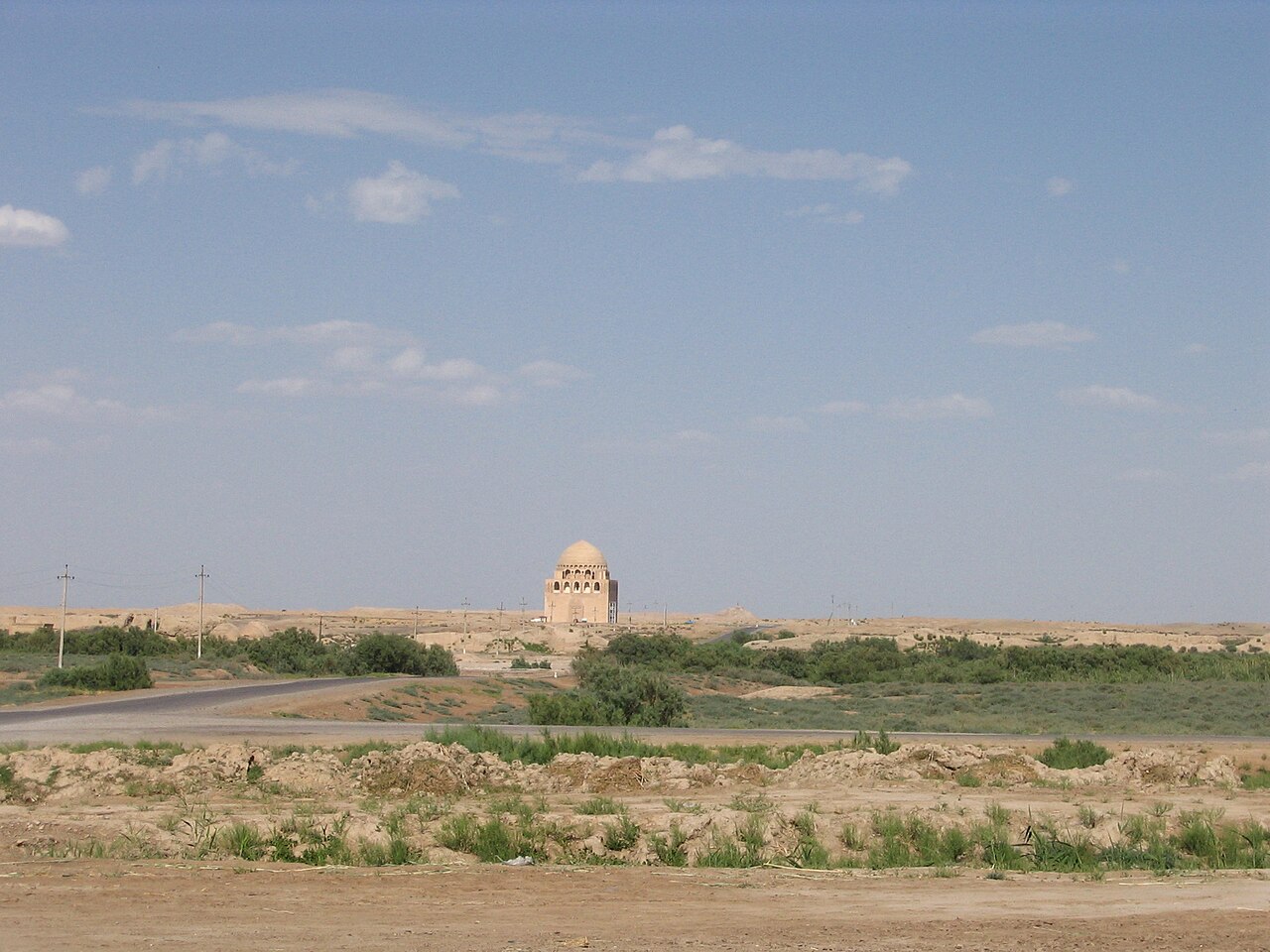
Merv never regained its place. The great walled city was largely abandoned, and the later settlement grew up elsewhere in the oasis; its ruins are now an archaeological park near Mary in Turkmenistan. Nishapur was rebuilt, but on a new site, and the medieval city, with its famous pottery workshops, became a field of mounds that archaeologists from the Metropolitan Museum of Art excavated in the 1930s and 1940s. The modern city is described on the page about Neyshabur, where the tombs of Attar and of Omar Khayyam stand. Herat recovered faster: under the local Kart dynasty and later the Timurids it became a capital again.
The longer damage was to the countryside. Irrigation works fell out of repair when the people who maintained them were killed or deported, and farmland reverted to pasture, which suited nomadic herders. More than a century later the Ilkhanid official Hamdallah Mustawfi, writing about the revenues of Iran, judged that the country had still not recovered from the invasion. Historians debate how much of the long-term decline was caused by 1221 and how much by later wars, but the destruction of Khorasan’s cities is generally seen as one of the deepest breaks in the history of eastern Iran.
The Mongols who came next behaved differently. Within a generation Mongol governors were restoring towns and collecting taxes rather than destroying them, as the page on Iran under the Great Khans explains.
Persian words from this page
| نیشابور | Neyshâbur | Nishapur |
| مرو | Marv | Merv |
| هرات | Herât | Herat |
| خراسان | Khorâsân | Khorasan |
| قنات | qanât | underground water channel |
| عطار | Attâr | Attar (the poet; literally “perfumer”) |
Sources and further reading
- Ata-Malik Juvayni, The History of the World-Conqueror, translated by J. A. Boyle (1958).
- Ibn al-Athir, al-Kamil fi’l-Ta’rikh, translated by D. S. Richards as The Chronicle of Ibn al-Athir for the Crusading Period, part 3 (2008).
- David Morgan, The Mongols (2nd edition, Blackwell, 2007).
- Peter Jackson, The Mongols and the Islamic World (Yale University Press, 2017).
- UNESCO World Heritage Centre, “State Historical and Cultural Park ‘Ancient Merv'” (whc.unesco.org/en/list/886).
Want to learn Persian? Get the free Starter Pack
Get the 14-page printable Starter Pack (all 32 letters, a 7-day reading plan, 100 core words and 20 survival phrases) and a short 5-email course. Free.
More in The Mongol Invasion and the Ilkhanate (1219–1357)
- Genghis Khan’s Invasion of Iran (1219–1221)
- The Destruction of Nishapur, Merv and Herat
- Iran under the Great Khans (1225–1256)
- Hulagu Khan, Founder of the Ilkhanate
- The Fall of Alamut (1256)
- The Mongol Sack of Baghdad (1258)
- The Battle of Ain Jalut and the Mamluk Wars
- Nasir al-Din Tusi and the Maragheh Observatory
- Abaqa and Arghun: The Ilkhanate, 1265–1291
- Ghazan Khan and the Conversion to Islam
- Öljaitü and the Dome of Soltaniyeh
- Abu Sa’id and the Collapse of the Ilkhanate
- Juvayni and the History of the World Conqueror
- Rashid al-Din and the Jami al-Tawarikh
- Rumi (Mowlana): A Life from Balkh to Konya
- Saadi of Shiraz
- Ilkhanid Art and the Great Mongol Shahnameh
- The Ilkhanate and Europe
- Tabriz under the Ilkhans
- The Black Death and Iran