Tabriz, in north-west Iran, was the main capital of the Mongol Ilkhanate from the reign of Abaqa (1265–1282) until the state collapsed in the 1330s. Under Ghazan Khan and his ministers it became one of the largest cities of western Asia, with a royal suburb, a scholars’ quarter and great mosques, and a market where goods from China, India, the Persian Gulf and the Black Sea changed hands with Italian merchants.

A city that survived the conquest
Tabriz was lucky in the 1220s and 1230s. While the cities of Khorasan were destroyed (see The Destruction of Nishapur, Merv and Herat), Tabriz bought peace by paying tribute to the Mongol armies that reached Azerbaijan. Its position was its fortune: it sat on rich farmland near the grasslands of Azerbaijan and Arran, which the Mongols needed for their horses, and on the trade road between Anatolia and Central Asia.
Hulagu made Maragheh, south of Lake Urmia, his first base, and built the observatory of Nasir al-Din Tusi there. His son Abaqa moved the capital to Tabriz. Like all Mongol rulers, the Ilkhans moved between summer and winter camps, so Tabriz was less a fixed residence than the centre of government, finance and trade.
Paper money in the bazaar
Tabriz saw one of the strangest experiments of the period. In 1294 the Ilkhan Gaykhatu, short of money, ordered the use of paper money on the Chinese model, called chao. Printed notes were issued in Tabriz and the use of coins was forbidden. Merchants closed their shops, the bazaar stopped, and within a few weeks the scheme was abandoned. Persian sources describe it as a disaster, and it is often cited as the first use of printed paper money outside China.
Ghazan’s Tabriz
Ghazan (r. 1295–1304) rebuilt the city as an Islamic imperial capital. He gave it a new and much longer wall that enclosed gardens and suburbs. To the west he founded a royal quarter called Shanb-e Ghazan, or Ghazaniyya, around his own domed tomb, with a mosque, two colleges, a hospital, an observatory, a library, a Sufi hospice and housing for the staff. Rashid al-Din, who describes it, says Ghazan designed parts of it himself. Almost nothing of it survives above ground.
East of the city, Ghazan’s vizier Rashid al-Din built the Rab’-e Rashidi, a self-contained quarter with a mosque, hospital, library and a workshop that copied and illustrated his books. Hundreds of people lived on its endowments. The city also had a Christian population, Armenian and Nestorian, and, by the 1300s, Catholic friars.
The Mosque of Ali Shah
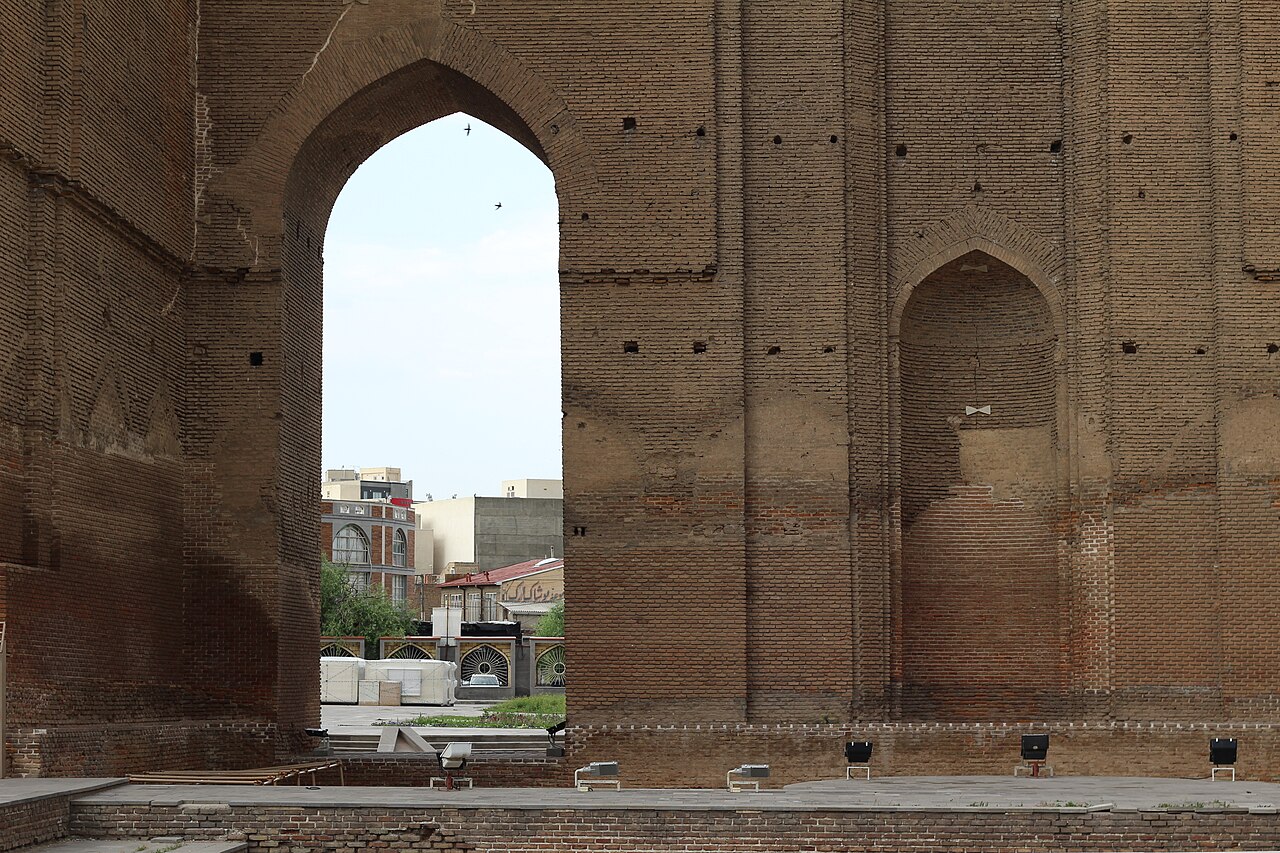
In the 1310s the vizier Taj al-Din Ali Shah, Rashid al-Din’s rival, began a congregational mosque meant to outdo everything before it. Its prayer hall was a single enormous vaulted iwan, intended to be larger than the Sasanian arch of Taq-e Kasra at Ctesiphon. The vault collapsed in the 14th century, apparently because it was built too quickly. The surviving walls, known as the Arg-e Alishah, ارگ علیشاه, are still the most striking Ilkhanid ruin in the city; in later centuries they were used as a fortress.
A market for the world
The Mongol peace, imperfect as it was, made Tabriz a hub of Eurasian trade. Caravans came from Central Asia and China, goods from India came up from the Persian Gulf port of Hormuz, and a road ran west to Trebizond on the Black Sea, where Genoese and Venetian ships waited. Silk from the Caspian provinces, cloth of gold, spices, pearls and precious stones all passed through.
Italian merchants settled in the city. A Venetian made his will in Tabriz in the 1260s, the Genoese had a community with its own officials, and Venice secured privileges from Abu Sa’id in 1320. Marco Polo’s book describes Tabriz as a city of merchants, where Latin traders came to buy goods brought from distant lands. The Moroccan traveller Ibn Battuta, who visited in 1327, was impressed by the jewellers’ market and the rich goods in the bazaar. These links are traced further on the page on the Ilkhanate and Europe.
Soltaniyeh and the shift of court
Öljaitü moved the court to his new city of Soltaniyeh after about 1305, but Tabriz remained the economic centre and the seat of many offices. When the Ilkhanate broke up after 1335, Tabriz was the prize for the warlords. The Chobanids ruled from it until Jani Beg of the Golden Horde captured the city in 1357; then came the Jalayirids, Timur in the 1380s, and the Turkmen dynasties (see The Chobanids and Jalayirids and the Qara Qoyunlu). In 1501 Tabriz became the first Safavid capital.
What remains
Earthquakes, wars and rebuilding have erased most of Ilkhanid Tabriz. The visible remains are the walls of the Arg-e Alishah and the excavated site of the Rab’-e Rashidi on a hill in the east of the city. The city’s great covered bazaar, a UNESCO World Heritage Site, stands on the site of the medieval market, though most of its present buildings are much later (see Tabriz Historic Bazaar). For the modern city, see the guide to Tabriz.
Persian words from this page
| تبریز | Tabriz | Tabriz |
| بازار | bâzâr | bazaar, market |
| ارگ | arg | citadel |
| ایوان | eyvân | iwan, vaulted hall |
| شنب غازان | Shanb-e Ghâzân | Ghazan’s royal quarter |
| کاروان | kârvân | caravan |
Sources and further reading
- Rashid al-Din, Jami’u’t-tawarikh: Compendium of Chronicles, trans. W. M. Thackston (1998–1999), on Ghazan’s buildings.
- Ibn Battuta, The Travels of Ibn Battuta, trans. H. A. R. Gibb, vol. 2 (Hakluyt Society).
- Marco Polo, The Description of the World, the chapter on Tabriz (“Tauris”).
- Judith Pfeiffer (ed.), Politics, Patronage and the Transmission of Knowledge in 13th–15th Century Tabriz (2014).
- Linda Komaroff and Stefano Carboni (eds.), The Legacy of Genghis Khan (2002).
- UNESCO World Heritage Centre, Tabriz Historic Bazaar Complex.
Want to learn Persian? Get the free Starter Pack
Get the 14-page printable Starter Pack (all 32 letters, a 7-day reading plan, 100 core words and 20 survival phrases) and a short 5-email course. Free.
More in The Mongol Invasion and the Ilkhanate (1219–1357)
- Genghis Khan’s Invasion of Iran (1219–1221)
- The Destruction of Nishapur, Merv and Herat
- Iran under the Great Khans (1225–1256)
- Hulagu Khan, Founder of the Ilkhanate
- The Fall of Alamut (1256)
- The Mongol Sack of Baghdad (1258)
- The Battle of Ain Jalut and the Mamluk Wars
- Nasir al-Din Tusi and the Maragheh Observatory
- Abaqa and Arghun: The Ilkhanate, 1265–1291
- Ghazan Khan and the Conversion to Islam
- Öljaitü and the Dome of Soltaniyeh
- Abu Sa’id and the Collapse of the Ilkhanate
- Juvayni and the History of the World Conqueror
- Rashid al-Din and the Jami al-Tawarikh
- Rumi (Mowlana): A Life from Balkh to Konya
- Saadi of Shiraz
- Ilkhanid Art and the Great Mongol Shahnameh
- The Ilkhanate and Europe
- Tabriz under the Ilkhans
- The Black Death and Iran