For about thirty years after Genghis Khan’s campaign, from the mid-1220s to the arrival of Hulagu in 1256, Iran had no Mongol ruler of its own. It was governed from Mongolia by the Great Khans Ögedei, Güyük and Möngke through two parallel systems: a military commander with his army in the north-west, first Chormaqan and then Baiju, and civilian governors in Khorasan who counted people and collected taxes. This period turned a conquest into a working administration and prepared the ground for the Ilkhanate.
| Period | c. 1225 to 1256 |
|---|---|
| Great Khans | Ögedei (1229–1241), regency of Töregene (1241–1246), Güyük (1246–1248), regency of Oghul Qaimish, Möngke (1251–1259) |
| Military commanders in the west | Chormaqan (from 1230), Baiju (from the early 1240s) |
| Civil governors in Khorasan | Chin Temür, Nosal, Körgüz, Arghun Aqa |
| Main source | Juvayni, whose father served this administration |
The gap after 1221
When Genghis Khan went home he left Iran wrecked but not occupied. Mongol garrisons held parts of Khorasan, and officials called darughachi (in Persian, shahna) were left in some towns to watch over local rulers. Western and central Iran were barely touched by the Mongols in these years. Into the gap came Jalal al-Din Mingburnu, the son of the last Khwarazmshah, who returned from India in about 1224 and built a short-lived power base in western Iran and Azerbaijan. He fought Georgians, Seljuks of Rum and the caliph’s forces more often than the Mongols, and made few friends (his career is told on the page on Jalal al-Din Mingburnu).
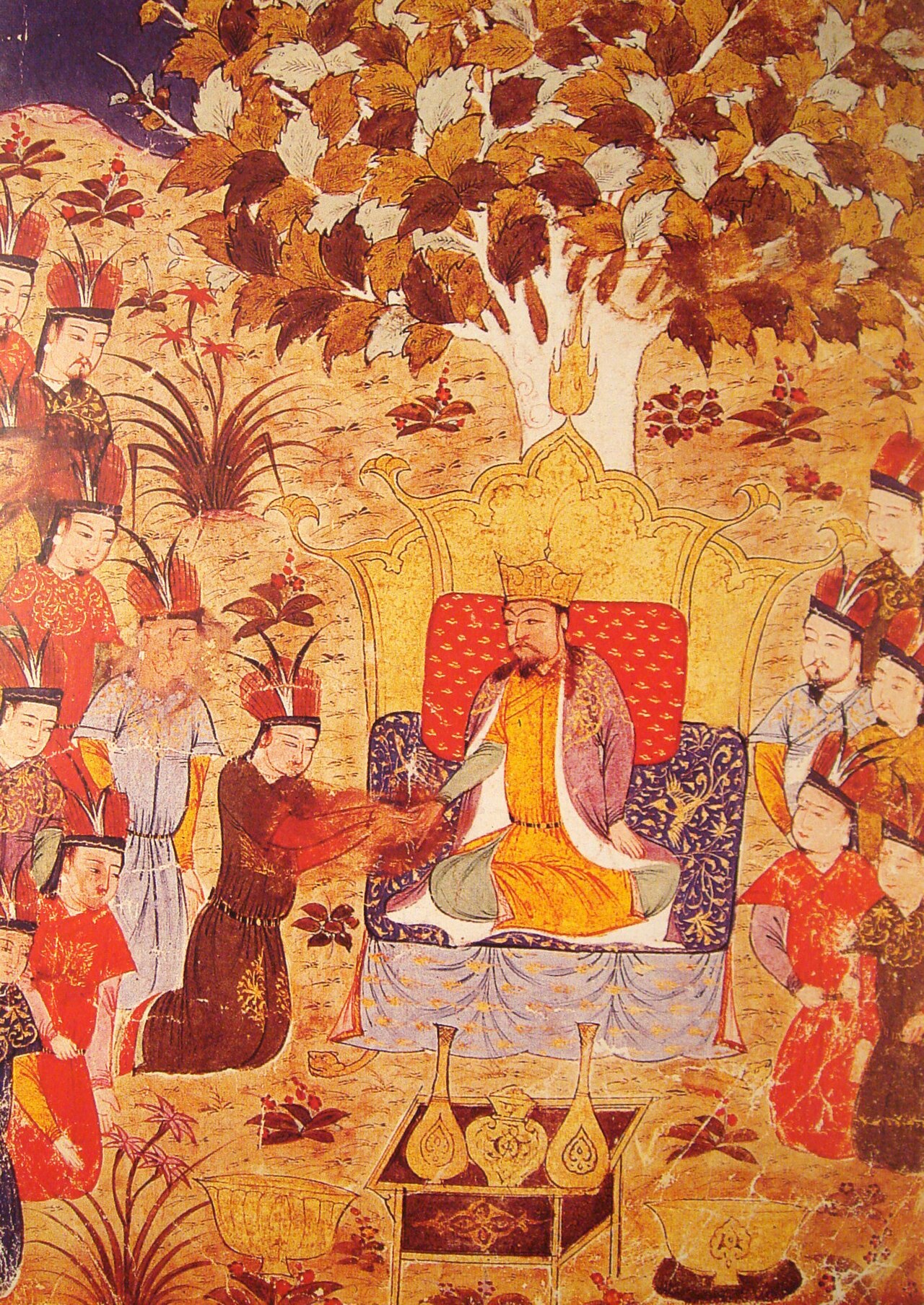

Chormaqan’s army, 1230
Ögedei, elected Great Khan in 1229, decided to finish the work. In 1230 he sent the commander Chormaqan west with an army usually estimated at about 30,000 men. Jalal al-Din’s forces scattered, and in 1231 he was killed, by most accounts by a Kurdish villager in the mountains of eastern Anatolia who did not know who he was. With him ended the last Khwarazmian resistance.
Chormaqan did not settle in a city. He made his base on the grasslands of Mughan and Arran, in what is now the Republic of Azerbaijan and Iranian Azerbaijan, where the horses of a nomadic army could graze through the winter. From there his troops forced the submission of Georgia and Greater Armenia during the 1230s and raided into northern Iraq. Towns that submitted quickly, such as Tabriz, were spared in exchange for tribute; Isfahan, which resisted, held out for years before it fell in the later 1230s.
In the early 1240s Chormaqan became unable to command, reportedly through illness, and Baiju replaced him. In 1243 Baiju defeated the Seljuk sultan of Rum at Köse Dağ in Anatolia, making the Seljuks Mongol vassals.
Governors, census and taxes in Khorasan
In the east a different kind of Mongol rule took shape. Ögedei placed Khorasan and Mazandaran under civilian governors who answered to the court in Mongolia. The first, Chin Temür, was a Qara Khitai officer; he was followed briefly by Nosal and then by Körgüz, an Uighur who had risen as a scribe. Juvayni portrays Körgüz as an energetic administrator who checked the abuses of local Mongol commanders, revived farming and began rebuilding in Khorasan, until he fell foul of court politics and was executed in the early 1240s.
His successor Arghun Aqa, a Mongol of the Oirat people, held the post from 1243 for over thirty years, first for the Great Khans and later for Hulagu and Abaqa. He supervised census-taking and tax registers across Iran in the 1250s on Möngke’s orders. The main taxes were the qubchur, a levy on herds that the Mongols extended to settled people as a poll tax, and the tamgha, a tax on trade. There were also heavy demands for supplies for the postal relay system (yam) and for travelling officials.
Juvayni knew this world from the inside. His father, Baha al-Din Juvayni, was the chief financial officer (sahib-divan) under Körgüz and Arghun Aqa, and Juvayni himself went with Arghun Aqa to the court at Karakorum, where he began writing his history. Persian administrators of this kind, from old bureaucratic families, became indispensable to Mongol rule (see Juvayni and the History of the World Conqueror).
Rivalry at the centre
Iran’s government in these years was shaped by politics in Mongolia. Each Great Khan, regent and princely house sent its own agents and issued its own grants of income, and many officials served several masters. Merchants and tax farmers bought the right to collect revenues and squeezed what they could. The result, in the picture given by Juvayni and later by Rashid al-Din, was overlapping demands and arbitrary levies, though both writers had reasons to praise the order that came after.
The turning point came with the election of Möngke in 1251. His branch of the family, the house of Tolui, took power after a bitter struggle with the descendants of Ögedei and Chagatai. Möngke ordered new censuses, tried to limit the private grants issued by princes, and decided on two great campaigns: his brother Kublai would complete the conquest of China, and his brother Hulagu would bring the lands west of the Amu Darya fully under Mongol control. That decision is the subject of the next page, on Hulagu Khan.
Why these decades matter
Historians once treated the years 1225 to 1256 as an empty interval. Recent work stresses that they decided much of what followed. The Mongols learned to govern settled Iranians through Iranian secretaries. Azerbaijan, with its pastures and its trade routes, became the military heart of Mongol Iran, which is why the later Ilkhanid capitals were Maragheh and Tabriz. And some regional dynasties, such as the Salghurids of Fars and the Qutlugh-Khanids of Kerman, survived by submitting early and paying tribute.
Persian words from this page
| شحنه | shahne | military governor, police chief |
| صاحب دیوان | sâheb-divân | head of the finance office |
| مالیات | mâliyât | taxes |
| آذربایجان | Âzarbâyjân | Azerbaijan |
| جوینی | Joveyni | Juvayni |
Sources and further reading
- Ata-Malik Juvayni, The History of the World-Conqueror, translated by J. A. Boyle (1958), especially the chapters on Chin Temür, Körgüz and Arghun Aqa.
- J. A. Boyle, “Dynastic and Political History of the Il-Khans”, in The Cambridge History of Iran, vol. 5 (1968).
- Thomas T. Allsen, Mongol Imperialism: The Policies of the Grand Qan Möngke in China, Russia and the Islamic Lands, 1251–1259 (University of California Press, 1987).
- Timothy May, “Chormaqan Noyan: The First Mongol Military Governor in the Middle East” (MA thesis, Indiana University, 1996).
- Peter Jackson, The Mongols and the Islamic World (Yale University Press, 2017).
Want to learn Persian? Get the free Starter Pack
Get the 14-page printable Starter Pack (all 32 letters, a 7-day reading plan, 100 core words and 20 survival phrases) and a short 5-email course. Free.
More in The Mongol Invasion and the Ilkhanate (1219–1357)
- Genghis Khan’s Invasion of Iran (1219–1221)
- The Destruction of Nishapur, Merv and Herat
- Iran under the Great Khans (1225–1256)
- Hulagu Khan, Founder of the Ilkhanate
- The Fall of Alamut (1256)
- The Mongol Sack of Baghdad (1258)
- The Battle of Ain Jalut and the Mamluk Wars
- Nasir al-Din Tusi and the Maragheh Observatory
- Abaqa and Arghun: The Ilkhanate, 1265–1291
- Ghazan Khan and the Conversion to Islam
- Öljaitü and the Dome of Soltaniyeh
- Abu Sa’id and the Collapse of the Ilkhanate
- Juvayni and the History of the World Conqueror
- Rashid al-Din and the Jami al-Tawarikh
- Rumi (Mowlana): A Life from Balkh to Konya
- Saadi of Shiraz
- Ilkhanid Art and the Great Mongol Shahnameh
- The Ilkhanate and Europe
- Tabriz under the Ilkhans
- The Black Death and Iran