Saadi of Shiraz (c. 1210–1291 or 1292), سعدی, is one of the greatest Persian poets and the master of Persian prose. After studying in Baghdad and travelling for many years, he returned to Shiraz and in 1257–1258 wrote the Bustan (“The Orchard”) and the Golestan (“The Rose Garden”), books of moral stories that Iranians have learned at school ever since. His life spans the whole Mongol conquest, and his home province of Fars survived it by paying tribute.

| Name | Abu Muhammad Mosleh al-Din, pen name Saadi |
|---|---|
| Born | c. 1210, Shiraz (older dates such as 1184 are now rejected by most scholars) |
| Died | 1291 or 1292 (690 or 691 AH), Shiraz |
| Patrons | Salghurid atabegs of Fars; later the Juvayni brothers |
| Main works | Bustan (1257), Golestan (1258), ghazals and qasidas |
Shiraz, Baghdad and the road
Saadi’s dates and early life are known mainly from hints in his own writing, which makes them uncertain. Most scholars now place his birth around 1209–1210 in Shiraz, the capital of Fars, then ruled by the Salghurids, a Turkmen dynasty of atabegs. His father died when he was young. He went to Baghdad to study at the Nizamiyya college, the most famous school of the Sunni world, and in the Bustan he names the Sufi master Shihab al-Din Suhrawardi as a teacher.
Then came years of travel, perhaps three decades, through Iraq, Syria and the Hijaz. Saadi tells many stories about this time: that he was captured by Crusaders and forced to dig trenches at Tripoli until a man of Aleppo ransomed him and married him to his bad-tempered daughter; that he met a boy studying Arabic grammar in Kashgar; that he unmasked the priests of an idol temple at Somnath in India. Modern scholars treat many of these as literary stories told in the first person, not as autobiography. They are written to teach, and Saadi, like many classical writers, was happy to be the hero of his own examples.
Fars and the Mongols
Saadi’s absence coincided with the worst of the Mongol conquest. Fars escaped it. The Salghurid atabeg Abu Bakr ibn Sa’d (r. 1226–1260) submitted early to the Great Khan, paid tribute and later sent troops to help Hulagu. Shiraz remained one of the few great Iranian cities untouched by Mongol armies, and it became a refuge for scholars and poets. Saadi came home around 1256 to a city at peace but dependent on Mongol goodwill. His pen name comes from the Salghurid house, from Sa’d ibn Zangi or from Abu Bakr’s son Sa’d, to whom the Golestan is dedicated. The dynasty is described on the page on the Seljuk decline and the atabegs.
The Orchard and the Rose Garden
Within two years Saadi wrote the two books that made his name.
The Bustan (بوستان), finished in 1257, is a poem of about 4,000 couplets in ten chapters on justice, generosity, love, humility, contentment and other virtues, each taught through short stories. This site has stories from the Bustan in Persian with English translation.
The Golestan (گلستان), finished in 1258, is in rhymed prose mixed with verse, in eight chapters: on the conduct of kings, the morals of dervishes, contentment, silence, love and youth, old age, education, and the manners of conversation. Its sentences are short, balanced and easy to remember, and many have become proverbs. For centuries it was the first book of Persian prose that children in Iran, Central Asia and India read, and it was one of the first Persian books translated into European languages.
The Golestan was completed in the same year that the Mongols sacked Baghdad. Saadi, who had studied there, wrote elegies on the fall of the city and the killing of the last Abbasid caliph, in both Persian and Arabic (see The Mongol sack of Baghdad).
The most famous lines
A story in the first chapter of the Golestan, set at the tomb of the prophet Yahya in the great mosque of Damascus, contains the verses now known simply as “Bani Adam”:
بنی آدم اعضای یکدیگرند
که در آفرینش ز یک گوهرندBani âdam a’zâ-ye yekdigarand / ke dar âfarinesh ze yek gowharand
“The children of Adam are limbs of one another, for in creation they are of one essence.”
Many people know the first line in the form اعضای یک پیکرند, “limbs of one body”. Critical editions based on old manuscripts read yekdigarand, “of one another”. This site’s guide to Saadi quotes gives the whole poem and other famous lines with their sources.
Saadi under the Ilkhans
Saadi lived his last three decades in Ilkhanid Fars. After 1260 the Salghurid line weakened; the last ruler, Abish Khatun, married a son of Hulagu, and Fars came under direct Mongol administration. Saadi addressed poems of praise and advice to the great Persian ministers of the Ilkhans, especially the brothers Shams al-Din and Ata-Malik Juvayni, the second of whom was the historian of the conquest (see Juvayni’s History of the World Conqueror). His qasidas to rulers mix praise with frank warnings about justice, a tone that suited an old and famous poet.
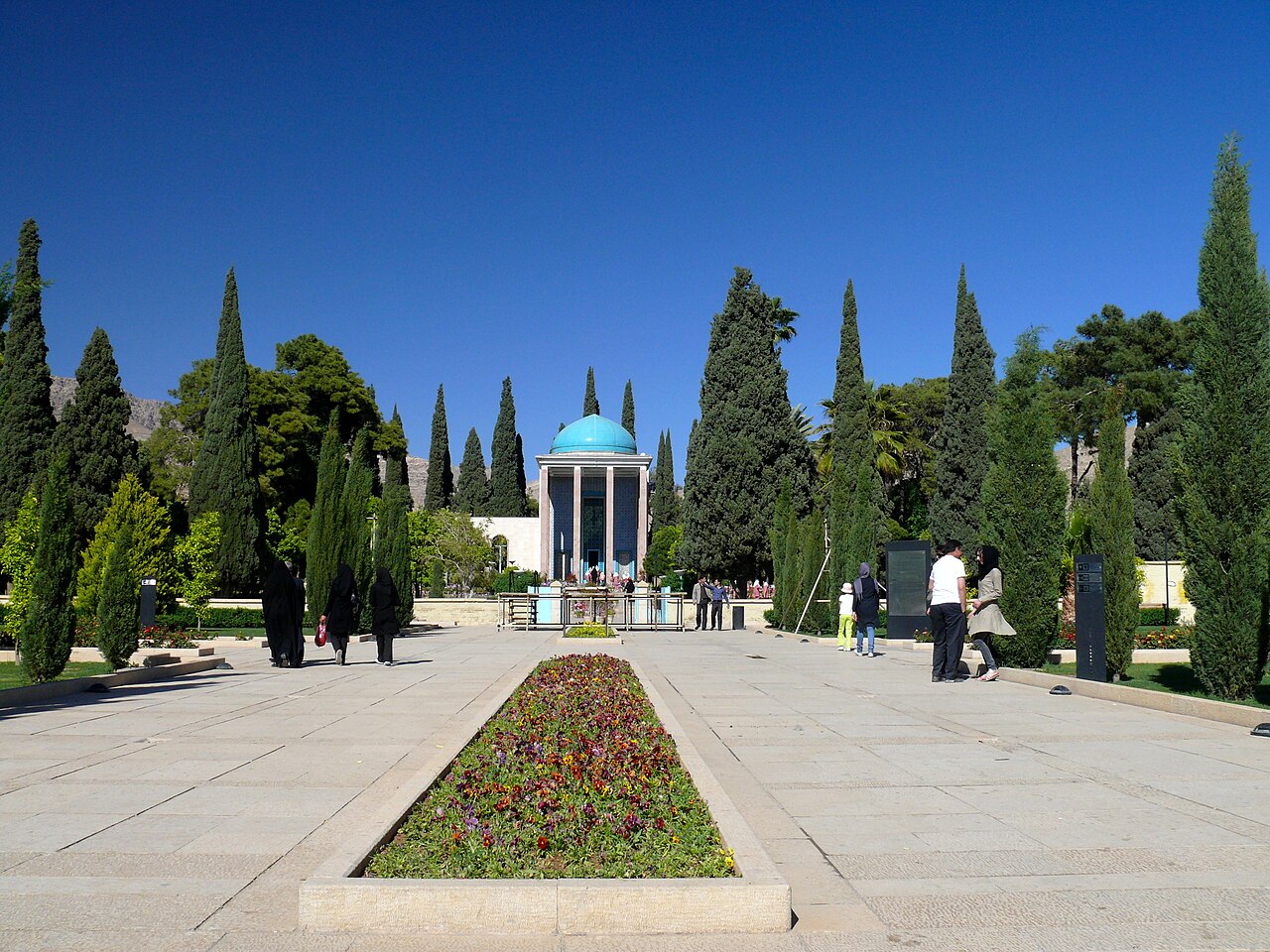
His ghazals, the love poems in which mystical and human love blend, set the model that Hafez of Shiraz would follow a century later. Saadi died in Shiraz around 1291–1292 and was buried at the edge of the city, where his tomb, the Saadieh, now stands in a garden.
Legacy
A fellow citizen of Shiraz, Ali ibn Ahmad Bisotun, collected Saadi’s works into the Kulliyat in the 1320s and 1330s, and this arrangement is still used. Saadi’s Persian is so clear that a modern reader can follow it with little help, which is one reason he is often the first classical poet that learners read. His contemporary Rumi wrote in exile in Anatolia; Saadi wrote at home, a moralist with a sharp eye for human behaviour.
For visiting his tomb, see Saadi’s Tomb in Shiraz: Persian for visitors, the Tomb of Saadi and the guide to Shiraz.
Persian words from this page
| سعدی | Sa’di | Saadi |
| گلستان | Golestân | rose garden |
| بوستان | Bustân | orchard, garden |
| شیراز | Shirâz | Shiraz |
| بنی آدم | bani âdam | children of Adam, humankind |
| گوهر | gowhar | essence, jewel |
| آفرینش | âfarinesh | creation |
Sources and further reading
- Saadi, The Gulistan (Rose Garden) of Sa’di, bilingual English and Persian edition, trans. Wheeler M. Thackston (2008).
- Saadi, The Bustan of Sadi, trans. G. M. Wickens as Morals Pointed and Tales Adorned (1974).
- Gholam-Hosein Yusofi (ed.), Golestan-e Sa’di and Bustan-e Sa’di, Persian critical editions.
- “Golestān-e Saʿdi” and “Bustān”, Encyclopaedia Iranica.
- Homa Katouzian, Sa’di: The Poet of Life, Love and Compassion (2006).
Love Persian poetry? Learn to read it: free Starter Pack
Get the 14-page printable Starter Pack (all 32 letters, a 7-day reading plan, 100 core words and 20 survival phrases) and a short 5-email course. Free.
More in The Mongol Invasion and the Ilkhanate (1219–1357)
- Genghis Khan’s Invasion of Iran (1219–1221)
- The Destruction of Nishapur, Merv and Herat
- Iran under the Great Khans (1225–1256)
- Hulagu Khan, Founder of the Ilkhanate
- The Fall of Alamut (1256)
- The Mongol Sack of Baghdad (1258)
- The Battle of Ain Jalut and the Mamluk Wars
- Nasir al-Din Tusi and the Maragheh Observatory
- Abaqa and Arghun: The Ilkhanate, 1265–1291
- Ghazan Khan and the Conversion to Islam
- Öljaitü and the Dome of Soltaniyeh
- Abu Sa’id and the Collapse of the Ilkhanate
- Juvayni and the History of the World Conqueror
- Rashid al-Din and the Jami al-Tawarikh
- Rumi (Mowlana): A Life from Balkh to Konya
- Saadi of Shiraz
- Ilkhanid Art and the Great Mongol Shahnameh
- The Ilkhanate and Europe
- Tabriz under the Ilkhans
- The Black Death and Iran