Ilkhanid art is the art of Iran under Mongol rule, roughly 1256 to 1353. Contact with China across a single empire brought new motifs and ways of painting landscape, and the Ilkhans and their Persian ministers paid for illustrated books on a scale not seen before. The period produced the first great Persian manuscript paintings, above all the Great Mongol Shahnameh of the 1330s, and some of the finest tilework and architecture in Iran.
Why the Mongol period mattered for art
Very little Persian book painting survives from before the Mongols. The conquest itself destroyed workshops and libraries, but the empire that followed linked Iran to China under one ruling family. Artisans, merchants, scrolls, silks and porcelain moved along the routes between Tabriz and Khanbaliq (Beijing). The Ilkhans were patrons with Mongol tastes, and their viziers, such as Rashid al-Din, ran workshops that combined Persian, Chinese, Byzantine and Arab traditions.
Chinese motifs in Persian art
The Chinese influence is easy to see. Painters began to show landscapes with twisted trees, layered rocks and ribbon-like clouds, taken from Chinese scroll painting. The lotus and peony entered Persian ornament. The Chinese dragon and the phoenix appear on tiles and textiles; the phoenix was easily read as the Simorgh, the magical bird of Persian legend. These motifs stayed in the Persian repertoire long after the Mongols had gone, and they are still visible in Safavid painting and in carpets.
The first great painted books
Early Ilkhanid manuscripts
One of the earliest dated works is a Persian bestiary, the Manafi’-i Hayawan (“Benefits of Animals”), made at Maragheh around 1297–1300 for Ghazan and now in the Morgan Library in New York. Its animals sit in landscapes that already show Chinese features. Around 1300 a group of small illustrated copies of the Shahnameh was made, possibly for officials, showing new demand for the national epic among Persian readers under Mongol rule.
The Jami al-Tawarikh
Rashid al-Din’s workshop in Tabriz produced illustrated copies of his world history. The oldest surviving one, an Arabic copy dated 1314–1315, is divided between Edinburgh University Library and the Khalili Collection. Its wide, strip-like paintings show Mongol rulers enthroned, battles, the Buddha, Chinese emperors and scenes from the life of the Prophet. The drawing is often in ink with light washes, a technique learned from Chinese scrolls.

The Great Mongol Shahnameh
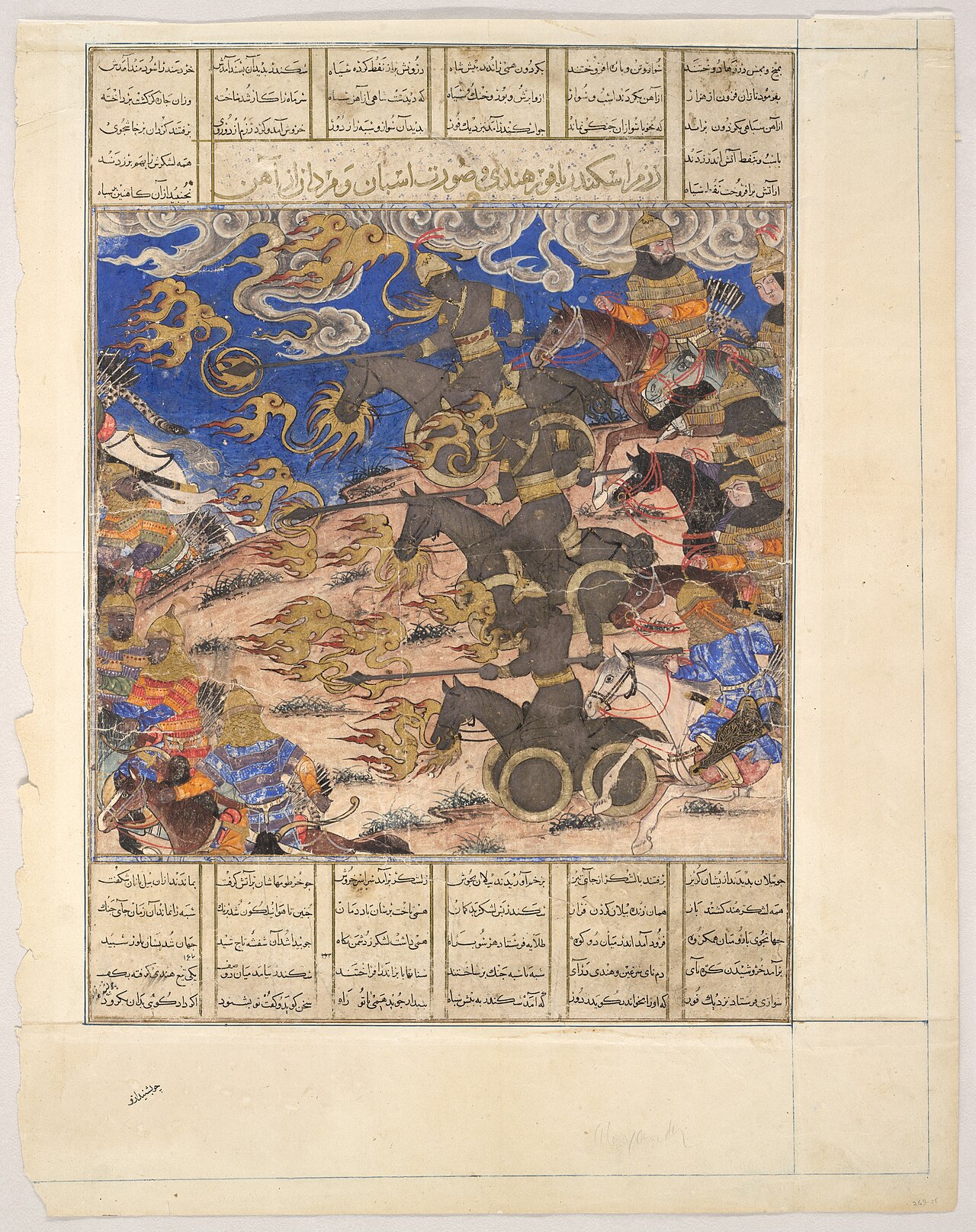
The masterpiece of Ilkhanid painting is a huge copy of Ferdowsi’s Shahnameh known as the Great Mongol Shahnameh, the Great Ilkhanid Shahnameh, or the Demotte Shahnameh. It was probably made in Tabriz in the 1330s, perhaps for the vizier Ghiyath al-Din Muhammad, son of Rashid al-Din, during the reign of Abu Sa’id. The patron is not recorded, so this is an informed guess.
The pages are large, about 41 by 29 cm without margins. The paintings are dramatic: crowds of mourners tearing their hair around the bier of Alexander, heroes fighting dragons and wolves, kings enthroned among courtiers in Mongol dress. Many historians see in them a new emotional power in Persian art. Some scholars have suggested that the choice of scenes, kings who lose their thrones and heroes who die young, reflects the troubled politics of the last years of the Ilkhanate.
The book stayed in Iran until the early 20th century. The Paris dealer Georges Demotte then took it apart, separated paintings from their text, and in some cases altered pages to sell them one by one. Today 57 pages survive in museums and private collections around the world, including the Freer Gallery in Washington, the Metropolitan Museum and the Harvard Art Museums. The full original order has had to be reconstructed by scholars.
Tiles and pottery
Kashan, south of Tehran, was the great centre of ceramics. Its potters made lustre tiles, with a metallic golden sheen, for shrines and palaces: star-shaped and cross-shaped wall tiles, frieze tiles with Qur’anic and Persian inscriptions, and large mihrabs signed by potter families. A treatise on making ceramics written in 1301 by Abu’l-Qasim Kashani, a member of one of these families, is a rare technical source. Potters also made lajvardina, a deep cobalt-blue ware with gold and red overglaze.
At Takht-e Soleyman in Azerbaijan, the Ilkhan Abaqa built a summer palace on the site of the Sasanian fire temple in the 1270s. Its tiles mix Chinese dragons and phoenixes with lines from the Shahnameh, the clearest single example of Ilkhanid taste: Mongol patrons, Chinese motifs, Persian poetry.
Architecture
The Ilkhans and their ministers built on a grand scale. The surviving monuments include the Dome of Soltaniyeh (see Öljaitü and the Dome of Soltaniyeh), the remains of the Mosque of Ali Shah in Tabriz, Öljaitü’s carved stucco mihrab of 1310 in the Jameh Mosque of Isfahan, the Friday mosque of Varamin and the shrine complex at Natanz. Their features, tall portals, high domes, and dense tile and stucco decoration, led directly to Timurid architecture.
Calligraphy, textiles and the wider world
The calligrapher Yaqut al-Musta’simi, who survived the sack of Baghdad, trained pupils whose styles dominated Qur’an copying for centuries, and Öljaitü sponsored Qur’ans of enormous size. Ilkhanid silks woven with gold reached Europe, where Italians called them “Tartar cloths”, and appear in Italian paintings. The best modern introduction to the whole field is the 2002 exhibition catalogue The Legacy of Genghis Khan. For the later tradition of Persian miniature painting, see Kamal al-Din Behzad and the page on Iranian handicrafts.
Persian words from this page
| نگارگری | negârgari | miniature painting |
| شاهنامه | Shâhnâmeh | Book of Kings |
| کاشی | kâshi | tile |
| زرینفام | zarrin-fâm | lustre (golden-coloured) |
| سیمرغ | Simorgh | Simorgh, the mythical bird |
| اژدها | ezhdehâ | dragon |
| کاشان | Kâshân | Kashan |
Sources and further reading
- Linda Komaroff and Stefano Carboni (eds.), The Legacy of Genghis Khan: Courtly Art and Culture in Western Asia, 1256–1353 (Metropolitan Museum of Art, 2002).
- Oleg Grabar and Sheila Blair, Epic Images and Contemporary History: The Illustrations of the Great Mongol Shahnama (1980).
- Sheila S. Blair, A Compendium of Chronicles: Rashid al-Din’s Illustrated History of the World (1995).
- “Demotte Šāh-nāma”, Encyclopaedia Iranica.
- Sheila S. Blair and Jonathan M. Bloom, The Art and Architecture of Islam, 1250–1800 (1994).
Want to learn Persian? Get the free Starter Pack
Get the 14-page printable Starter Pack (all 32 letters, a 7-day reading plan, 100 core words and 20 survival phrases) and a short 5-email course. Free.
More in The Mongol Invasion and the Ilkhanate (1219–1357)
- Genghis Khan’s Invasion of Iran (1219–1221)
- The Destruction of Nishapur, Merv and Herat
- Iran under the Great Khans (1225–1256)
- Hulagu Khan, Founder of the Ilkhanate
- The Fall of Alamut (1256)
- The Mongol Sack of Baghdad (1258)
- The Battle of Ain Jalut and the Mamluk Wars
- Nasir al-Din Tusi and the Maragheh Observatory
- Abaqa and Arghun: The Ilkhanate, 1265–1291
- Ghazan Khan and the Conversion to Islam
- Öljaitü and the Dome of Soltaniyeh
- Abu Sa’id and the Collapse of the Ilkhanate
- Juvayni and the History of the World Conqueror
- Rashid al-Din and the Jami al-Tawarikh
- Rumi (Mowlana): A Life from Balkh to Konya
- Saadi of Shiraz
- Ilkhanid Art and the Great Mongol Shahnameh
- The Ilkhanate and Europe
- Tabriz under the Ilkhans
- The Black Death and Iran