In November and December 1256 the Nizari Ismaili imam Rukn al-Din Khurshah surrendered to Hulagu Khan, and the castle of Alamut in the Alborz mountains north of Qazvin opened its gates to the Mongols. The surrender ended the Nizari state, a network of mountain fortresses in Iran and Syria that had kept its independence for over 160 years. The Nizari community itself survived and continues today as a worldwide Shi’i Muslim community.
| Date | Surrender of Khurshah at Maymun-Diz, November 1256; surrender of Alamut, December 1256 |
|---|---|
| Place | Alamut valley and Rudbar, Qazvin province, Iran |
| Nizari imam | Rukn al-Din Khurshah (imam 1255–1256, killed 1257) |
| Mongol commander | Hulagu Khan |
| Last castle to fall | Girdkuh, near Damghan, in 1270 |
| Persian name | قلعه الموت (Qal’e-ye Alamut) |
| Heritage status | UNESCO World Heritage, inscribed July 2026 as Alamut Castle and Related Fortifications |
A state made of castles
The Nizari state began in 1090, when the missionary Hasan-i Sabbah took Alamut, and grew into a chain of fortresses in Rudbar, in Quhistan in eastern Iran, around Girdkuh, and later in the mountains of Syria. Its founding and organisation are covered on the page about Hasan-i Sabbah and the fortress of Alamut. For a century and a half the Nizaris resisted the Seljuks and their successors from these strongholds, governing the villages and towns around them and keeping libraries and scholars in the castles.
By the 1250s the Mongols had reasons to make the Nizaris their first target in the west. The Franciscan traveller William of Rubruck, who visited Möngke’s court in 1254, heard a story that Nizari agents had been sent to kill the Great Khan. Whether true or not, such reports circulated, and the castles controlled the roads across northern Iran that an army marching on Baghdad would use.

Negotiation and surrender
The Nizari imam Ala al-Din Muhammad was murdered in December 1255, and his young son Rukn al-Din Khurshah succeeded him while the Mongol army was already approaching. Khurshah tried to negotiate. He sent envoys, ordered some castles to be dismantled as a sign of goodwill, and sent his brother to Hulagu, but he would not come down in person. Hulagu lost patience in the autumn of 1256 and closed in on Maymun-Diz, the fortress where Khurshah was staying, with several armies at once.
The season was late and the Mongols risked being caught by winter in the mountains. Hulagu’s Chinese engineers set up siege machines that could reach the walls from long range. After a few days of bombardment Khurshah came out and surrendered, in about the third week of November 1256. Among the scholars with him was the astronomer Nasir al-Din Tusi, who now entered Hulagu’s service; sources disagree on whether he urged the surrender.
Khurshah then sent orders to the other castles to give themselves up. Most did. Alamut’s commander hesitated, then surrendered in December 1256. Lamasar held out for about another year, and Girdkuh, near Damghan east of Tehran, resisted for fourteen years before its garrison finally gave in in December 1270.
Juvayni in the library of Alamut
The historian Ata-Malik Juvayni, travelling with Hulagu, asked to see Alamut’s famous library. In his own account he picked out copies of the Qur’an, astronomical instruments and works he considered valuable, and burned the books he judged heretical, that is, the Nizaris’ own religious writings. He also used Nizari chronicles from the library, including a biography of Hasan-i Sabbah, and summarised them in his history. Much of what is known about Nizari history in Iran reaches us through this hostile reader.
Khurshah was treated well at first; he even married a Mongol woman. He then asked to be sent to Möngke in Mongolia. Möngke refused to receive him, and Khurshah was killed on the way back in 1257. Mongol orders followed to kill Nizaris held in custody, and Juvayni reports massacres in Quhistan. Juvayni presents all this as a deliverance. Modern historians, notably Farhad Daftary, stress that his narrative was written for the conquerors and must be read against what the Nizaris themselves wrote.
The “Assassins”: myth and history
The Nizaris are often still called the “Assassins”, and the fall of Alamut is retold with legends about them. Most of these stories came from their enemies or from Europeans who never met them. Opponents in Syria called them hashishi, a term of abuse for low, disreputable people, and European crusaders turned it into “assassin”. Marco Polo, who passed through Iran in the 1270s, nearly twenty years after Alamut fell, told of a secret garden of paradise where an “Old Man of the Mountain” drugged young men to make them obedient killers. There is no evidence for this garden or for the use of hashish, and historians treat the tale as legend.
What is historical is that the Nizari state did carry out political killings of some of its enemies, a tactic used by a small and outnumbered power at a time when rulers of every faith also had rivals murdered. The growth of the legend is told on the page on the Nizari Ismailis and the “Assassins” legend.
After 1256: survival of the community
The end of the castles was not the end of the Nizaris. According to Nizari tradition, Khurshah’s young son Shams al-Din Muhammad was hidden and the line of imams continued. For two centuries the community lived discreetly, often in the outward form of Sufi orders, in Iran, Central Asia and South Asia. In the 15th century the imams re-emerged at Anjudan in central Iran, and in the 19th century the Qajar shah Fath-Ali Shah gave the imam of the time the title Aga Khan, by which the imams are still known. Nizari Ismailis today live in Afghanistan, Tajikistan, Pakistan, India, Syria, East Africa, Europe and North America, among other places.
Alamut today
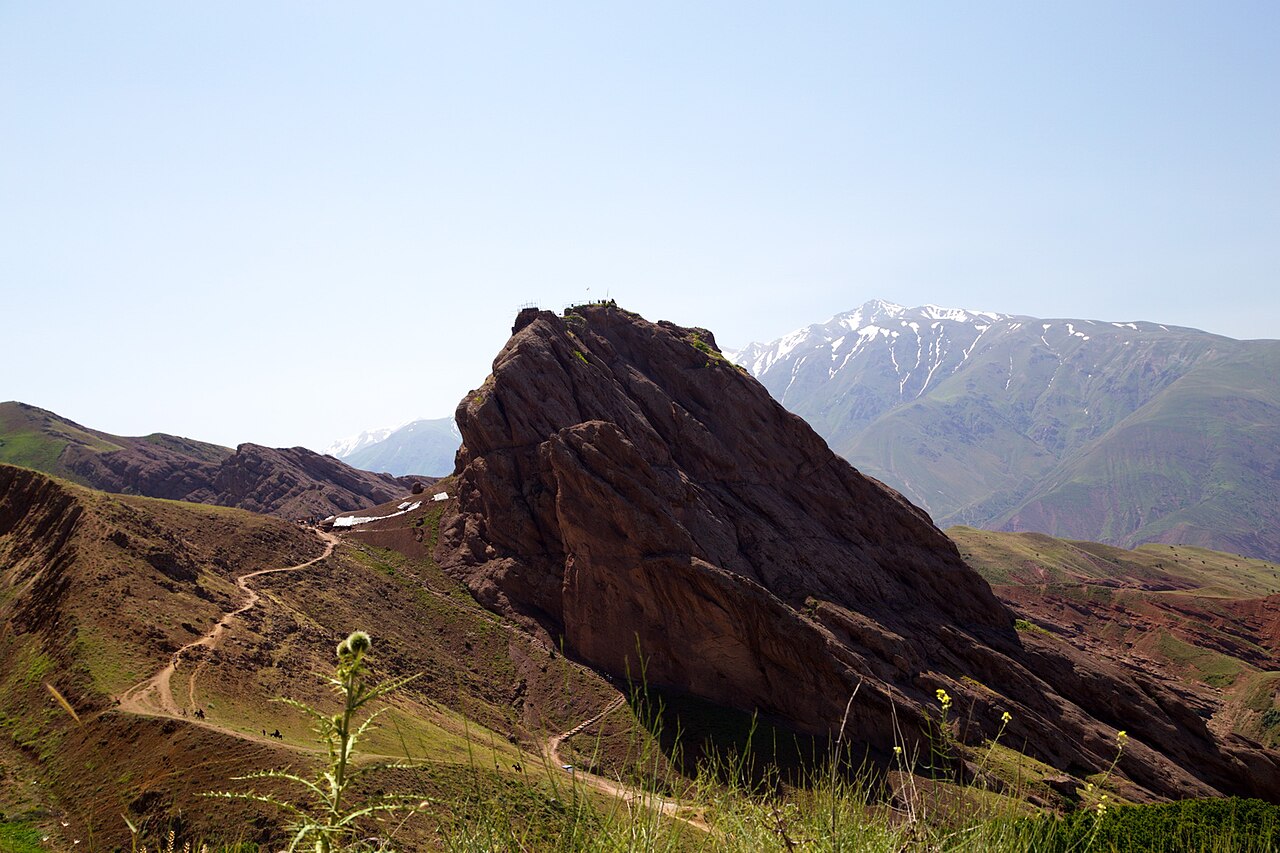
The castle stands on a rock above the village of Gazor Khan in the Alamut valley, reached by road from Qazvin. Excavation and restoration have been carried out in recent decades. In July 2026 UNESCO inscribed Alamut Castle and Related Fortifications on the World Heritage List. Practical information for a visit is on the page on Alamut Castle, and the nearest city is described on the page on Qazvin.
Persian words from this page
| الموت | Alamut | Alamut |
| قلعه | qal’e | castle, fortress |
| اسماعیلیه | Esmâ’iliye | the Ismailis |
| نزاری | Nezâri | Nizari |
| امام | emâm | imam |
| قزوین | Qazvin | Qazvin |
| کتابخانه | ketâbkhâne | library |
Sources and further reading
- Ata-Malik Juvayni, The History of the World-Conqueror, translated by J. A. Boyle (1958), the chapters on the Ismailis.
- Farhad Daftary, The Isma’ilis: Their History and Doctrines (2nd edition, Cambridge University Press, 2007).
- Farhad Daftary, The Assassin Legends: Myths of the Isma’ilis (I. B. Tauris, 1994).
- Peter Willey, Eagle’s Nest: Ismaili Castles in Iran and Syria (I. B. Tauris, 2005).
- UNESCO World Heritage Centre, Alamut Castle and Related Fortifications (whc.unesco.org/en/list/1770).
Want to learn Persian? Get the free Starter Pack
Get the 14-page printable Starter Pack (all 32 letters, a 7-day reading plan, 100 core words and 20 survival phrases) and a short 5-email course. Free.
More in The Mongol Invasion and the Ilkhanate (1219–1357)
- Genghis Khan’s Invasion of Iran (1219–1221)
- The Destruction of Nishapur, Merv and Herat
- Iran under the Great Khans (1225–1256)
- Hulagu Khan, Founder of the Ilkhanate
- The Fall of Alamut (1256)
- The Mongol Sack of Baghdad (1258)
- The Battle of Ain Jalut and the Mamluk Wars
- Nasir al-Din Tusi and the Maragheh Observatory
- Abaqa and Arghun: The Ilkhanate, 1265–1291
- Ghazan Khan and the Conversion to Islam
- Öljaitü and the Dome of Soltaniyeh
- Abu Sa’id and the Collapse of the Ilkhanate
- Juvayni and the History of the World Conqueror
- Rashid al-Din and the Jami al-Tawarikh
- Rumi (Mowlana): A Life from Balkh to Konya
- Saadi of Shiraz
- Ilkhanid Art and the Great Mongol Shahnameh
- The Ilkhanate and Europe
- Tabriz under the Ilkhans
- The Black Death and Iran