Rashid al-Din Fazlallah Hamadani (c. 1247–1318) was a physician from a Jewish family of Hamadan who became the chief minister of the Ilkhans Ghazan and Öljaitü. He directed the writing of the Jami al-Tawarikh (جامع التواریخ), “Compendium of Chronicles”, often called the first world history: an account of the Mongols followed by histories of the Persians, Arabs, Turks, Chinese, Indians, Jews and Franks. He was executed in 1318 on a charge of poisoning Öljaitü.
| Born | c. 1247, Hamadan |
|---|---|
| Persian name | رشیدالدین فضلالله همدانی |
| Offices | Physician at the Ilkhanid court; vizier from 1298 |
| Main work | Jami al-Tawarikh, completed c. 1307–1310 |
| Foundation | Rab’-e Rashidi quarter, Tabriz |
| Died | Executed July 1318 |
From Hamadan to the Mongol court
Rashid al-Din was born into a family of Jewish physicians and apothecaries in Hamadan, the old Median city of Ecbatana. He trained as a doctor and entered the service of the Ilkhan Abaqa. Around the age of thirty, about 1277, he converted to Islam. His Jewish origins were never forgotten: enemies used them against him throughout his career, and he wrote theological works partly to prove the sincerity of his faith.
He rose under Ghazan Khan, who made him a vizier in 1298, sharing the office with Sa’d al-Din Savaji. Rashid al-Din is associated with Ghazan’s reforms of taxation, coinage and land grants, which are described on the Ghazan page. This page follows the man and his books.
A history ordered by a Mongol khan
The project began with Ghazan, who wanted the history of the Mongols written down before the memory of the steppe faded among his Persian-speaking, Muslim court. Rashid al-Din worked with informants who knew the oral traditions. Ghazan himself was one; another was Bolad Chingsang, a Mongol official who had served Kublai Khan in China and settled in Iran. The result, the Tarikh-e Ghazani, describes the Turkic and Mongol tribes, the life of Genghis Khan and the reigns of his successors down to Ghazan. Because it uses Mongol sources now lost, it is still one of the basic texts for Mongol history.
Ghazan died in 1304 before it was presented. Öljaitü accepted it and asked for more: a history of all the peoples the Mongols had met. Rashid al-Din’s team produced histories of the ancient kings of Iran, the Prophet and the caliphs, the Ghaznavids, Seljuks and Khwarazmshahs, the Ismailis, the Oghuz Turks, the Jews, China, India and the “Franks”, meaning the popes and emperors of Europe. The chapter on India, including a life of the Buddha, was written with the help of a Kashmiri Buddhist monk. A third volume on geography has not survived.

How the work was made
No single man wrote all of this while running an empire. Rashid al-Din was the director of a team of scholars and translators, and he drew on earlier works such as Juvayni’s History of the World Conqueror. Some contemporaries accused him of taking credit for others’ work, notably the historian Abu’l-Qasim Kashani, who claimed to be the real author. Modern scholars accept that the book was a collective production under his direction.
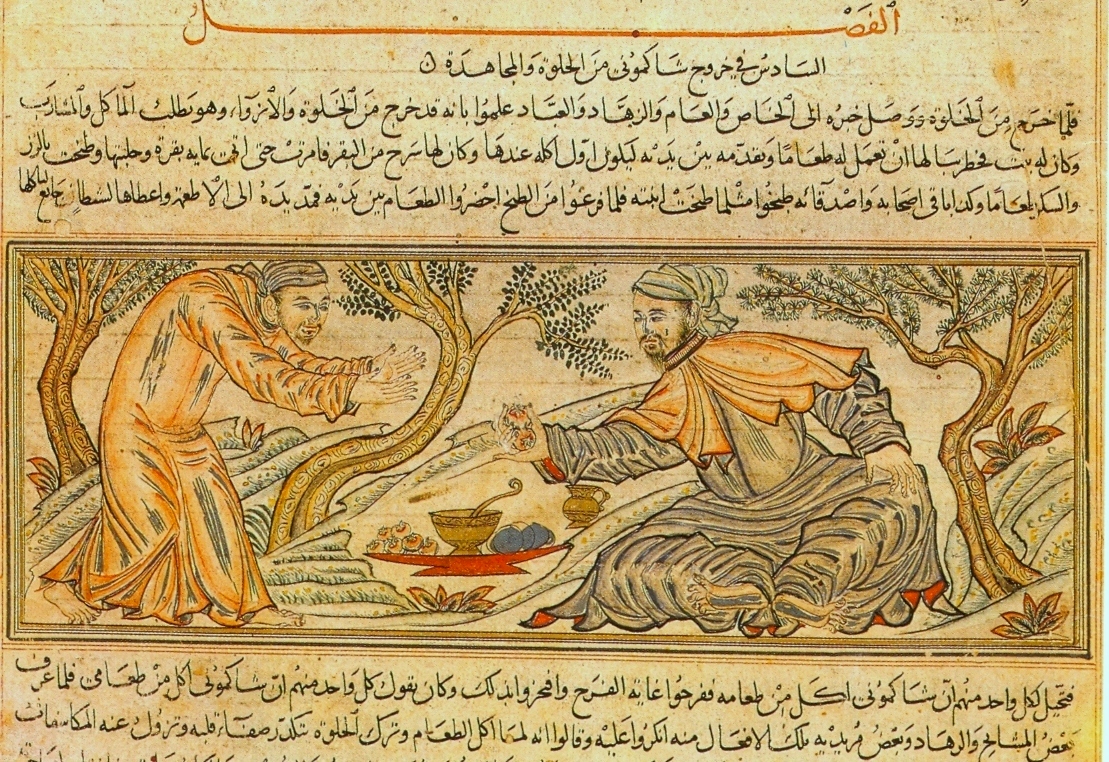
The finished text was written in Persian and translated into Arabic. Rashid al-Din wanted it to survive, so he ordered that copies in both languages be made every year and sent to cities across the realm. The oldest illustrated copy that survives is part of an Arabic manuscript dated 1314–1315, now divided between Edinburgh University Library and the Khalili Collection in London. Its paintings mix Persian, Chinese and Byzantine elements and are among the key works of Ilkhanid art.
Rab’-e Rashidi
On the eastern side of Tabriz Rashid al-Din built a quarter called Rab’-e Rashidi, ربع رشیدی, “Rashid’s quarter”. Its endowment deed of 1309 survives and describes what it held: a mosque, a hospital, a library, a hospice for Sufis, lodgings for teachers and paid students, and his own tomb. It also had a scriptorium where scribes and painters copied his books, using paper from the endowment’s own funds. The deed shows the scale of his wealth: estates and gardens across the Ilkhanate, from Anatolia to Khorasan.
Other writings
Rashid al-Din also wrote, or sponsored, works on theology and Qur’an commentary, a book on agriculture and building, and a Persian work on Chinese medicine. A collection of letters attributed to him, the Mukatabat-i Rashidi, was long used as a source for his life and estates, but several scholars have argued that it is a later fabrication, so historians now use it with great caution.
Rivalry and execution
Ilkhanid viziers rarely died in their beds. Rashid al-Din outlived his colleague Savaji, who was executed in 1312, but then had to share power with Taj al-Din Ali Shah, a former jewel merchant. The two men hated each other. After Öljaitü’s death in December 1316, Ali Shah and other enemies accused Rashid al-Din of having poisoned the Ilkhan through a wrong prescription. In July 1318, during the reign of the young Abu Sa’id, he was executed, aged about seventy, together with his teenage son Ibrahim. Rab’-e Rashidi was plundered.
The family recovered. His son Ghiyath al-Din Muhammad became vizier in 1327 and held power until the collapse of 1336. Later sources report that around 1400 Timur’s son Miranshah had Rashid al-Din’s remains removed from his tomb and reburied in the Jewish cemetery.
Legacy
The Jami al-Tawarikh is the main source for the Mongol Empire as seen from its western half, and the world-history chapters show a curiosity about other peoples that was rare in any medieval literature. Its approach, a history of the Mongols set inside a history of the world, shaped Persian historical writing under the Timurids. The surviving paintings give the earliest large group of Persian book illustrations, and through them the beginnings of Persian miniature painting.
Persian words from this page
| رشیدالدین | Rashid od-Din | Rashid al-Din |
| جامع التواریخ | Jâme’ ot-Tavârikh | Compendium of Chronicles |
| همدان | Hamedân | Hamadan |
| پزشک | pezeshk | physician |
| وقفنامه | vaqf-nâmeh | endowment deed |
| ربع رشیدی | Rab’-e Rashidi | Rashid’s quarter |
Rashid al-Din’s home town is described on the page on Hamadan.
Sources and further reading
- Rashid al-Din, Jami’u’t-tawarikh: Compendium of Chronicles, trans. W. M. Thackston, 3 vols. (1998–1999).
- “Rašid-al-Din Fażl-Allāh”, Encyclopaedia Iranica.
- Sheila S. Blair, A Compendium of Chronicles: Rashid al-Din’s Illustrated History of the World (1995).
- Anna Akasoy, Charles Burnett and Ronit Yoeli-Tlalim (eds.), Rashid al-Din: Agent and Mediator of Cultural Exchanges in Ilkhanid Iran (2013).
- Thomas T. Allsen, Culture and Conquest in Mongol Eurasia (2001), on Bolad and the making of the history.
Want to learn Persian? Get the free Starter Pack
Get the 14-page printable Starter Pack (all 32 letters, a 7-day reading plan, 100 core words and 20 survival phrases) and a short 5-email course. Free.
More in The Mongol Invasion and the Ilkhanate (1219–1357)
- Genghis Khan’s Invasion of Iran (1219–1221)
- The Destruction of Nishapur, Merv and Herat
- Iran under the Great Khans (1225–1256)
- Hulagu Khan, Founder of the Ilkhanate
- The Fall of Alamut (1256)
- The Mongol Sack of Baghdad (1258)
- The Battle of Ain Jalut and the Mamluk Wars
- Nasir al-Din Tusi and the Maragheh Observatory
- Abaqa and Arghun: The Ilkhanate, 1265–1291
- Ghazan Khan and the Conversion to Islam
- Öljaitü and the Dome of Soltaniyeh
- Abu Sa’id and the Collapse of the Ilkhanate
- Juvayni and the History of the World Conqueror
- Rashid al-Din and the Jami al-Tawarikh
- Rumi (Mowlana): A Life from Balkh to Konya
- Saadi of Shiraz
- Ilkhanid Art and the Great Mongol Shahnameh
- The Ilkhanate and Europe
- Tabriz under the Ilkhans
- The Black Death and Iran