For about sixty years, from Hulagu’s letter to Louis IX in 1262 to the 1320s, the Mongol Ilkhans of Iran exchanged letters and envoys with the popes and the kings of France and England. Their shared enemy was the Mamluk sultanate of Egypt and Syria, and both sides spoke of a joint campaign to take Jerusalem. The alliance never worked in practice, but the contacts brought European missionaries and merchants to Tabriz and Soltaniyeh, and a Chinese-born monk to the courts of Europe.
A common enemy
After the Mamluks defeated the Mongols at Ain Jalut in 1260, Syria became a permanent battleground. The Ilkhans needed allies, and the Crusader states on the Syrian coast, slowly being taken by the Mamluks, needed help. The Ilkhanid court had many Christians: Hulagu’s chief wife Doquz Khatun was a Nestorian Christian, and Abaqa married Maria, a daughter of the Byzantine emperor Michael VIII. To European observers, the Mongols looked like possible converts and partners.
There were obstacles from the start. Early Mongol letters demanded submission rather than offering alliance, as the Great Khans believed they had a mandate from Heaven to rule the world. Distances were huge: a letter from Tabriz took many months to reach Paris, and a reply as long again.

Letters and envoys, 1262–1305
- 1262 Hulagu writes to Louis IX of France proposing cooperation against Egypt. A Latin copy was found in a Vienna library in the 20th century.
- 1274 Envoys of Abaqa attend the Second Council of Lyon; some are baptised.
- 1285 Arghun writes to Pope Honorius IV suggesting a joint attack on Egypt.
- 1287–1288 Rabban Sauma’s embassy to Constantinople, Rome, Paris and Gascony.
- 1289 Arghun’s Genoese envoy Buscarello de Ghizolfi brings a letter to Philip IV proposing that the French and Mongols meet before Damascus, and promising Jerusalem to the French.
- 1291 The Mamluks take Acre, the last major Crusader city.
- 1299–1303 Ghazan invades Syria three times, briefly holding Damascus in 1300; Buscarello carries his letters to Edward I.
- 1305 Öljaitü writes to Philip IV about peace among the Mongol khans and friendship with the Christian kings.
Rabban Sauma: a Mongol envoy in Paris
The most remarkable envoy was Rabban Sauma, a Turkic-speaking Nestorian Christian monk born near Khanbaliq (Beijing). In the 1270s he and his pupil Markos set out on pilgrimage to Jerusalem. They never got there, but in Ilkhanid Iran Markos was elected head of the Church of the East as Catholicos Yahballaha III in 1281.
In 1287 Arghun sent the elderly Sauma west. He visited Constantinople and admired Hagia Sophia, watched a sea battle in the Bay of Naples, and reached Rome just after the death of Pope Honorius IV, so he argued theology with the cardinals instead. In Paris Philip IV showed him the relics of the Sainte-Chapelle and the university. In Gascony he met Edward I of England, who took communion from him. Back in Rome in 1288 he celebrated Easter with the newly elected Pope Nicholas IV, who gave him letters and gifts.
Sauma’s own account of the journey survives in a Syriac version of his travel record. It is a rare view of medieval Europe through Asian eyes: he describes, for example, the thousands of students at the university of Paris. The kings were friendly, but none made a firm commitment.
Why the alliance failed
Historians disagree about how close the two sides came. Some, such as Jean Richard, have stressed the seriousness of the plans; others, especially Peter Jackson, argue that mutual suspicion, Mongol claims to universal rule and Europe’s loss of interest in crusading meant a real alliance was never likely. The practical problems were plain. European rulers were busy with their own wars and rivalries, and the papacy with the struggle over Sicily. When Ghazan took Damascus in 1300, rumours in Europe said the Mongols had taken Jerusalem and handed it to the Christians, but no European army came. A small Templar force landed on the island of Ruad off the Syrian coast in 1300–1302, hoping to join the Mongols, and was destroyed.
Ghazan’s conversion to Islam in 1295 changed the tone but not the policy, since the war with the Mamluks was about Syria, not religion. The peace that Abu Sa’id made with Egypt around 1322–1323 ended the strategic reason for the contacts.
Missionaries and merchants
Diplomacy faded, but other contacts grew. Franciscan and Dominican friars founded houses in Tabriz and other towns. In 1318 Pope John XXII made Soltaniyeh the seat of a Catholic archbishop, the Dominican Francesco da Perugia. Travellers on the way to China, such as John of Montecorvino around 1290 and the friar Odoric of Pordenone around 1320, passed through Ilkhanid Iran.
Italian merchants were already active. A Venetian merchant made his will in Tabriz in the 1260s; Genoese traders had their own community there; and Venice obtained trading privileges from Abu Sa’id in 1320. Marco Polo’s book describes Tabriz as a city of merchants and fine silks. The Polos themselves came back to Europe via Iran: around 1293 they escorted the Mongol princess Kököchin from China to marry Arghun, found him dead, and saw her married to his son Ghazan instead. See Tabriz under the Ilkhans for the city they found.
The letters as objects
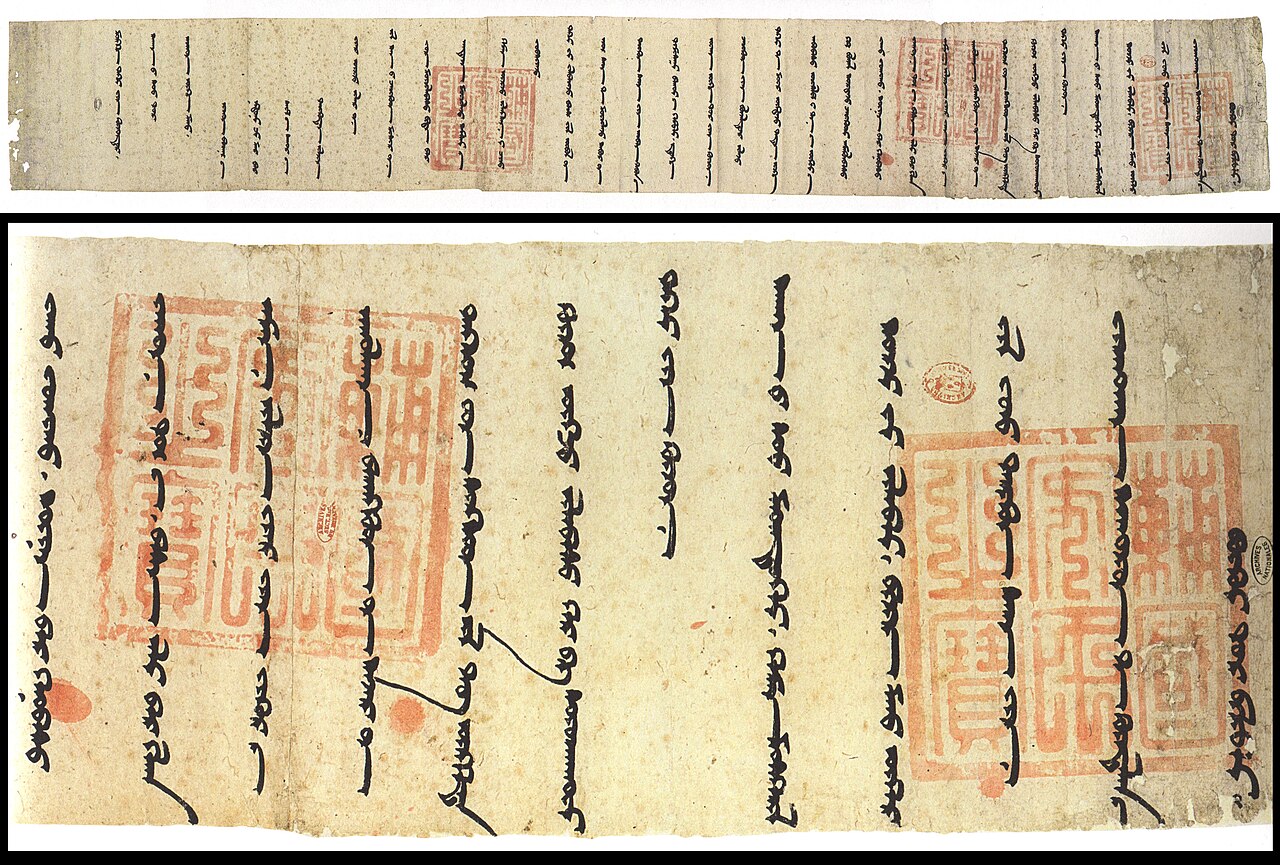
Several original Ilkhanid letters survive in European archives, including Arghun’s letter of 1289 and Öljaitü’s of 1305 in the Archives nationales in Paris. They are long scrolls of Mongolian in the vertical Uighur script, stamped with red seals in Chinese characters that the Great Khan had granted to the Ilkhans. They are among the most important original documents of the Mongol Empire anywhere, and they show the Ilkhans presenting themselves in Europe as part of a world empire ruled from China.
Persian words from this page
| فرنگ | Farang | the Franks, Europe |
| فرنگی | farangi | European, Frankish |
| ایلچی | ilchi | envoy |
| نامه | nâmeh | letter |
| پاپ | pâp | pope |
| مسیحی | masihi | Christian |
Sources and further reading
- Peter Jackson, The Mongols and the West, 1221–1410 (2005; 2nd ed. 2018).
- Morris Rossabi, Voyager from Xanadu: Rabban Sauma and the First Journey from China to the West (1992).
- E. A. Wallis Budge (trans.), The Monks of Kublai Khan, Emperor of China (1928), the Syriac account of Rabban Sauma and Yahballaha.
- Reuven Amitai-Preiss, Mongols and Mamluks: The Mamluk-Ilkhanid War, 1260–1281 (1995).
- J. A. Boyle, “Dynastic and Political History of the Il-Khans”, in The Cambridge History of Iran, vol. 5 (1968).
Want to learn Persian? Get the free Starter Pack
Get the 14-page printable Starter Pack (all 32 letters, a 7-day reading plan, 100 core words and 20 survival phrases) and a short 5-email course. Free.
More in The Mongol Invasion and the Ilkhanate (1219–1357)
- Genghis Khan’s Invasion of Iran (1219–1221)
- The Destruction of Nishapur, Merv and Herat
- Iran under the Great Khans (1225–1256)
- Hulagu Khan, Founder of the Ilkhanate
- The Fall of Alamut (1256)
- The Mongol Sack of Baghdad (1258)
- The Battle of Ain Jalut and the Mamluk Wars
- Nasir al-Din Tusi and the Maragheh Observatory
- Abaqa and Arghun: The Ilkhanate, 1265–1291
- Ghazan Khan and the Conversion to Islam
- Öljaitü and the Dome of Soltaniyeh
- Abu Sa’id and the Collapse of the Ilkhanate
- Juvayni and the History of the World Conqueror
- Rashid al-Din and the Jami al-Tawarikh
- Rumi (Mowlana): A Life from Balkh to Konya
- Saadi of Shiraz
- Ilkhanid Art and the Great Mongol Shahnameh
- The Ilkhanate and Europe
- Tabriz under the Ilkhans
- The Black Death and Iran