In February 1258 a Mongol army under Hulagu Khan captured Baghdad after a siege of about two weeks, sacked the city and put to death the last Abbasid caliph in Baghdad, al-Musta’sim. The Abbasid caliphate, which had stood at the head of the Sunni Muslim world since 750, came to an end there, and Iraq became a province of the new Mongol state in Iran, the Ilkhanate.
| Siege | Late January to 10 February 1258 |
|---|---|
| Sack | From about 13 February 1258, for roughly a week |
| Mongol commanders | Hulagu Khan; Baiju; the Chinese general Guo Kan |
| Defender | Caliph al-Musta’sim billah (r. 1242–1258); vizier Ibn al-Alqami; commander Aybak the Lesser Dawatdar |
| Result | End of the Abbasid caliphate in Baghdad; Iraq ruled from Iran |
| Death toll | Unknown; chronicles give figures from about 200,000 to over a million |
The last caliph
By the 13th century the Abbasid caliphs had long lost most of their empire, but they still ruled Baghdad and central Iraq and were recognised by Sunni rulers from Egypt to India as the head of the Muslim community. Al-Musta’sim, caliph from 1242, is portrayed by almost every source as indecisive. His court was divided between his vizier, Mu’ayyad al-Din Ibn al-Alqami, a Shi’i, and the military commander known as the Lesser Dawatdar.
Hulagu, sent west by his brother Möngke (see Hulagu Khan), had just destroyed the Nizari castles of northern Iran (see the fall of Alamut). He wrote to the caliph demanding that he come in person or send his chief officials and demolish the city’s outer defences. Al-Musta’sim replied with warnings that the whole Muslim world would rise against anyone who harmed the caliph. It did not. He also failed to raise a large army or to prepare the city for a siege.
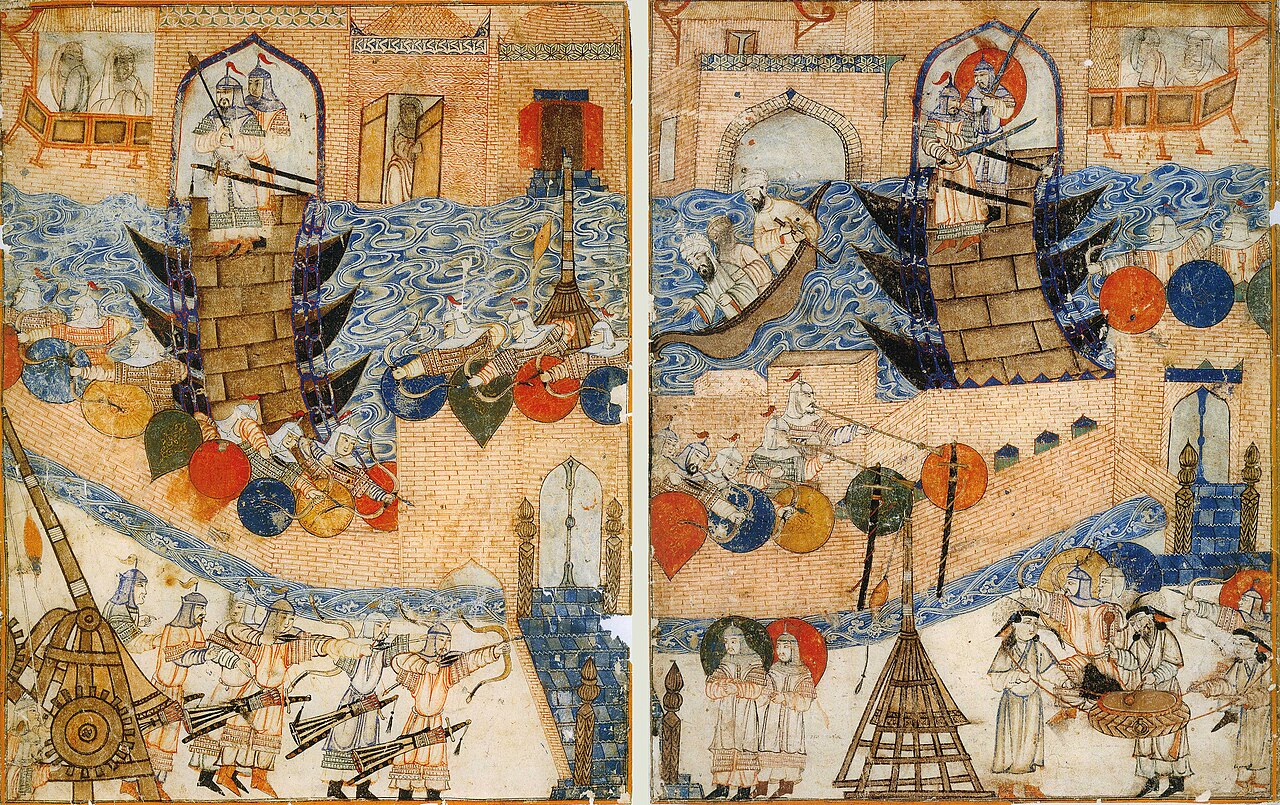

The siege, January and February 1258
The Mongols converged on Baghdad from several directions late in 1257. Baiju’s army came from Anatolia down the west bank of the Tigris. The Dawatdar led the caliph’s army out against it near Anbar, and the Mongols broke the dykes of the Euphrates canals behind the Baghdad troops, flooding their camp. Most of the army was drowned or cut down, and the Dawatdar escaped back to the city with a few men.
By the end of January the city was surrounded on both banks. Hulagu’s engineers built a wall and ditch around the Mongol lines and placed catapults against the eastern walls. After about a week of bombardment a section of the wall near the Persian Tower was breached and the Mongols took the walls. Pontoon bridges and boats on the Tigris blocked escape downstream.
The caliph tried to negotiate, sending his vizier and the Nestorian Catholicos with gifts. On 10 February 1258 he came out of the city with his sons and his officials and surrendered.
The sack and the death of the caliph
The soldiers of the garrison who came out on promises of safety were divided among the Mongol units and killed. A few days later the sack of the city began and lasted about a week. Palaces, mosques and the tombs of the caliphs were burned, and large parts of the population were killed. The Christians of Baghdad, who had taken refuge in a church, were spared, a decision Christian writers credit to Hulagu’s Christian wife Doquz Khatun.
The caliph was made to reveal the palace treasure. About 20 February he was put to death near the city with most of his family. Many sources say he was rolled in a carpet and trampled by horses, a method that respected the Mongol taboo against shedding royal blood. Nasir al-Din Tusi, who was with Hulagu, wrote a short account of the campaign that survives as an appendix to some manuscripts of Juvayni’s history.
How many died, and what was lost
The numbers in the sources cannot be taken literally. Figures range from about 200,000 to 800,000 and, in some later Arabic writers, to two million, more than medieval Baghdad could have held. Modern historians agree that the killing was very heavy, but no reliable count exists.
The same caution applies to the most famous image of the sack: the Tigris running black with the ink of books thrown in from the libraries. The story appears in later accounts, and while libraries were certainly destroyed, historians note that the famous House of Wisdom (Bayt al-Hikma) of the 9th century is not clearly attested as a working institution by 1258. Some writers have overstated the sack as the single moment when Islamic science or civilisation ended; within a year Hulagu was funding the Maragheh observatory, staffed by scholars from across the Islamic world.
A further dispute concerns the vizier Ibn al-Alqami. Several Sunni writers accused him of betraying the caliph to the Mongols because he was Shi’i. Modern historians generally see this as a later polemic rather than an established fact. What is clearer is that the Shi’i shrine towns of Iraq, such as Hilla, Najaf and Karbala, submitted early and were spared.
After 1258
Baghdad did not disappear. The city was cleared and repopulated, and from 1259 it was governed for more than twenty years by the historian Ata-Malik Juvayni, who repaired canals and buildings. But it was now a provincial centre within a state whose capitals were in Azerbaijan, and it never regained its old position.
The caliphate itself was revived in a limited form. In 1261 the Mamluk sultan Baybars installed an Abbasid survivor in Cairo as caliph. The Cairo caliphs had religious prestige but no real power, and the line lasted until the Ottoman conquest of Egypt in 1517. For the Mamluks, the fall of Baghdad made the war against the Mongols a religious duty, a war that began in 1260 at Ain Jalut.
For Iran, the sack had a quieter long-term effect. Iraq and Iran were again ruled together, as in Sasanian times, and in time, with the Ilkhans’ conversion to Islam under Ghazan Khan, a Persian-speaking Muslim monarchy took shape that no longer looked to any caliph.
Persian words from this page
| بغداد | Baghdâd | Baghdad |
| خلافت | khelâfat | caliphate |
| عباسیان | Abbâsiyân | the Abbasids |
| وزیر | vazir | vizier, minister |
| دجله | Dejle | the Tigris |
| محاصره | mohâsere | siege |
Sources and further reading
- Rashid al-Din, Jami al-Tawarikh, translated by W. M. Thackston (Harvard, 1998–1999), the section on Hülegü.
- J. A. Boyle, “The Death of the Last ‘Abbasid Caliph: A Contemporary Muslim Account”, Journal of Semitic Studies 6 (1961), a translation of Nasir al-Din Tusi’s report.
- David Morgan, The Mongols (2nd edition, Blackwell, 2007).
- Peter Jackson, The Mongols and the Islamic World (Yale University Press, 2017).
- Justin Marozzi, Baghdad: City of Peace, City of Blood (Allen Lane, 2014).
Want to learn Persian? Get the free Starter Pack
Get the 14-page printable Starter Pack (all 32 letters, a 7-day reading plan, 100 core words and 20 survival phrases) and a short 5-email course. Free.
More in The Mongol Invasion and the Ilkhanate (1219–1357)
- Genghis Khan’s Invasion of Iran (1219–1221)
- The Destruction of Nishapur, Merv and Herat
- Iran under the Great Khans (1225–1256)
- Hulagu Khan, Founder of the Ilkhanate
- The Fall of Alamut (1256)
- The Mongol Sack of Baghdad (1258)
- The Battle of Ain Jalut and the Mamluk Wars
- Nasir al-Din Tusi and the Maragheh Observatory
- Abaqa and Arghun: The Ilkhanate, 1265–1291
- Ghazan Khan and the Conversion to Islam
- Öljaitü and the Dome of Soltaniyeh
- Abu Sa’id and the Collapse of the Ilkhanate
- Juvayni and the History of the World Conqueror
- Rashid al-Din and the Jami al-Tawarikh
- Rumi (Mowlana): A Life from Balkh to Konya
- Saadi of Shiraz
- Ilkhanid Art and the Great Mongol Shahnameh
- The Ilkhanate and Europe
- Tabriz under the Ilkhans
- The Black Death and Iran