Between 1219 and 1221 Genghis Khan led a Mongol army west against the Khwarazmian Empire, the state that then ruled most of Iran and Central Asia. In about three years the Mongols took Otrar, Bukhara, Samarkand and Urgench, drove the Khwarazmshah Muhammad II to his death on a Caspian island and ravaged Khorasan. The campaign began the Mongol age in Iran, which lasted until the collapse of the Ilkhanate in the 1330s.
| Date | 1219 to 1221 (main campaign); Genghis Khan back in Mongolia by 1225 |
|---|---|
| Region | Transoxiana (today Uzbekistan and Kazakhstan), Khwarazm, Khorasan, northern Iran, Afghanistan |
| Mongol leaders | Genghis Khan; his sons Jochi, Chagatai, Ögedei and Tolui; the generals Jebe and Sübe’etei |
| Khwarazmian leaders | Ala al-Din Muhammad II; his son Jalal al-Din Mingburnu |
| Result | Collapse of the Khwarazmian Empire; eastern Iran under Mongol control |
A quarrel over a caravan
In 1218 the Khwarazmian state looked like the strongest power in the eastern Islamic world. Ala al-Din Muhammad II had expanded it from the Syr Darya to western Iran and into Afghanistan (its rise is told on the page on the Khwarazmian Empire and in the life of Ala al-Din Muhammad II). Genghis Khan, fresh from his wars in northern China, had sent a large trading caravan to the frontier town of Otrar. Its governor, Inalchuq, accused the merchants of spying and had them killed. When Genghis sent envoys to demand that the governor be handed over, the Khwarazmshah had one of them executed and the others humiliated.
Medieval writers on both sides treated this as the cause of the war, and it is covered in detail on the page about the Otrar incident. Modern historians add that a clash between two expanding empires with a shared border was likely in any case. What Otrar did decide was the tone: the campaign that followed was conducted as a war of revenge.

The Khwarazmshah’s strategy
Muhammad II had a large army on paper, but it was built from Qipchaq and Qangli Turkish contingents whose loyalty ran to their own chiefs and to his mother, Terken Khatun, more than to him. He chose not to meet the Mongols in the field. Instead he spread his troops among the fortified cities of Transoxiana, hoping that sieges would wear the invaders down. Juvayni and Ibn al-Athir both judged this a fatal mistake: it let the Mongols take the cities one by one, each garrison isolated from the others.
The size of Genghis Khan’s army is not known. Medieval figures run to many hundreds of thousands and are not credible. Modern estimates usually fall somewhere between about 100,000 and 200,000 men, including allied and conscripted troops, and engineers from northern China who handled siege machines.
Otrar, Bukhara and Samarkand
The Mongols reached the Syr Darya in the autumn of 1219 and split up. Chagatai and Ögedei besieged Otrar, which held out for about five months; when it fell, Inalchuq was captured and put to death. Jochi took the towns lower down the river, and another column moved upstream towards Khujand.
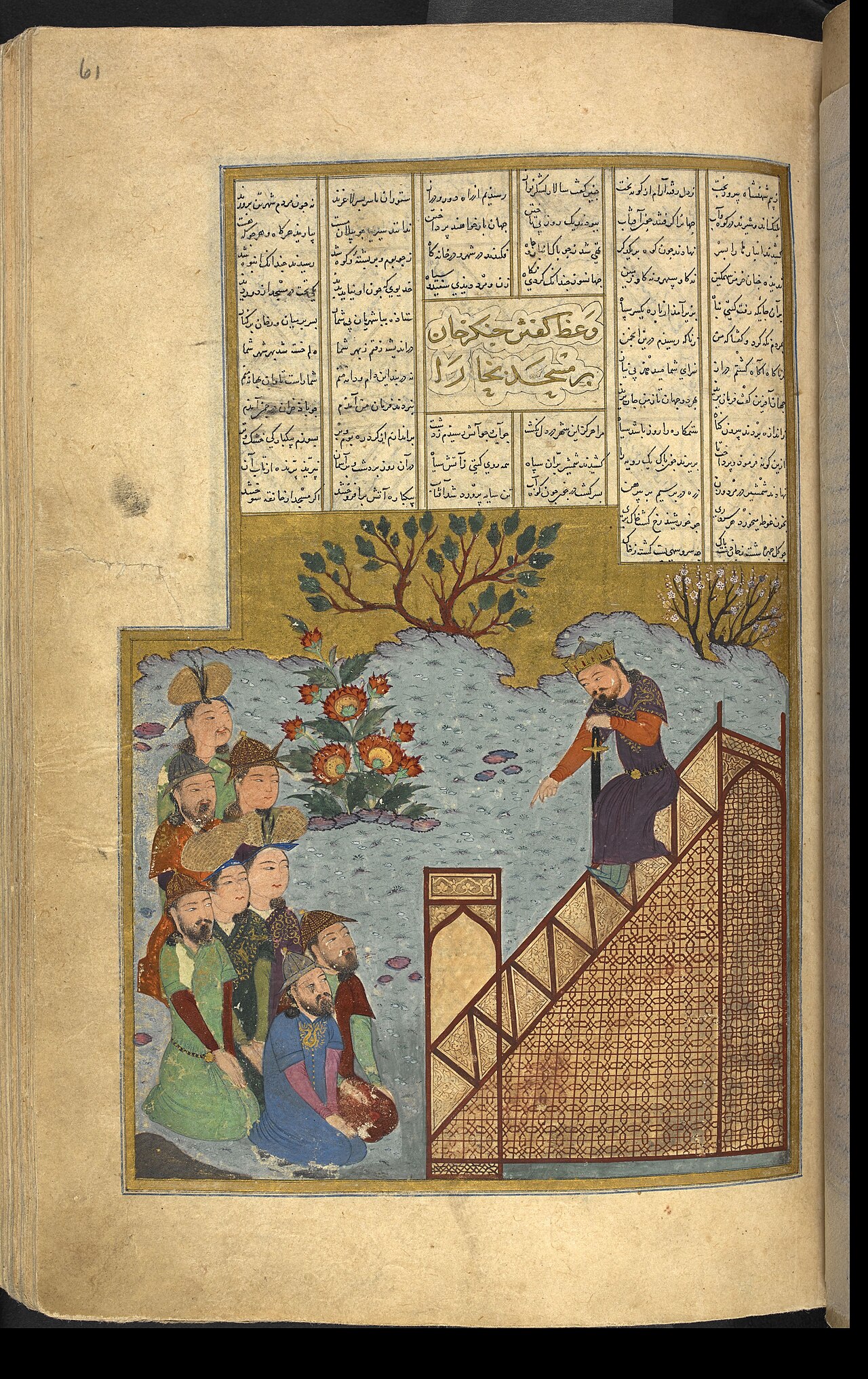
Genghis Khan himself, with his youngest son Tolui, crossed the Kyzylkum desert and appeared before Bukhara in February 1220, far from where the defenders expected him. The town surrendered, though the citadel resisted for some days before it was stormed. Juvayni, writing about forty years later, describes Genghis riding into the great mosque and telling the assembled notables that he was the punishment of God sent for their sins. The scene may be shaped by the writer, but it became the best-known image of the conquest. Bukhara was then plundered and largely burned.
Samarkand, the Khwarazmshah’s new capital, fell in March 1220 after a short siege. Its Turkish garrison, which had changed sides, was killed anyway. Skilled craftsmen were separated out and sent east to work for the Mongols, a pattern repeated in city after city.
The flight and death of Muhammad II
Muhammad left Transoxiana before the cities fell and retreated across Khorasan towards western Iran. Genghis sent Jebe and Sübe’etei after him with orders not to let him rest. The Khwarazmshah moved from Nishapur to Qazvin and on to the Caspian coast, and died, probably of pleurisy, on an island off the shore near Abaskun in the winter of 1220–1221. His mother and his harem were captured in Mazandaran and sent to Mongolia.
Jebe and Sübe’etei did not turn back. They rode through northern Iran, sacking Rey and other towns, wintered in Azerbaijan, defeated the Georgians, crossed the Caucasus and beat an army of Rus’ princes and Cumans on the Kalka river in 1223 before rejoining Genghis. This reconnaissance raid is one of the longest cavalry operations recorded.
Urgench and Khorasan, 1221
Urgench (Gorganj), the old capital of Khwarazm on the lower Amu Darya, was besieged in 1220–1221 by Jochi, Chagatai and Ögedei together. The siege was slowed by quarrels between the brothers, and the city was taken street by street. Juvayni says the Mongols then broke the river dams and flooded what was left.
In the same year Tolui swept through Khorasan, where Merv, Nishapur and Herat were destroyed with a scale of killing that shocked contemporaries. That story, and the question of how far the chroniclers’ numbers can be trusted, is on a separate page: the destruction of Nishapur, Merv and Herat.
Jalal al-Din’s resistance
Muhammad’s son Jalal al-Din Mingburnu gathered troops in Afghanistan and in 1221 defeated a Mongol army at Parwan, north of Kabul, one of the few Mongol defeats of the whole war. Genghis came south in person and caught him on the Indus in late 1221. Jalal al-Din’s army was destroyed, but he escaped by riding his horse into the river and swimming across, and later returned to fight in western Iran (see Jalal al-Din Mingburnu).
Genghis Khan spent 1222 in the region, then started for home and was back in Mongolia by 1225. He died in 1227. He left garrisons and governors in Transoxiana and Khorasan, but no settled government over most of Iran, which is why the next three decades are a story of raids, tax officials and military governors, told in Iran under the Great Khans.
- 1218 Mongol merchants killed at Otrar
- Autumn 1219 Mongols reach the Syr Darya; siege of Otrar begins
- February 1220 Bukhara falls
- March 1220 Samarkand falls
- Winter 1220–1221 Muhammad II dies on a Caspian island
- 1221 Urgench taken; Merv, Nishapur and Herat destroyed; Jalal al-Din wins at Parwan
- Late 1221 Battle of the Indus
- 1223 Jebe and Sübe’etei win on the Kalka
- 1227 Death of Genghis Khan
How we know: the sources
The two main narratives come from opposite sides. Ibn al-Athir, writing in Mosul in the 1220s, saw the invasion as a disaster without parallel; his account is close in time but based on refugees’ reports. Ata-Malik Juvayni wrote his History of the World Conqueror in the 1250s and 1260s as an official in Mongol service. He describes the horrors frankly but also presents the conquest as the work of providence. Later Persian historians, above all Rashid al-Din, drew on Mongol traditions. Their numbers of soldiers and dead are rhetorical, but their sequence of events is broadly consistent and accepted by modern historians such as Barthold and Peter Jackson.
Persian words from this page
| چنگیز خان | Changiz Khân | Genghis Khan |
| مغول | Moghul | Mongol |
| خوارزم | Khârazm | Khwarazm |
| بخارا | Bokhârâ | Bukhara |
| سمرقند | Samarqand | Samarkand |
| اترار | Otrâr | Otrar |
Sources and further reading
- Ata-Malik Juvayni, The History of the World-Conqueror, translated by J. A. Boyle (Manchester University Press, 1958).
- Ibn al-Athir, The Chronicle of Ibn al-Athir for the Crusading Period from al-Kamil fi’l-Ta’rikh, part 3, translated by D. S. Richards (Ashgate, 2008).
- W. Barthold, Turkestan Down to the Mongol Invasion (3rd edition, 1968).
- J. A. Boyle, “Dynastic and Political History of the Il-Khans”, in The Cambridge History of Iran, vol. 5 (1968).
- Peter Jackson, The Mongols and the Islamic World: From Conquest to Conversion (Yale University Press, 2017).
Want to learn Persian? Get the free Starter Pack
Get the 14-page printable Starter Pack (all 32 letters, a 7-day reading plan, 100 core words and 20 survival phrases) and a short 5-email course. Free.
More in The Mongol Invasion and the Ilkhanate (1219–1357)
- Genghis Khan’s Invasion of Iran (1219–1221)
- The Destruction of Nishapur, Merv and Herat
- Iran under the Great Khans (1225–1256)
- Hulagu Khan, Founder of the Ilkhanate
- The Fall of Alamut (1256)
- The Mongol Sack of Baghdad (1258)
- The Battle of Ain Jalut and the Mamluk Wars
- Nasir al-Din Tusi and the Maragheh Observatory
- Abaqa and Arghun: The Ilkhanate, 1265–1291
- Ghazan Khan and the Conversion to Islam
- Öljaitü and the Dome of Soltaniyeh
- Abu Sa’id and the Collapse of the Ilkhanate
- Juvayni and the History of the World Conqueror
- Rashid al-Din and the Jami al-Tawarikh
- Rumi (Mowlana): A Life from Balkh to Konya
- Saadi of Shiraz
- Ilkhanid Art and the Great Mongol Shahnameh
- The Ilkhanate and Europe
- Tabriz under the Ilkhans
- The Black Death and Iran