On 3 September 1260, at Ain Jalut in the Jezreel valley of Palestine, the Mamluk army of Egypt under Sultan Qutuz defeated a Mongol force led by Kitbuqa, the general Hulagu Khan had left in Syria. The battle stopped the Mongol advance towards Egypt and opened sixty years of war between the Ilkhanate of Iran and the Mamluk sultanate, a frontier that ran along the Euphrates until peace was made in the 1320s.
| Date | 3 September 1260 (25 Ramadan 658) |
|---|---|
| Place | Ain Jalut (“Goliath’s Spring”), near today’s Ein Harod, north of Jenin |
| Mamluk leaders | Sultan Qutuz; Baybars commanding the vanguard |
| Mongol leader | Kitbuqa, a Christian Naiman general, killed in the battle |
| Army sizes | Unknown; modern estimates often around 10,000 to 20,000 on the Mongol side, with the Mamluks probably at least as numerous |
| Result | Mamluk victory; Mongols lose Syria |
| Wars ended | Treaty of Aleppo, c. 1323, under the Ilkhan Abu Sa’id |
Why Hulagu was not there
Early in 1260 the Mongols seemed unstoppable in the Near East. After taking Baghdad, Hulagu marched into Syria, stormed Aleppo in January and received the surrender of Damascus. Then news came that the Great Khan Möngke had died in China. A succession struggle between Kublai and Ariq Böke was beginning, and the Golden Horde to the north was hostile. Hulagu withdrew most of his army to Azerbaijan, which had better pasture for a large cavalry force than Syria in summer. He left Kitbuqa with a much smaller army.
Hulagu had already sent envoys to Cairo with a letter demanding submission. Qutuz, a former slave soldier who had just made himself sultan, had the envoys executed, a deliberate act that made war certain. He then marched north. The Crusader barons of Acre, after some debate, allowed the Mamluk army to pass through their territory and buy supplies, but stayed neutral.
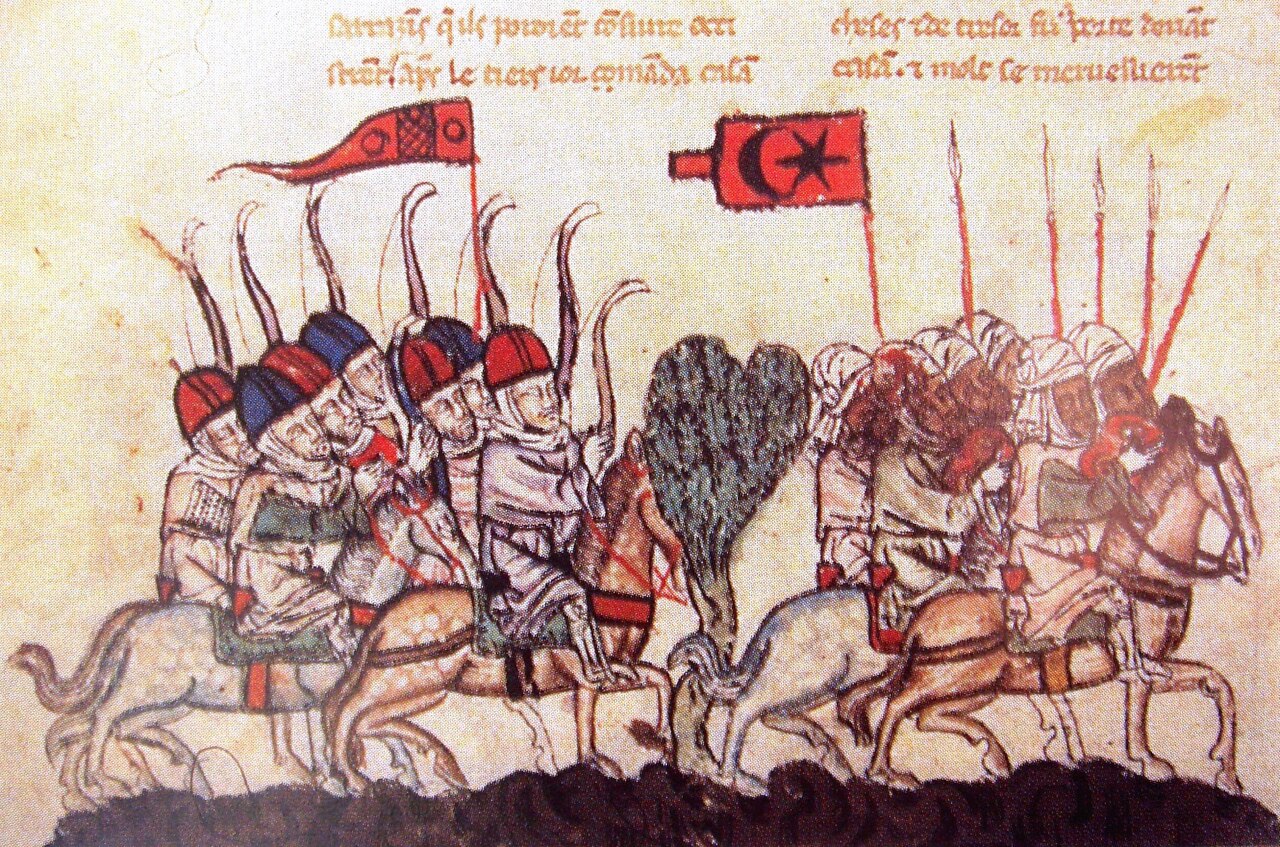

The battle
The armies met at the spring of Ain Jalut on the morning of 3 September 1260. The Mamluk accounts, which are our main sources, say that Baybars, commanding the vanguard, drew the Mongols forward while the main army waited in the hills. The Mongol charge broke the Mamluk left wing, and Qutuz is said to have thrown off his helmet and rallied his men with the cry “O Islam!” The Mamluks held, Kitbuqa was killed or captured and executed, and the Mongol army was driven from the field.
Both armies used the same methods: mounted archers, feigned retreats and charges by heavy cavalry. Many of the Mamluks were themselves Qipchaq Turks from the steppe, bought as boys, and some had been sold as slaves after earlier Mongol conquests. Historians stress that numbers and the absence of the main Mongol army mattered more than any special tactic.
Within weeks the Mongols lost Damascus and Aleppo. On the way back to Egypt, Qutuz was murdered by a group of emirs that included Baybars, who became sultan and ruled until 1277.
A battle often misdescribed
Ain Jalut is often called the first defeat of the Mongols or the battle that saved Islam. Neither is quite right. The Mongols had lost battles before, for example to Jalal al-Din Mingburnu at Parwan in 1221. And Hulagu’s withdrawal after Möngke’s death had already reduced the threat. What the battle did was establish that the Mamluks could fight the Mongols on equal terms, and give the new Mamluk regime the legitimacy of having saved Egypt and Syria.
Sixty years of war
The two sides never made a lasting peace in Hulagu’s lifetime. The Mamluks allied with Berke of the Golden Horde, the Ilkhans’ enemy in the Caucasus, and both sides looked for allies in Europe and Armenia. The frontier ran roughly along the Euphrates, with raids by both sides and fortified towns such as al-Bira and Rahba on the river. The major battles were these:
- 1260 Ain Jalut; a second Mongol force is defeated at Homs in December
- 1277 Baybars defeats a Mongol army in Anatolia at Elbistan
- 1281 Second Battle of Homs: Abaqa’s brother Möngke Temür is beaten by Sultan Qalawun
- 1299 Ghazan wins at Wadi al-Khazandar near Homs and briefly occupies Damascus
- 1303 Ghazan’s army is defeated at Marj al-Saffar (Shaqhab) south of Damascus
- 1312–1313 Öljaitü’s siege of Rahba fails
- c. 1323 Peace agreed under Abu Sa’id
The Ilkhans won some battles but could never hold Syria. The distance from their grazing lands in Azerbaijan, the lack of summer pasture in Syria for Mongol horses, and the Mamluks’ policy of burning grazing land along the frontier all worked against them. The rivalry also shaped the Ilkhans’ diplomacy: Abaqa and Arghun sent repeated embassies to the Pope and European kings proposing a joint attack, and after Ghazan converted to Islam, the Mamluk scholar Ibn Taymiyya issued rulings arguing that the Mongols were still not true Muslims and that war against them remained lawful.
Why it matters for Iran
For Iran, Ain Jalut fixed the western limit of the Ilkhanate. The Mongol state centred on Tabriz and Maragheh became a power of Iran, Iraq, Anatolia and the Caucasus, not of the whole Near East. Egypt and Syria developed separately under the Mamluks, and the Euphrates frontier became, roughly, the line between a Persian-speaking and an Arabic-speaking political world, a line that the Safavids and Ottomans would later fight over again.
Persian words from this page
| عین جالوت | Eyn Jâlut | Ain Jalut |
| ممالیک | Mamâlik | the Mamluks |
| مصر | Mesr | Egypt |
| شام | Shâm | Syria (historic name) |
| فرات | Forât | the Euphrates |
| جنگ | jang | war, battle |
Sources and further reading
- Reuven Amitai-Preiss, Mongols and Mamluks: The Mamluk-Ilkhanid War, 1260–1281 (Cambridge University Press, 1995).
- Reuven Amitai-Preiss, “In the Aftermath of ‘Ayn Jalut: The Beginnings of the Mamluk-Ilkhanid Cold War”, Al-Masaq 3 (1990).
- J. M. Smith Jr., “‘Ayn Jalut: Mamluk Success or Mongol Failure?”, Harvard Journal of Asiatic Studies 44 (1984).
- Peter Jackson, The Mongols and the Islamic World (Yale University Press, 2017).
- David Morgan, The Mongols (2nd edition, Blackwell, 2007).
Want to learn Persian? Get the free Starter Pack
Get the 14-page printable Starter Pack (all 32 letters, a 7-day reading plan, 100 core words and 20 survival phrases) and a short 5-email course. Free.
More in The Mongol Invasion and the Ilkhanate (1219–1357)
- Genghis Khan’s Invasion of Iran (1219–1221)
- The Destruction of Nishapur, Merv and Herat
- Iran under the Great Khans (1225–1256)
- Hulagu Khan, Founder of the Ilkhanate
- The Fall of Alamut (1256)
- The Mongol Sack of Baghdad (1258)
- The Battle of Ain Jalut and the Mamluk Wars
- Nasir al-Din Tusi and the Maragheh Observatory
- Abaqa and Arghun: The Ilkhanate, 1265–1291
- Ghazan Khan and the Conversion to Islam
- Öljaitü and the Dome of Soltaniyeh
- Abu Sa’id and the Collapse of the Ilkhanate
- Juvayni and the History of the World Conqueror
- Rashid al-Din and the Jami al-Tawarikh
- Rumi (Mowlana): A Life from Balkh to Konya
- Saadi of Shiraz
- Ilkhanid Art and the Great Mongol Shahnameh
- The Ilkhanate and Europe
- Tabriz under the Ilkhans
- The Black Death and Iran