Jalal al-Din Muhammad Balkhi (1207–1273), known in Iran as Mowlana, “our master”, or Mowlavi, and in the West as Rumi, was a Persian-speaking scholar and Sufi poet. Born in Khorasan, he spent most of his life in Konya in Anatolia under the Seljuks of Rum, and there, after meeting the wandering dervish Shams of Tabriz, he wrote the lyric Divan-e Shams and the six-book Masnavi, which Persian readers call “the Qur’an in Persian”.

Why Rumi belongs in the Mongol era
Rumi never lived in today’s Iran as an adult and never served a Mongol khan. He appears here because the Mongol conquest framed his whole life. His family left Khorasan in the years before Genghis Khan’s armies destroyed its cities in 1219–1221 (see Genghis Khan’s invasion of Iran). In 1243, a year before Shams arrived in Konya, the Mongols crushed the Seljuks of Rum at the Battle of Köse Dağ, and from then on the sultans of Konya were Mongol vassals. Rumi’s most powerful patron, the minister Mu’in al-Din Parvana, governed Anatolia in practice on behalf of the Mongols until the Ilkhan Abaqa had him executed in 1277. The Masnavi was written in a Seljuk kingdom that was, in fact, a province of the Ilkhanate’s world. And Persian, the language of the court in Konya as in Tabriz, carried his work across the whole Mongol-ruled region.
From Balkh to Konya
Rumi was born on 30 September 1207, traditionally in Balkh, in today’s northern Afghanistan. His biographer Franklin Lewis has shown that the family actually lived for some years in Vakhsh, in today’s Tajikistan. His father, Baha al-Din Walad, was a preacher and religious scholar whose own book of mystical teaching, the Ma’arif, Rumi later studied closely.
Some time between about 1216 and 1221 the family began a long westward journey. Later biographers say that in Nishapur they met the poet Attar, who gave the boy a book and predicted his greatness; this is a legend, not history. They went to Baghdad and on pilgrimage to Mecca, then north into Anatolia. In Larende (Karaman) Rumi married Gowhar Khatun, and their son Sultan Walad was born there in 1226. Around 1229 the Seljuk sultan Ala al-Din Kayqubad I invited Baha al-Din to Konya, the capital.
Scholar and teacher
When his father died in 1231, the young Rumi took over his teaching post. A former student of his father, Burhan al-Din Muhaqqiq of Tirmidh, came to Konya and trained him in the Sufi path for about nine years, and Rumi also studied in Aleppo and Damascus. By the early 1240s he was a respected jurist and preacher with many students: a conventional, learned career.
Shams of Tabriz
In late 1244 a wandering dervish in his sixties, Shams al-Din of Tabriz, arrived in Konya. The meeting changed Rumi’s life. The two men spent months in seclusion together; Rumi neglected his students, and his disciples grew jealous of the stranger. Shams left for Damascus in 1246. Sultan Walad was sent to bring him back, and he returned, but in about 1247 he vanished for good. A later story says he was murdered with the help of Rumi’s younger son Ala al-Din. There is no firm evidence for this, and he may simply have left.
Rumi’s grief and longing poured out as poetry. He wrote thousands of ghazals (lyric poems), and in place of his own name at the end, he often signed them with the name of Shams. This collection is the Divan-e Shams-e Tabrizi, or Divan-e Kabir, with more than 3,000 ghazals and many quatrains. After Shams, Rumi found spiritual companions first in Salah al-Din Zarkub, an illiterate goldsmith, and then in Husam al-Din Chalabi.
The Masnavi
It was Husam al-Din who asked Rumi for a long didactic poem in the manner of Sana’i and Attar. From about 1258 until his death Rumi dictated the Masnavi-ye Ma’navi, “rhyming couplets of spiritual meaning”, and Husam al-Din wrote it down and read it back. It runs to six books and about 25,000 couplets of stories, jokes, Qur’anic commentary and teaching, each story opening into the next. It begins with the lament of a reed flute cut from its reed bed, an image of the soul separated from its source:
بشنو این نی چون شکایت میکند
از جداییها حکایت میکندBeshnow in ney chon shekâyat mikonad / az jodâyi-hâ hekâyat mikonad
“Listen to this reed, how it complains, telling the tale of separations.”
This is the reading of R. A. Nicholson’s critical edition. Many Iranians know the line in a popular form, بشنو از نی چون حکایت میکند / از جداییها شکایت میکند, with the two verbs swapped. You can read the poem with translation in this site’s Masnavi section, starting with Book 1.
Rumi also left the Fihi ma fihi, prose talks recorded by his circle, as well as sermons and letters. The letters show him writing to Mongol-era officials on behalf of friends and students: the mystic was also a well-connected public figure in Konya.
Death and the Mevlevi order
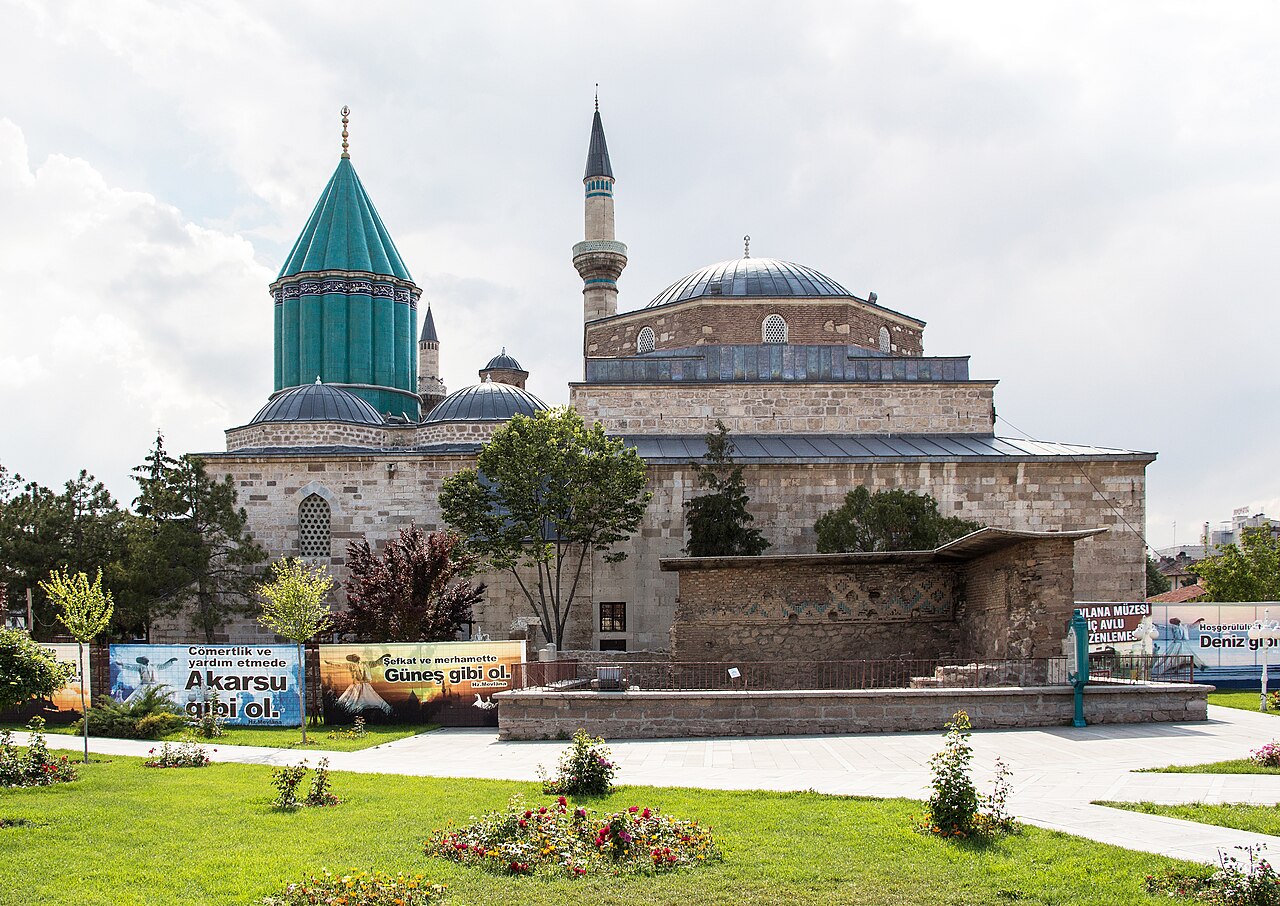
Rumi died in Konya on 17 December 1273. According to the hagiography of his follower Aflaki, Christians and Jews joined Muslims at the funeral. Mevlevis still commemorate the date as Shab-e Arus, the “wedding night” of the soul with God. His tomb under the green dome became the centre of the Mevlevi order, organised by Sultan Walad and his successors, known for the ritual music and turning dance of the sama’.
One poet, many claims
Turkey, Iran, Afghanistan and Tajikistan all regard Rumi as their own. He wrote almost entirely in Persian, with some Arabic and a few lines in Turkish and Greek, and he lived in Anatolia. Each claim has a basis, and none is complete. In the English-speaking world he is often read through loose modern versions, and many “Rumi quotes” online are not his at all; this site’s guide to real Rumi quotes in Persian separates the genuine from the invented, and Life of Rumi: America’s most-read poet looks at his modern fame. His younger contemporary in Shiraz, Saadi, lived through the same Mongol decades in a very different way.
Persian words from this page
| مولانا | Mowlânâ | our master (Rumi) |
| مثنوی معنوی | Masnavi-ye Ma’navi | the Masnavi |
| شمس تبریزی | Shams-e Tabrizi | Shams of Tabriz |
| نی | ney | reed flute |
| جدایی | jodâyi | separation |
| غزل | ghazal | lyric poem |
| بلخ | Balkh | Balkh |
Sources and further reading
- Franklin D. Lewis, Rumi: Past and Present, East and West. The Life, Teachings and Poetry of Jalal al-Din Rumi (2000; rev. ed. 2008).
- Jalal al-Din Rumi, The Mathnawi of Jalalu’ddin Rumi, ed. and trans. R. A. Nicholson, 8 vols. (1925–1940).
- Shams al-Din Aflaki, The Feats of the Knowers of God (Manaqeb al-‘arefin), trans. John O’Kane (2002).
- Annemarie Schimmel, The Triumphal Sun: A Study of the Works of Jalaloddin Rumi (1978).
- Badi’ al-Zaman Forouzanfar, Resaleh dar tahqiq-e ahval va zendegani-ye Mowlana (Persian biography of Rumi, 1936).
Love Persian poetry? Learn to read it: free Starter Pack
Get the 14-page printable Starter Pack (all 32 letters, a 7-day reading plan, 100 core words and 20 survival phrases) and a short 5-email course. Free.
More in The Mongol Invasion and the Ilkhanate (1219–1357)
- Genghis Khan’s Invasion of Iran (1219–1221)
- The Destruction of Nishapur, Merv and Herat
- Iran under the Great Khans (1225–1256)
- Hulagu Khan, Founder of the Ilkhanate
- The Fall of Alamut (1256)
- The Mongol Sack of Baghdad (1258)
- The Battle of Ain Jalut and the Mamluk Wars
- Nasir al-Din Tusi and the Maragheh Observatory
- Abaqa and Arghun: The Ilkhanate, 1265–1291
- Ghazan Khan and the Conversion to Islam
- Öljaitü and the Dome of Soltaniyeh
- Abu Sa’id and the Collapse of the Ilkhanate
- Juvayni and the History of the World Conqueror
- Rashid al-Din and the Jami al-Tawarikh
- Rumi (Mowlana): A Life from Balkh to Konya
- Saadi of Shiraz
- Ilkhanid Art and the Great Mongol Shahnameh
- The Ilkhanate and Europe
- Tabriz under the Ilkhans
- The Black Death and Iran