Öljaitü (1282–1316), Ilkhan of Iran from 1304 to 1316, was the brother and successor of Ghazan Khan. He is remembered for two things: his religious journey, which ended with him making Twelver Shi’ism the faith of the court, and the new capital he built at Soltaniyeh, between Zanjan and Qazvin, where his huge domed mausoleum still stands. The dome is one of the largest brick domes ever built and a UNESCO World Heritage Site.

| Full name | Öljaitü Sultan Muhammad Khodabandeh |
|---|---|
| Born | 1282 (some sources give 1280) |
| Reigned | 1304–1316 |
| Father | Arghun; mother Uruk Khatun, a Kerait Christian |
| Capitals | Tabriz, then Soltaniyeh |
| Died | 16 December 1316, Soltaniyeh |
| Successor | His son Abu Sa’id |
A prince of many faiths
Öljaitü’s religious life mirrors the mixed world of the early Ilkhanate. His mother was a Christian, and as a boy he was baptised with the name Nicholas, after Pope Nicholas IV, at a time when his father Arghun was courting the Latin West. He was brought up partly as a Buddhist, like his brother Ghazan. When Ghazan publicly converted to Islam in 1295, Öljaitü followed him into Sunni Islam.
His personal name changed almost as often. Persian chronicles record that he was first called Öljei Buqa, then Temüder, then Kharbanda, “mule-driver”, a protective name of a kind Mongols gave to children. As a Muslim ruler he became Khodabandeh, “servant of God”, and the Mongol name Öljaitü, “blessed”, is the one historians use.
Under Ghazan he governed Khorasan. When Ghazan died without a surviving son in May 1304, Öljaitü came west and was enthroned that summer. He kept on his brother’s ministers, above all Rashid al-Din, who finished the great history Jami al-Tawarikh during his reign.
From Sunni to Shi’a
The best-known episode of the reign is Öljaitü’s move to Twelver Shi’ism around 1309–1310. The chroniclers tell it as a story of disgust with quarrels: Hanafi and Shafi’i scholars at court argued so bitterly over points of law that the Ilkhan and his Mongol emirs began to wonder whether they had been right to give up their old ways. Shi’i theologians, above all the jurist al-Allama al-Hilli of Hilla in Iraq, won his favour.
Coins struck after the change carry the names of the twelve imams, and the Friday sermon was read in their names. The stucco mihrab Öljaitü added to the Jameh Mosque of Isfahan in 1310 is one of the finest pieces of Ilkhanid carving and has Shi’i content in its inscriptions. The change did not last as state policy: his son Abu Sa’id returned to Sunni Islam. It does show that Shi’ism had deep roots in Iran two centuries before the Safavids made it the state religion.
Building Soltaniyeh
The site of Soltaniyeh, سلطانیه, “the imperial”, is a high, well-watered plain that Mongol rulers used as summer pasture. Arghun had begun a settlement there. Öljaitü turned it into a capital from about 1305, with a citadel, palaces, mosques, a hospital, markets and houses for his ministers. Rashid al-Din built a whole quarter. Moving the court from Tabriz to a new city on open grassland was a very Mongol choice: it kept the ruler close to the pastures his army needed.
The city flourished for a few decades. It was the seat of a Catholic archbishop from 1318, and the Castilian envoy Ruy González de Clavijo still found it a busy market town when he passed through in 1404. Afterwards it declined to the village it is today, and almost all of the Ilkhanid city has gone.
The mausoleum
What survives is Öljaitü’s tomb, the Dome of Soltaniyeh, گنبد سلطانیه, built between about 1307 and 1313. It is an octagon crowned by a double-shelled, egg-shaped dome about 25 metres across and some 50 metres high. Eight minarets once rose from the corners of the roof. For its time it was an engineering feat, and art historians often link it to later great domes of the Islamic world, such as the Timurid domes of Samarkand.
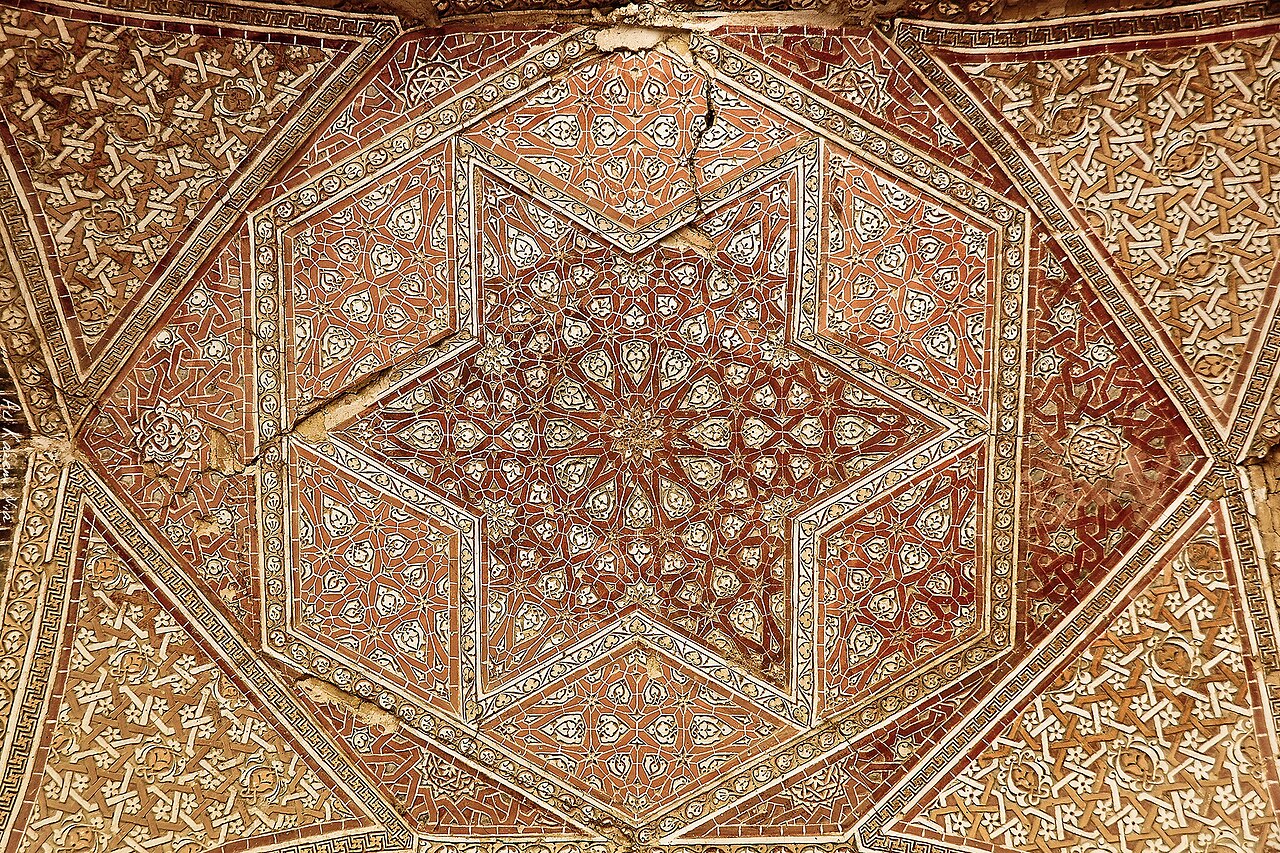
The interior has two layers of decoration. The first is glazed tile and carved brick in turquoise, cobalt and white. A few years later much of it was covered with painted plaster carrying large inscriptions and geometric patterns. Scholars have offered different explanations for this change, including Öljaitü’s change of faith and simple changes in taste; the evidence does not settle the question.
A later story says Öljaitü planned the building as a shrine for the remains of the imams Ali and Husayn, to be brought from Iraq. It is a tradition, not a documented plan. What is certain is that he was buried here in 1316. Restoration has gone on for decades, and since 2005 Soltaniyeh has been on the UNESCO World Heritage List. Visitors usually come from Zanjan, about 40 km away.
Wars and diplomacy
Öljaitü’s military record was mixed. In 1307 he sent armies into Gilan, the wet forested province south of the Caspian that the Mongols had never fully controlled. It was taken at a high cost, including the death of one of his leading emirs. In 1310 Ilkhanid troops and Kurdish tribesmen took the citadel of Erbil after a siege, massacring its Christian defenders, an episode that shows how far the position of Christians had fallen since Arghun’s day. His one major campaign against the Mamluks, the siege of Rahba on the Euphrates in 1312–1313, failed and was abandoned.
He kept up his father’s correspondence with Europe. In 1305 he wrote to Philip IV of France, proposing friendship among the Mongol rulers and the Christian kings; the letter survives in Paris. The story of these contacts is told on the page on the Ilkhanate and Europe.
Death and reputation
Öljaitü died at Soltaniyeh on 16 December 1316, in his mid-thirties. Court physicians were blamed, and the accusation that Rashid al-Din had poisoned him led to the old vizier’s execution in 1318. His heir, Abu Sa’id, was a boy of eleven.
Persian historians of the time, writing for his court, praise him as just and pious. Modern historians see a reign that kept Ghazan’s state together without his energy: generous patronage, costly building, and a slow drift of power toward the great emirs, which would shape the troubled reign of his son.
Persian words from this page
| الجایتو | Oljâytu | Öljaitü |
| خدابنده | Khodâbandeh | servant of God |
| سلطانیه | Soltâniyeh | Soltaniyeh, “the imperial” |
| گنبد | gonbad | dome |
| آرامگاه | ârâmgâh | tomb, mausoleum |
| زنجان | Zanjân | Zanjan |
Sources and further reading
- UNESCO World Heritage Centre, Soltaniyeh (inscribed 2005).
- Abu’l-Qasim Kashani, Tarikh-i Uljaytu, a Persian chronicle of the reign written by a court historian.
- J. A. Boyle, “Dynastic and Political History of the Il-Khans”, in The Cambridge History of Iran, vol. 5 (1968).
- Sheila S. Blair, “The Mongol Capital of Sultaniyya, ‘the Imperial'”, Iran 24 (1986).
- Linda Komaroff and Stefano Carboni (eds.), The Legacy of Genghis Khan: Courtly Art and Culture in Western Asia, 1256–1353 (2002).
Want to learn Persian? Get the free Starter Pack
Get the 14-page printable Starter Pack (all 32 letters, a 7-day reading plan, 100 core words and 20 survival phrases) and a short 5-email course. Free.
More in The Mongol Invasion and the Ilkhanate (1219–1357)
- Genghis Khan’s Invasion of Iran (1219–1221)
- The Destruction of Nishapur, Merv and Herat
- Iran under the Great Khans (1225–1256)
- Hulagu Khan, Founder of the Ilkhanate
- The Fall of Alamut (1256)
- The Mongol Sack of Baghdad (1258)
- The Battle of Ain Jalut and the Mamluk Wars
- Nasir al-Din Tusi and the Maragheh Observatory
- Abaqa and Arghun: The Ilkhanate, 1265–1291
- Ghazan Khan and the Conversion to Islam
- Öljaitü and the Dome of Soltaniyeh
- Abu Sa’id and the Collapse of the Ilkhanate
- Juvayni and the History of the World Conqueror
- Rashid al-Din and the Jami al-Tawarikh
- Rumi (Mowlana): A Life from Balkh to Konya
- Saadi of Shiraz
- Ilkhanid Art and the Great Mongol Shahnameh
- The Ilkhanate and Europe
- Tabriz under the Ilkhans
- The Black Death and Iran