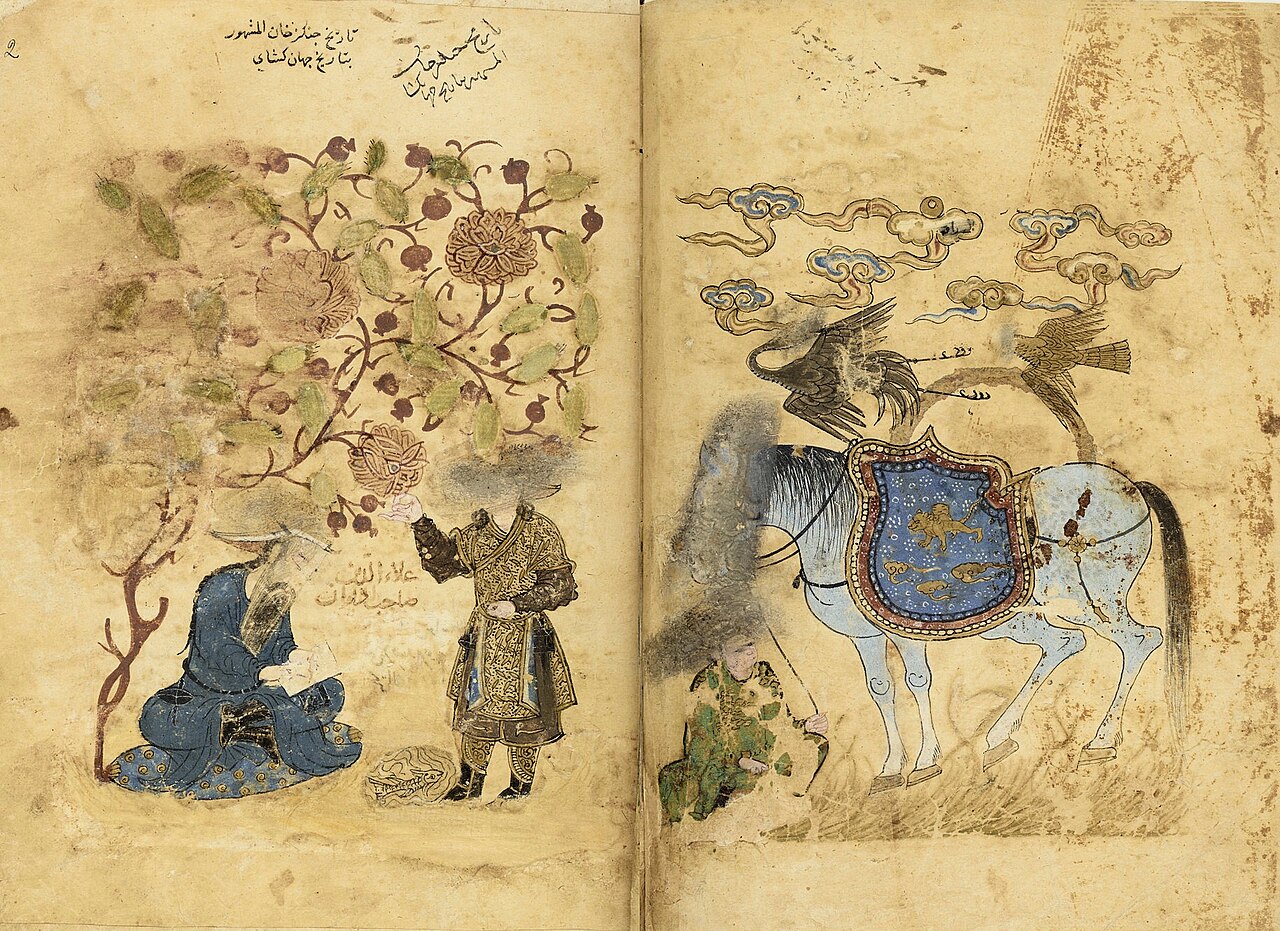
The Tarikh-i Jahangushay (تاریخ جهانگشای), “History of the World Conqueror”, is a Persian chronicle of Genghis Khan and his successors written in the 1250s by Ata-Malik Juvayni (1226–1283), an Iranian official who served the Mongols. It is the most important contemporary history of the Mongol conquest of Iran and of the fall of the Ismaili castles, written by a man who travelled to the Mongol capital and stood beside Hulagu at Alamut.
A family of administrators
Juvayni came from Juvayn, a district north-west of Nishapur in Khorasan. His family had served the Seljuks and the Khwarazmshahs as secretaries and financial officials. When the Mongols arrived, the family did what many Persian bureaucrats did: they went on doing their jobs under new masters. His father Baha al-Din became head of finance for the Mongol governors of Khorasan, and the young Ata-Malik joined the staff of the governor Arghun Aqa (not to be confused with the later Ilkhan Arghun).
In the service of Arghun Aqa he twice made the long journey to Mongolia. During a stay at Karakorum in about 1252–1253, after the enthronement of the Great Khan Möngke, friends urged him to record the deeds of the conquerors. He began the work there, and he wrote most of it within a few years, while still in his twenties.

What the book covers
The history is in three parts.
- Part one tells of the Mongols, their customs and the yasa (law) of Genghis Khan, his campaigns against the Khwarazmian Empire in 1219–1223, including the fall of Bukhara, Samarkand and the cities of Khorasan, and the reigns of Ögödei and Güyük.
- Part two is a history of the Khwarazmshah dynasty to its end with Jalal al-Din, followed by the Mongol governors of Khorasan, the world Juvayni knew from the inside.
- Part three covers Möngke’s accession, Hulagu’s march west and the destruction of the Nizari Ismaili state in 1256, with a long account of the Ismailis from their origins.
The book stops before the sack of Baghdad in 1258, which Juvayni witnessed. Some manuscripts add a short account of Baghdad’s fall attributed to Nasir al-Din Tusi.
Juvayni at Alamut
In 1256 Juvayni rode with Hulagu against the Ismaili strongholds. After the surrender of Alamut he asked to examine its famous library. By his own account he saved copies of the Qur’an, “choice books” and astronomical instruments, and burned works of Ismaili doctrine that he, as a Sunni, considered heretical. He also read the Ismaili chronicles there, including a life of Hassan-i Sabbah, and used them in his third part. Much of what we know about the early Nizaris comes, through Juvayni, from books he then destroyed.
A servant writing about his masters
Juvayni wrote for the Mongol court, and the book praises Genghis Khan and his house as rulers chosen by God. Yet the same pages give the most terrible descriptions of the conquest in Persian literature. He reports Genghis telling the people of Bukhara, from the pulpit of their mosque, that he was a punishment sent by God for their sins. And he records the words of a man who escaped from Bukhara, which became the most quoted line about the invasion:
آمدند و کندند و سوختند و کشتند و بردند و رفتند
“They came, they sapped, they burnt, they slew, they plundered and they departed.” (trans. J. A. Boyle)
Six verbs and no adjectives: Juvayni, whose usual style is very ornate, quotes it as the perfect summary of what happened. Elsewhere he laments that learning had died out and that men of culture were replaced by upstarts, and he presents the ruin as God’s will that a believer must accept. Historians read the book as a balancing act between loyalty to his employers and grief for his country.
The numbers problem
Juvayni gives huge death tolls: at Merv, he says, the counting of the dead took thirteen days and reached more than 1.3 million. Modern historians do not accept such figures as counts. They were probably far larger than any city’s population, and medieval writers used numbers to express horror. The scale of the destruction was nonetheless real, and Juvayni’s figures are one of the main sources for the debate over how many died (see The Destruction of Nishapur, Merv and Herat).
Style and influence
The prose is rhymed and elaborate, full of Arabic phrases, Qur’anic quotations and verses from the Shahnameh. It set a fashion for decorated historical prose that later chroniclers, such as Vassaf, pushed even further. Rashid al-Din used Juvayni heavily for the conquest period in his Jami al-Tawarikh, though he wrote in a plainer style and drew on Mongol informants that Juvayni did not have.
Governor of Baghdad and his fall
After 1259 Juvayni governed Baghdad and lower Iraq for more than twenty years. He is credited with repairing canals and with bringing a canal to Najaf. His brother Shams al-Din was sahib-divan, head of the Ilkhanid administration, so the brothers were among the most powerful Persians of their time (their political careers appear on the page on Abaqa and Arghun). Rivals accused Ata-Malik of embezzlement under Abaqa; he was arrested and humiliated, then restored under Ahmad Tegüder. He died in March 1283, and in 1284 Arghun had Shams al-Din executed.
Reading Juvayni today
The standard Persian text is the three-volume edition by Mirza Muhammad Qazvini (1912–1937). J. A. Boyle’s English translation, The History of the World-Conqueror (1958), is readable and well annotated. For learners of Persian, the opening of the Bukhara chapter is a hard but rewarding text: the vocabulary of the court historian mixed with short, plain sentences like the one above.
Persian words from this page
| جوینی | Joveyni | Juvayni |
| جهانگشا | jahângoshâ | world conqueror |
| تاریخ | târikh | history |
| صاحب دیوان | sâheb-divân | head of the administration |
| بخارا | Bokhârâ | Bukhara |
| سوختند | sukhtand | they burned |
| رفتند | raftand | they went, departed |
Sources and further reading
- Ata-Malik Juvayni, Tarikh-i Jahangushay, ed. Mirza Muhammad Qazvini, 3 vols., E. J. W. Gibb Memorial Series (1912–1937).
- Ata-Malik Juvayni, The History of the World-Conqueror, trans. J. A. Boyle (1958; reprinted 1997 with an introduction by David Morgan).
- “Jovayni, ‘Ala’-al-Din ‘Ata-Malek”, Encyclopaedia Iranica.
- David Morgan, The Mongols, 2nd ed. (2007), chapter on the sources.
- George Lane, Early Mongol Rule in Thirteenth-Century Iran: A Persian Renaissance (2003).
Want to learn Persian? Get the free Starter Pack
Get the 14-page printable Starter Pack (all 32 letters, a 7-day reading plan, 100 core words and 20 survival phrases) and a short 5-email course. Free.
More in The Mongol Invasion and the Ilkhanate (1219–1357)
- Genghis Khan’s Invasion of Iran (1219–1221)
- The Destruction of Nishapur, Merv and Herat
- Iran under the Great Khans (1225–1256)
- Hulagu Khan, Founder of the Ilkhanate
- The Fall of Alamut (1256)
- The Mongol Sack of Baghdad (1258)
- The Battle of Ain Jalut and the Mamluk Wars
- Nasir al-Din Tusi and the Maragheh Observatory
- Abaqa and Arghun: The Ilkhanate, 1265–1291
- Ghazan Khan and the Conversion to Islam
- Öljaitü and the Dome of Soltaniyeh
- Abu Sa’id and the Collapse of the Ilkhanate
- Juvayni and the History of the World Conqueror
- Rashid al-Din and the Jami al-Tawarikh
- Rumi (Mowlana): A Life from Balkh to Konya
- Saadi of Shiraz
- Ilkhanid Art and the Great Mongol Shahnameh
- The Ilkhanate and Europe
- Tabriz under the Ilkhans
- The Black Death and Iran