Ghazan (1271–1304), Ilkhan of Iran from 1295, publicly converted to Islam in June 1295 and made the Mongol state in Iran a Muslim monarchy. With his vizier Rashid al-Din he issued a series of reforms of taxation, coinage, land grants and justice meant to restore a country still damaged by decades of war and heavy taxes. His reign is usually seen as the high point of the Ilkhanate.
| Born | November 1271, in Mazandaran |
|---|---|
| Reigned | 1295–1304 |
| Died | May 1304, near Qazvin, aged 32 |
| Father | Arghun |
| Muslim name | Mahmud; title Padishah-i Islam |
| Conversion | June 1295, at Firuzkuh, through Shaykh Sadr al-Din Ibrahim Hamuya |
| Vizier | Rashid al-Din Fazlullah Hamadani (from 1298) |
| Tomb | Shanb-e Ghazan, Tabriz (largely lost) |
| Successor | His brother Öljaitü |
A Buddhist prince in Khorasan
Ghazan was the son of the Ilkhan Arghun and grew up at the court of his grandfather Abaqa. He was raised as a Buddhist and, as governor of Khorasan from the 1280s, built Buddhist temples there. Rashid al-Din, who knew him well, says he learned several languages and took an interest in medicine, crafts and the history of the Mongols, which he knew better than most of the Mongol elders.
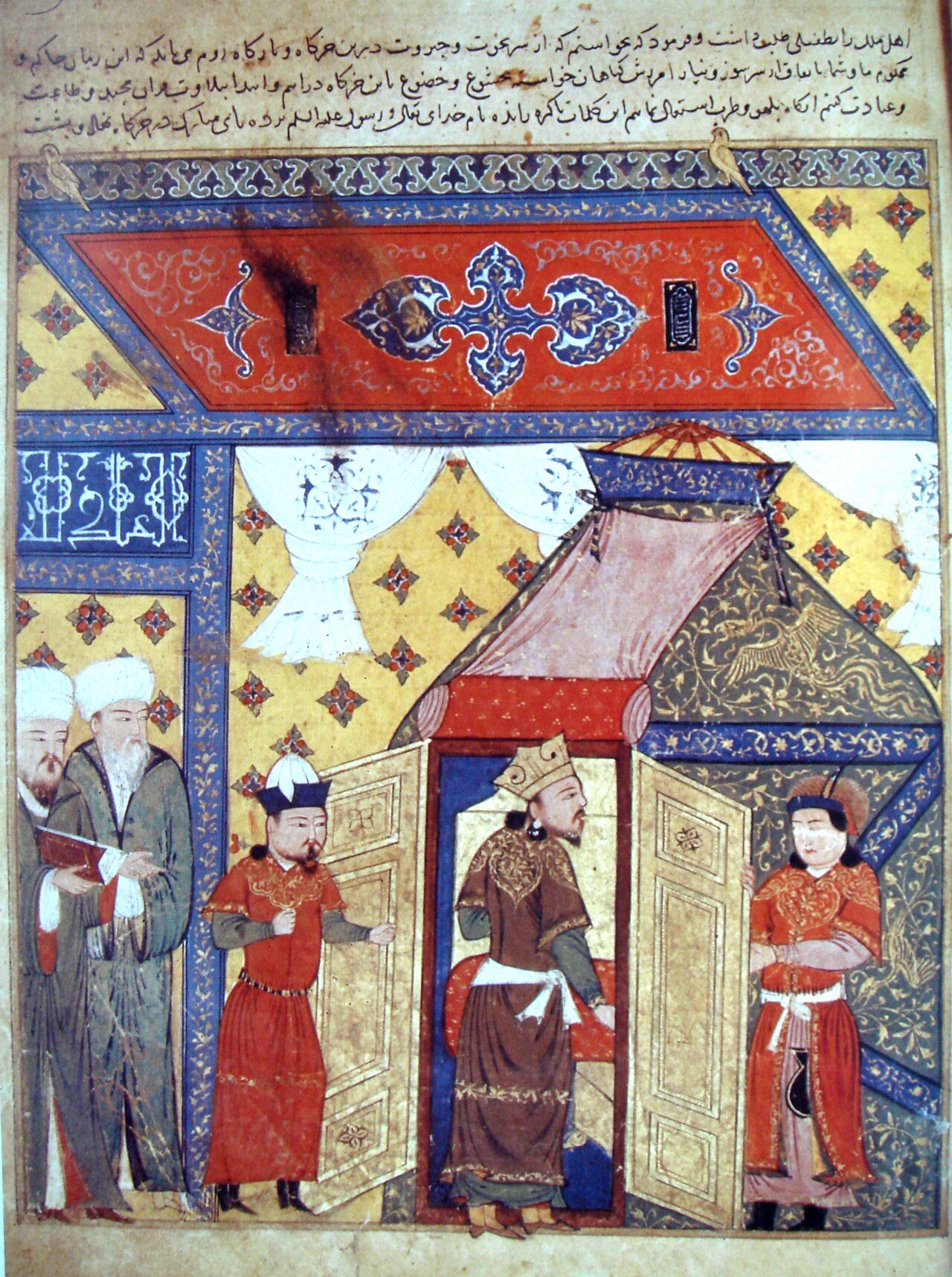
In 1295 the throne was held by Baydu, who had overthrown Ghazan’s uncle Gaykhatu. Ghazan went to war against him, and the decisive support came from the emir Nawruz, a Muslim commander who urged him to convert. In June 1295, at Firuzkuh in the Alborz mountains, Ghazan made the profession of faith before Shaykh Sadr al-Din Ibrahim Hamuya, a Sufi from a prominent Khorasani family, together with many of his followers. With the backing of Muslim commanders and many Mongol troops who had already converted, he defeated Baydu, who was killed in October 1295, and was enthroned the following month.

Why did he convert?
Rashid al-Din presents the conversion as a sincere act of faith. Later Persian historians agreed and celebrated Ghazan as the restorer of Islam in Iran. Modern historians usually also see political calculation: by the 1290s many of the Mongol rank and file in Iran had become Muslims, and conversion won Ghazan the support he needed against Baydu. The two motives are not exclusive. Whatever its causes, the conversion was lasting. Every later Ilkhan was a Muslim, and the Mongol ruling class in Iran became part of Muslim society.
The first years were harsh for other faiths. Under pressure from Nawruz, orders went out to destroy Buddhist temples, churches and synagogues in Tabriz, Baghdad and elsewhere, and the poll tax (jizya) on non-Muslims was revived. Buddhist monks were told to convert or leave. Nawruz fell from power and was executed in 1297, and the pressure on Christians and Jews then eased, but Buddhism, which had flourished at the Ilkhanid court for forty years, disappeared from Iran.
The reforms
Ghazan inherited an empty treasury. Gaykhatu’s failed paper money of 1294 had disrupted trade, and Rashid al-Din describes a countryside where peasants fled from repeated, unpredictable demands by tax collectors, officials and soldiers. The reforms are known mainly from the texts of Ghazan’s decrees (yarligh) preserved in Rashid al-Din’s history. Their main points were:
- Fixed tax assessments recorded in registers for each district, with fixed dates of payment, to end repeated collection of the same tax.
- Limits on the use of the postal relay system (yam) and on demands for food and lodging by travelling officials and envoys.
- Land grants (iqta) to Mongol soldiers from 1303, so that troops were supported from particular districts instead of by arbitrary levies.
- Standard silver coinage struck throughout the realm, and uniform weights and measures.
- Measures against banditry on the roads, rules for the courts and for written legal documents, and incentives to bring abandoned land back into cultivation.
How much these measures achieved is debated. Rashid al-Din, their author, describes great success, and some historians, such as I. P. Petrushevsky, accepted much of his account. Others note that the reforms survive almost only in the words of the minister who drafted them, and that many problems they describe, such as the abuse of the postal service, returned under Ghazan’s successors. Most agree that the reign marks a deliberate turn by Mongol rulers towards governing Iran in the interest of its settled population.
Builder, patron and soldier
Outside Tabriz, Ghazan built a new quarter around his own tomb, known as Shanb-e Ghazan or Ghazaniyya. It included a mosque, two madrasas, a hospital, a library, an observatory and lodgings for Sufis, all paid for by endowments. Little of it survives today, but the idea of a royal tomb at the centre of a charitable complex influenced later monuments such as his brother’s dome at Soltaniyeh. Ghazan also commissioned Rashid al-Din to write a history of the Mongols, which grew into the Jami al-Tawarikh, one of the first attempts at a world history.
Conversion did not end the war with the Mamluks. In December 1299 Ghazan defeated a Mamluk army at Wadi al-Khazandar near Homs and occupied Damascus for a few months in 1300, but could not hold Syria. A second invasion ended in defeat at Marj al-Saffar in 1303 (see Ain Jalut and the Mamluk wars). In Damascus the scholar Ibn Taymiyya argued that the Mongols, though they professed Islam, still followed Mongol law and could be fought as unbelievers.
Ghazan also distanced the Ilkhanate from the Great Khan in China. He kept friendly relations with the Yuan court, but his coins dropped the name of the Great Khan and bore Islamic formulas and his own titles. He died in May 1304, aged 32, and was buried in his tomb at Tabriz.
Persian words from this page
| غازان خان | Ghâzân Khân | Ghazan Khan |
| اسلام | eslâm | Islam |
| پادشاه | pâdeshâh | king, emperor |
| رشیدالدین | Rashid od-Din | Rashid al-Din |
| فیروزکوه | Firuzkuh | Firuzkuh |
| سکه | sekke | coin |
| اصلاحات | eslâhât | reforms |
Sources and further reading
- Rashid al-Din, Jami al-Tawarikh, translated by W. M. Thackston (Harvard, 1998–1999), the history of Ghazan.
- I. P. Petrushevsky, “The Socio-Economic Condition of Iran under the Il-Khans”, in The Cambridge History of Iran, vol. 5 (1968).
- Charles Melville, “Pādshāh-i Islām: The Conversion of Sultan Maḥmūd Ghāzān Khān”, Pembroke Papers 1 (1990).
- Reuven Amitai, Holy War and Rapprochement: Studies in the Relations between the Mamluk Sultanate and the Mongol Ilkhanate (1260–1335) (Brepols, 2013).
- Encyclopaedia Iranica, “Ghazan Khan, Maḥmud”.
Want to learn Persian? Get the free Starter Pack
Get the 14-page printable Starter Pack (all 32 letters, a 7-day reading plan, 100 core words and 20 survival phrases) and a short 5-email course. Free.
More in The Mongol Invasion and the Ilkhanate (1219–1357)
- Genghis Khan’s Invasion of Iran (1219–1221)
- The Destruction of Nishapur, Merv and Herat
- Iran under the Great Khans (1225–1256)
- Hulagu Khan, Founder of the Ilkhanate
- The Fall of Alamut (1256)
- The Mongol Sack of Baghdad (1258)
- The Battle of Ain Jalut and the Mamluk Wars
- Nasir al-Din Tusi and the Maragheh Observatory
- Abaqa and Arghun: The Ilkhanate, 1265–1291
- Ghazan Khan and the Conversion to Islam
- Öljaitü and the Dome of Soltaniyeh
- Abu Sa’id and the Collapse of the Ilkhanate
- Juvayni and the History of the World Conqueror
- Rashid al-Din and the Jami al-Tawarikh
- Rumi (Mowlana): A Life from Balkh to Konya
- Saadi of Shiraz
- Ilkhanid Art and the Great Mongol Shahnameh
- The Ilkhanate and Europe
- Tabriz under the Ilkhans
- The Black Death and Iran