Iranian manners rest on hospitality and on careful, ritual politeness called taarof. Guests are treated with great generosity, elders and strangers are addressed formally, and offers are often made and refused several times before anyone accepts. Knowing a few customs and phrases makes everyday encounters, from a taxi ride to a family dinner, much easier.
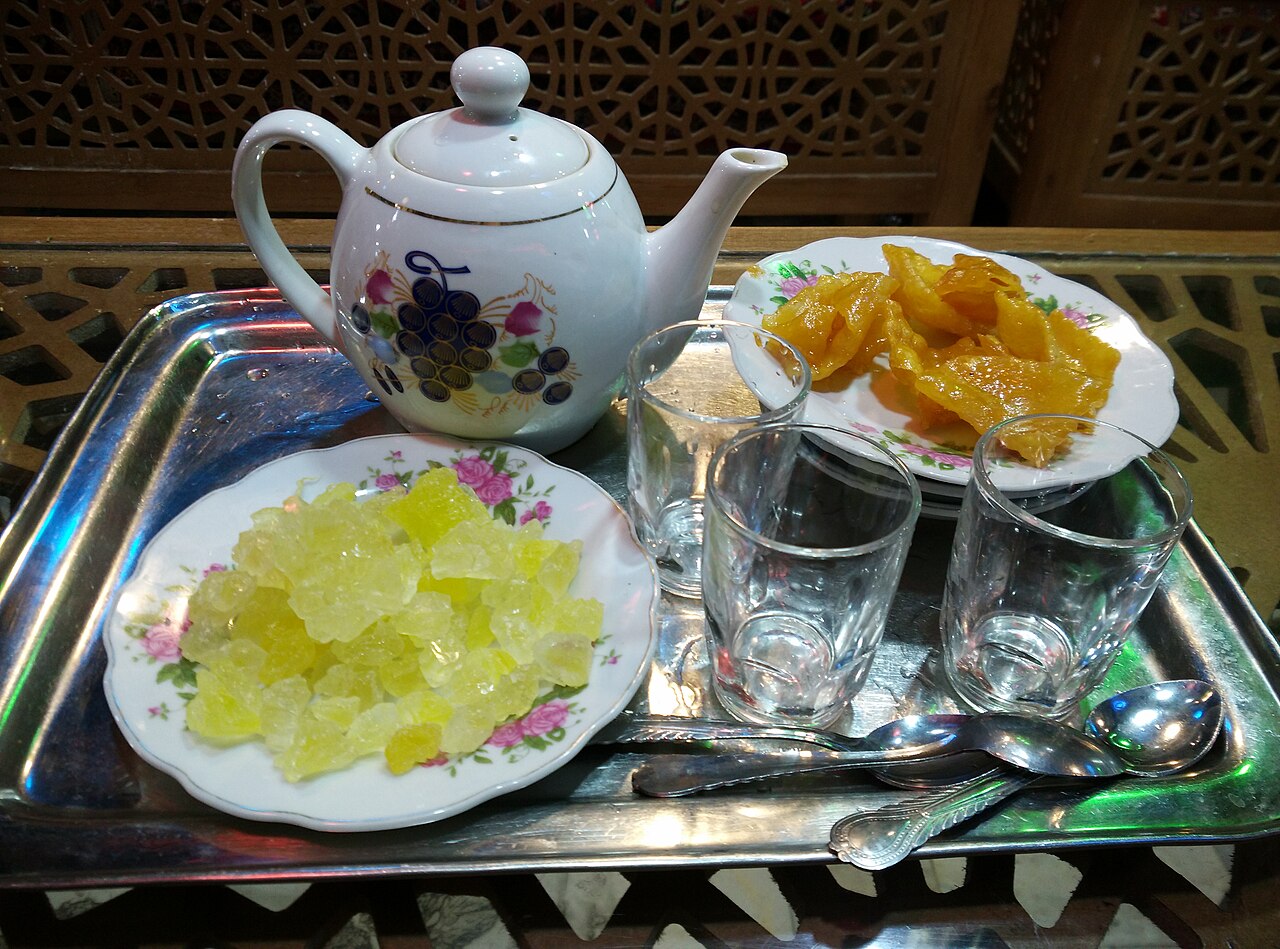

The guest as a gift from God
A Persian saying calls the guest habib-e khodâ, “the beloved of God”, and hospitality is taken very seriously. A visitor to a home, an office or even a shop will usually be offered tea at once, then fruit, sweets and often a meal. Hosts put the best food in front of the guest and keep refilling the plate. Travellers in Iran regularly find themselves invited home by people they have just met on a bus or in a park.
Behind this sits an old distinction between the outer world and the inner, family world. Traditional houses had a reception area for visitors (biruni) and a private family area (andaruni), and the same line still runs through social life. In public Iranians tend to be reserved and formal; among family and close friends they are warm, loud and informal.
Greetings and forms of address
The everyday greeting is salâm, followed by questions about health and family. It is polite for the younger person, or the one entering the room, to greet first. To someone who is working, or has just finished a task, people say khaste nabâshid, “may you not be tired”, which is used far more widely than any English equivalent.
Adults are addressed as âghâ (Mr) or khânom (Mrs, Ms) followed by the surname, or by the first name with the title for a little more warmth (Âghâ-ye Reza, Maryam Khânom). Persian has a polite “you”, shomâ, and an informal to; with strangers and older people use shomâ. Doctors and engineers are often called by their title: doktor, mohandes.
Men shake hands with men, and close friends of the same sex kiss on both cheeks. Many religious Iranians do not shake hands with someone of the opposite sex. A man meeting a woman should wait to see whether she offers her hand; placing the right hand on the chest with a slight nod is a polite alternative.
Taarof in everyday life
Taarof (تعارف, ta’ârof) is the set of polite rituals of offering, refusing, insisting and self-deprecation. A shopkeeper or taxi driver may say ghâbel nadâre, “it’s not worthy of you”, when you ask the price; this is a courtesy, and you are expected to insist and pay. A host will offer food again and again, and a guest is expected to decline at least once before accepting. At a doorway two people may spend a while each insisting the other go first, saying befarmâyid (“please, after you”).
For visitors the safest rule is to make or refuse an offer twice, and to accept on the third time if the other person still insists. Our article on taarof, the Persian art of politeness explains the rules and the phrases in detail.
Visiting an Iranian home
- Shoes: take them off at the door. Many homes have carpets on the floor, and families often eat seated on the floor around a cloth (sofreh).
- Gifts: bring a box of pastries, flowers or fruit. A gift is often put aside and opened later rather than in front of the giver.
- Food: you will be served more than you can eat. Leaving a little on the plate shows you have had enough; an empty plate will be refilled. Compliments on the food are welcome, and the host may reply nush-e jân, “may it nourish your soul”.
- Thanks: dastetun dard nakone, “may your hand not hurt”, is the standard thanks for a meal or any effort made for you.
- Timing: dinner is often late, at nine or ten in the evening, and leaving takes time; saying goodbye can last half an hour at the door.
Behaving in public
Dress
Iranian law requires women to cover their hair and to wear loose clothing that covers the arms and the body to the thighs or below, and this applies to foreign visitors. Enforcement has varied a great deal over the years. Since the protests of 2022 many women in Tehran and other large cities have appeared in public without a headscarf, and the authorities’ response has shifted between tolerance and crackdowns. Men usually wear long trousers in public, and shorts are rare outside sports. At major shrines women are asked to wear a chador, which is often lent at the entrance.
Religion and the calendar
During Ramadan eating, drinking and smoking in public in daytime are not allowed. During Muharram, especially on Tasua and Ashura, the mood is one of mourning: avoid music, bright parties and jokes about the rituals. The page on Iranian festivals and public holidays lists these periods.
Other points
- Couples, married or not, generally avoid kissing or embracing in public.
- The thumbs-up sign is traditionally a rude gesture in Iran, though younger Iranians know its Western meaning.
- Photographing government buildings, military sites and police is forbidden and can lead to arrest. Ask before photographing people, especially women.
- Iranians are usually happy to talk about poetry, food, football and family. They may ask direct questions about salary, marriage or children. Political subjects are best left for the other person to raise.
Useful phrases
A few words of Persian are always received warmly, and even a short phrase will often bring praise for your “excellent” Persian, which is itself a small piece of taarof. For more travel phrases, see travel words and phrases in Persian.
Persian words from this page
| سلام | salâm | hello |
| خسته نباشید | khaste nabâshid | “may you not be tired” |
| بفرمایید | befarmâyid | please (go ahead, help yourself) |
| قابل ندارد | ghâbel nadâre | “it’s not worthy of you” |
| دستتان درد نکند | dastetun dard nakone | thank you (for your effort) |
| نوش جان | nush-e jân | enjoy your meal |
| مهمان | mehmân | guest |
| ببخشید | bebakhshid | excuse me, sorry |
Sources and further reading
- William O. Beeman, Language, Status, and Power in Iran, Indiana University Press, 1986 (the classic study of taarof).
- Encyclopaedia Iranica, “Taʿārof”.
- Michael Axworthy, Iran: Empire of the Mind, Penguin, 2008.
- Hooman Majd, The Ayatollah Begs to Differ: The Paradox of Modern Iran, Doubleday, 2008.
Want to learn Persian? Get the free Starter Pack
Get the 14-page printable Starter Pack (all 32 letters, a 7-day reading plan, 100 core words and 20 survival phrases) and a short 5-email course. Free.
More in Iran Facts and Overview
- Iran at a Glance: Key Facts and Figures
- Geography of Iran: Mountains, Deserts and Seas
- Climate of Iran and the Best Time to Visit
- The 31 Provinces of Iran
- The People of Iran: Ethnic Groups
- Languages Spoken in Iran
- Religion in Iran Today
- How Iran Is Governed
- The Economy of Iran
- Iranian Currency: Rial and Toman Explained
- Persian Food: Dishes Every Visitor Should Try
- Iranian Festivals and Public Holidays
- Iranian Culture and Etiquette
- Iranian Handicrafts
- UNESCO World Heritage Sites in Iran
- Iran Records and Superlatives
- National Symbols of Iran
- Sports in Iran
- Practical Tips for Travelling to Iran