Football is by far the most popular sport in Iran, but wrestling is the one Iranians most often call their national sport and the source of most of the country’s Olympic medals. Volleyball, weightlifting and taekwondo also have big followings, and the zurkhaneh, a traditional gymnasium where men train to drumming and poetry, keeps an older sporting culture alive.

| Most popular sport | Football (فوتبال, futbâl) |
|---|---|
| Traditional national sport | Wrestling (کشتی, koshti) |
| FIFA World Cups | 7 appearances: 1978, 1998, 2006, 2014, 2018, 2022, 2026; never past the group stage |
| AFC Asian Cup | Champions 1968, 1972, 1976 |
| Paris 2024 Olympics | 12 medals: 3 gold, 6 silver, 3 bronze (21st in the medal table) |
| UNESCO intangible heritage | Pahlevani and zurkhaneh rituals (2010); chogân, horseback polo with music (2017) |
Football: Team Melli and the Tehran derby
The national team, known as Team Melli, won the Asian Cup three times in a row between 1968 and 1976 and has reached seven World Cups. Its most celebrated match is the 2–1 win over the United States at the 1998 World Cup in Lyon, which set off street celebrations across Iran. At the 2026 World Cup, held in North America while Iran was at war, the team drew all three group games (2–2 with New Zealand, 0–0 with Belgium and 1–1 with Egypt) and went out in the group stage. Ali Daei scored 109 goals for Iran between 1993 and 2006, a world record for men’s international football until Cristiano Ronaldo passed it in 2021.
At club level the great rivalry is between the two Tehran clubs, Persepolis (red) and Esteghlal (blue), whose derby, the Sorkhâbi (“red-blue”), fills Azadi Stadium. Clubs from Isfahan (Sepahan) and Tabriz (Tractor) have also won the league title.
Women and the stadium
For decades after 1979 women were not allowed to attend men’s football matches in stadiums. The issue came to world attention in 2019, when Sahar Khodayari, arrested for trying to enter a match, set herself on fire and died; under pressure from FIFA, women were allowed into a World Cup qualifier in Tehran that October. Since then women have been admitted to some national team and league games, but access remains limited and has varied from season to season.
Wrestling, the national sport
Wrestling (koshti) has deep roots in Iran, from the folk styles of the provinces, such as koshti-ye pahlavâni and the belt wrestling of Gilan and Khorasan, to Olympic freestyle and Greco-Roman. The sport’s great hero is Gholamreza Takhti, Olympic champion in Melbourne in 1956 and world champion, remembered as much for his modesty and help for earthquake victims as for his wins. He died in 1968, and his funeral became a large public gathering. Wrestlers have won the largest share of Iran’s Olympic medals; at Paris 2024, Mohammad Hadi Saravi and Saeid Esmaeili both won gold in Greco-Roman.
Other Olympic sports
- Weightlifting: Iran’s first Olympic medal was a weightlifting bronze in London in 1948. Hossein Rezazadeh won the super-heavyweight gold in 2000 and 2004 and was a national celebrity.
- Taekwondo: Hadi Saei won Olympic gold in 2004 and 2008, and Arian Salimi won gold in Paris in 2024. In 2016 Kimia Alizadeh won bronze in taekwondo, the first Olympic medal for an Iranian woman; she later left Iran and has since competed for other teams.
- Volleyball: the men’s team is one of the strongest in Asia and has played at the Olympics, and big matches draw television audiences close to football’s.
- Paralympic sport: Iran is one of the leading nations in sitting volleyball and has strong powerlifting and athletics teams.
Politics has affected some competitions. Iranian athletes have for many years withdrawn from or avoided matches against Israeli opponents, and in 2019 the International Judo Federation suspended Iran’s judo federation after the world champion Saeid Mollaei said he had been ordered to lose a bout to avoid meeting an Israeli.
The zurkhaneh: the house of strength
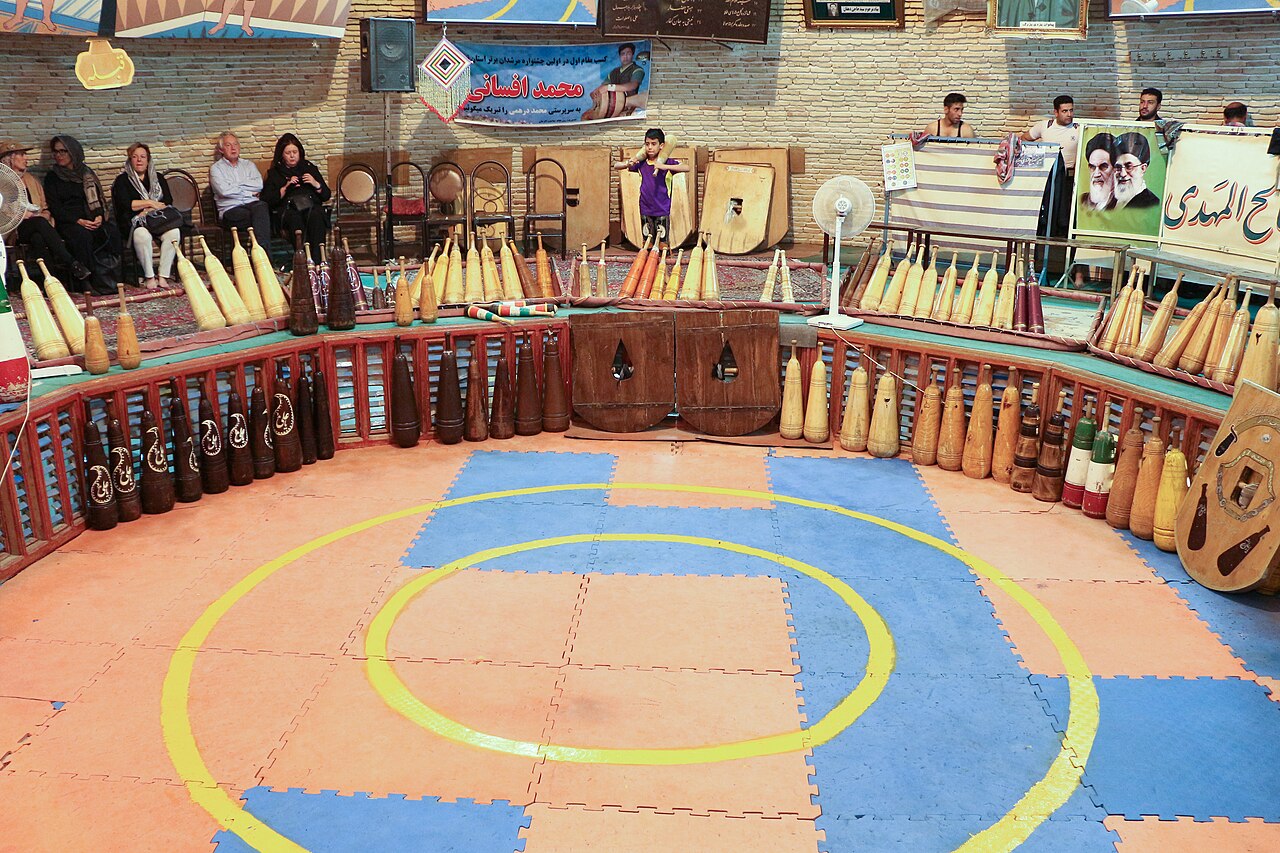
The zurkhaneh (زورخانه, zurkhâneh) is a traditional gym, often a domed room built around a sunken octagonal pit (gowd). Men in embroidered knee-length breeches exercise there in a group, led by a morshed who sits in a raised alcove, beats a goblet drum (zarb), rings a bell and chants verses from the Shahnameh and religious poetry. The routine includes push-ups, swinging heavy wooden clubs (mil), lifting a large iron bow hung with rings (kabbâdeh) and spinning in place (charkh). The ethic of the zurkhaneh is javânmardi, chivalry: strength used with humility and for others. UNESCO added the Pahlevani and zurkhaneh rituals to its Representative List in 2010. The history of this and of polo is told in Sports in Iranian History.
Polo, mountains and snow
Polo (chogân) was played by Sasanian kings, and the stone goalposts still stand at each end of Naqsh-e Jahan Square in Isfahan, which was used as a polo field under the Safavids; see Polo, Hunting and Games at the Sasanian Court. In the Alborz, Tehranis ski at Dizin and Shemshak in winter (see Skiing in Iran) and climb Damavand in summer. Our post on the most popular sports in Iran has a shorter overview with sport vocabulary.
Persian words from this page
| ورزش | varzesh | sport, exercise |
| فوتبال | futbâl | football |
| کشتی | koshti | wrestling |
| زورخانه | zurkhâneh | “house of strength” |
| جوانمردی | javânmardi | chivalry |
| چوگان | chogân | polo |
| تیم ملی | tim-e melli | national team |
Sources and further reading
- H. E. Chehabi, “The Politics of Football in Iran”, Soccer and Society, 2006.
- Philippe Rochard and H. E. Chehabi, “The identities of the Iranian zurkhānah”, Iranian Studies, 2002.
- UNESCO Intangible Cultural Heritage: “Pahlevani and Zoorkhanei rituals” (2010); “Chogān, a horse-riding game accompanied by music and storytelling” (2017).
- Olympic results: Iran at the 2024 Summer Olympics (official Paris 2024 results).
Want to learn Persian? Get the free Starter Pack
Get the 14-page printable Starter Pack (all 32 letters, a 7-day reading plan, 100 core words and 20 survival phrases) and a short 5-email course. Free.
More in Iran Facts and Overview
- Iran at a Glance: Key Facts and Figures
- Geography of Iran: Mountains, Deserts and Seas
- Climate of Iran and the Best Time to Visit
- The 31 Provinces of Iran
- The People of Iran: Ethnic Groups
- Languages Spoken in Iran
- Religion in Iran Today
- How Iran Is Governed
- The Economy of Iran
- Iranian Currency: Rial and Toman Explained
- Persian Food: Dishes Every Visitor Should Try
- Iranian Festivals and Public Holidays
- Iranian Culture and Etiquette
- Iranian Handicrafts
- UNESCO World Heritage Sites in Iran
- Iran Records and Superlatives
- National Symbols of Iran
- Sports in Iran
- Practical Tips for Travelling to Iran