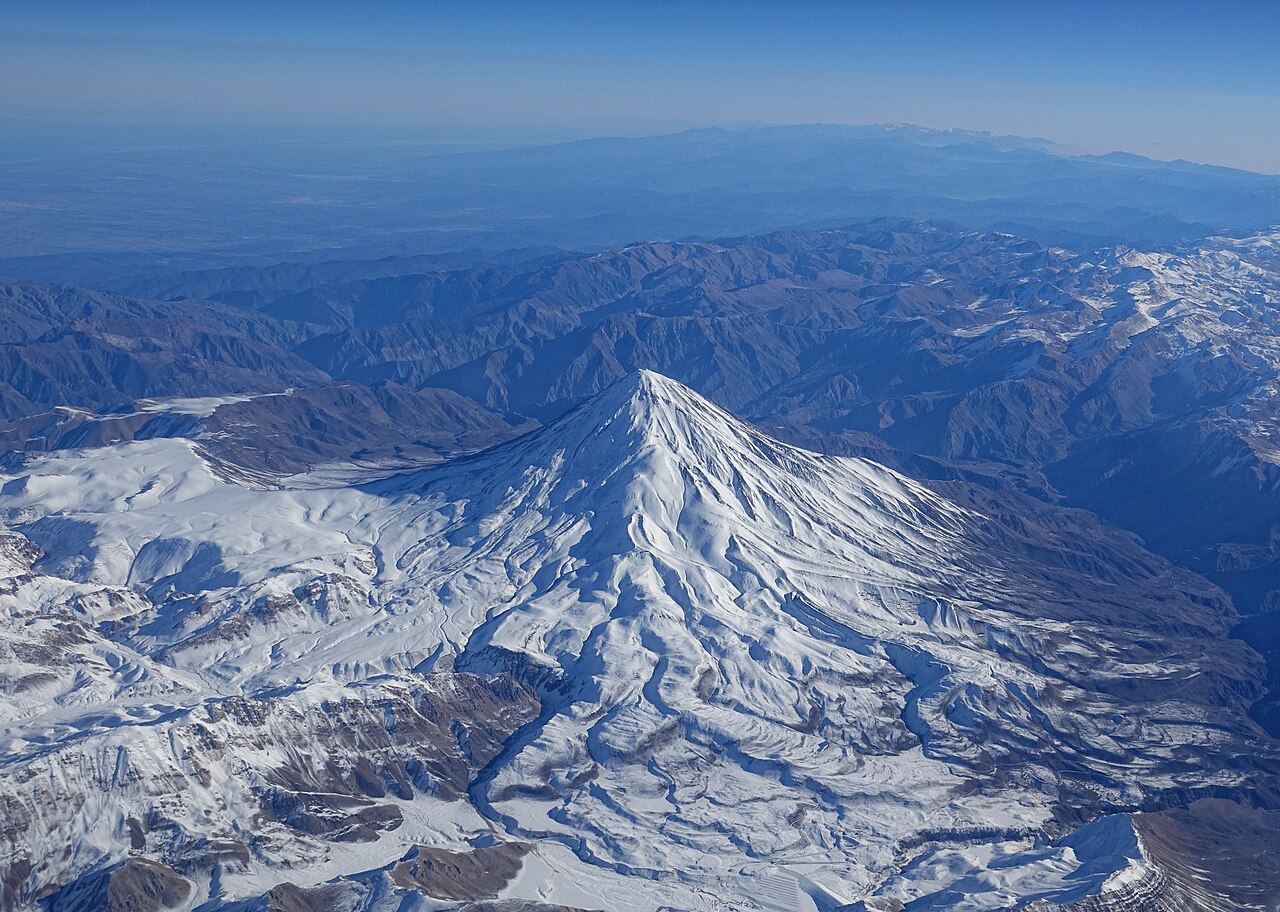
Iran holds some genuine world records and many more claims. Mount Damavand, at about 5,610 metres, is the highest peak in Iran and the highest volcano in Asia; satellites have measured ground temperatures above 80°C in the Lut Desert; and Iran’s qanats and early farming villages are among the oldest of their kind. This page sorts the well-founded superlatives from the ones that are only often repeated.

A word on method: “the largest” and “the oldest” are easy to say and hard to prove. Where a record rests on a careful measurement or a published study, it is given as fact. Where it is a popular claim that depends on how a category is defined, it is marked “often described as”.
Highest, lowest, hottest
| Highest point | Mount Damavand (دماوند), about 5,610 m; published figures range from 5,609 to 5,671 m |
|---|---|
| Lowest point | The Caspian Sea shore, about 28 m below sea level |
| Hottest ground | Dasht-e Lut: 70.7°C land surface temperature (2005); up to 80.8°C in a 2021 study |
| Largest lake on the border | The Caspian Sea, the largest enclosed body of water on Earth |
Damavand
Damavand is a dormant stratovolcano in the Alborz range north-east of Tehran. It is the highest mountain in Iran and the Middle East and the highest volcano in Asia, and it still gives off sulphurous gas near the summit. In the Shahnameh, the hero Fereydun chains the tyrant Zahhak inside the mountain. See Mount Damavand and our post on climbing Damavand.
The Lut Desert
The Lut (دشت لوت) in south-eastern Iran is the strongest candidate for the hottest place on Earth, though the record is for the temperature of the ground surface, not of the air. A NASA-supported study by David Mildrexler and colleagues, published in 2011, found a land surface temperature of 70.7°C in the Lut in 2005, the highest in seven years of MODIS satellite data. A later study in the Bulletin of the American Meteorological Society (2021) reported surface readings of up to 80.8°C in both the Lut and the Sonoran Desert. The black volcanic pebbles of the Gandom Beryan plateau absorb the most heat. The Lut was also Iran’s first natural World Heritage Site (2016); see Dasht-e Lut.
Oldest
- Early farming: at Chogha Golan in the Zagros foothills, archaeologists found evidence of the cultivation of wild barley, wheat and lentils from about 11,700 years ago, one of the earliest records of plant cultivation anywhere. At Ganj Dareh, near Kermanshah, goats were being managed by herders around 10,000 years ago, among the earliest known cases of animal domestication. See Prehistoric Iran.
- Wine: jars from Hajji Firuz Tepe in north-western Iran, dated to about 5400 to 5000 BCE, contained residues of resinated wine, among the oldest chemical evidence for wine in the world.
- An artificial eye: a woman buried at Shahr-e Sukhteh around 2900 to 2800 BCE wore an artificial eyeball made of a light material, possibly bitumen paste, with gold lines; it is often called the oldest known artificial eye. See Shahr-e Sukhteh.
- Qanats: Iran’s underground water channels go back at least to the early first millennium BCE. The qanat of Qasabeh at Gonabad, built roughly between 700 and 500 BCE, runs for about 33 km with 427 wells and is still flowing; it is one of the deepest and longest in the country. See The Qanat of Gonabad and Qanats: Iran’s Ancient Water Tunnels.
- A living tree: the Cypress of Abarkuh (Sarv-e Abarkuh) in Yazd province is usually estimated at around 4,000 years old or more, which would make it one of the oldest living trees in Asia. Its age has not been fixed by tree-ring dating, so the figure is an estimate.
Largest and tallest
- An empire: under Darius I, around 500 BCE, the Achaemenid Empire stretched from Egypt and Thrace to the Indus, the largest empire the world had yet seen. Estimates of its area are around 5 million square kilometres or more.
- An adobe citadel: Arg-e Bam, in Kerman province, is often described as the largest adobe (mud-brick) building complex in the world. Much of it collapsed in the earthquake of 26 December 2003, which killed more than 26,000 people in Bam, and it has since been partly rebuilt. See Arg-e Bam.
- A brick tower: Gonbad-e Qabus in Golestan, built in 1006, rises 53 metres, and is often called the tallest brick tower in the world.
- A brick dome: the Dome of Soltaniyeh, built for the Ilkhan Öljaitü in the early 14th century, is often listed as the third-largest brick dome in the world, after Florence Cathedral and Hagia Sophia.
- A windcatcher: the badgir of Dowlatabad Garden in Yazd, built in the 18th century, is 33.8 metres high, often called the tallest adobe windcatcher in the world. See Dowlatabad Garden.
- A ziggurat: Chogha Zanbil, built around 1250 BCE, is among the largest and best-preserved ziggurats outside Mesopotamia.
- A covered bazaar: the Tabriz bazaar is often described as the largest covered bazaar in the world. See Tabriz Historic Bazaar.
- A square: Naqsh-e Jahan Square in Isfahan, laid out under Shah Abbas I from 1598, measures roughly 560 by 160 metres, one of the largest city squares in the world. See Naqsh-e Jahan Square.
- A tower: Milad Tower in Tehran, completed in 2007, is about 435 metres high, the tallest structure in Iran and one of the tallest telecommunications towers in the world.
Natural records
- Ancient forests: the Hyrcanian forests along the Caspian are relics of broadleaf forests that, according to UNESCO, date back 25 to 50 million years, when such forests covered much of the northern hemisphere.
- Saffron: Iran grows most of the world’s saffron, usually estimated at around 90 percent of global production, mainly in Razavi and South Khorasan.
- A salt lake in crisis: Lake Urmia was once the largest lake in the Middle East and one of the largest salt lakes on Earth; dams, irrigation and drought shrank it dramatically from the 1990s onward. See Lake Urmia.
Claims to treat with care
Some superlatives repeated on travel sites are weaker than they look. “Oldest civilisation in the world” is not a meaningful claim: Iran has one of the longest continuous histories of urban life and states, but Mesopotamia and Egypt developed cities and writing at about the same time or earlier. Claims that a single game, garden or invention “began in Iran” are often uncertain. Chess, for example, reached Iran from India in the 6th century and the Persian word shâh gave English “check” and “checkmate”, but the game itself was not invented in Iran. For a lighter collection of facts, see our 50 interesting facts about Iran, and for the land itself, the geography of Iran.
Persian words from this page
| دماوند | Damâvand | Mount Damavand |
| کویر | kavir | salt desert |
| بادگیر | bâdgir | windcatcher |
| ارگ | arg | citadel |
| سرو | sarv | cypress |
| زعفران | za’farân | saffron |
| بلندترین | bolandtarin | highest, tallest |
Sources and further reading
- D. J. Mildrexler, M. Zhao and S. W. Running, “Satellite finds highest land skin temperatures on Earth”, Bulletin of the American Meteorological Society, 2011.
- S. Riehl, M. Zeidi and N. J. Conard, “Emergence of agriculture in the foothills of the Zagros Mountains of Iran”, Science, 2013.
- P. E. McGovern and others, “Neolithic resinated wine”, Nature, 1996 (Hajji Firuz Tepe).
- UNESCO World Heritage Centre listings for Lut Desert, The Persian Qanat, Gonbad-e Qābus, Bam and its Cultural Landscape and Hyrcanian Forests.
- Encyclopaedia Iranica, “Damāvand”.
Want to learn Persian? Get the free Starter Pack
Get the 14-page printable Starter Pack (all 32 letters, a 7-day reading plan, 100 core words and 20 survival phrases) and a short 5-email course. Free.
More in Iran Facts and Overview
- Iran at a Glance: Key Facts and Figures
- Geography of Iran: Mountains, Deserts and Seas
- Climate of Iran and the Best Time to Visit
- The 31 Provinces of Iran
- The People of Iran: Ethnic Groups
- Languages Spoken in Iran
- Religion in Iran Today
- How Iran Is Governed
- The Economy of Iran
- Iranian Currency: Rial and Toman Explained
- Persian Food: Dishes Every Visitor Should Try
- Iranian Festivals and Public Holidays
- Iranian Culture and Etiquette
- Iranian Handicrafts
- UNESCO World Heritage Sites in Iran
- Iran Records and Superlatives
- National Symbols of Iran
- Sports in Iran
- Practical Tips for Travelling to Iran