Iran is mostly dry, with hot summers and cold winters on the central plateau, but its climate changes sharply from region to region: the Caspian coast is humid and wet all year, the Persian Gulf coast is extremely hot from May to October, and the north-western mountains have snowy winters. For most travellers the best times to visit are spring (late March to May) and autumn (late September to November), while winter suits the south coast and the deserts.
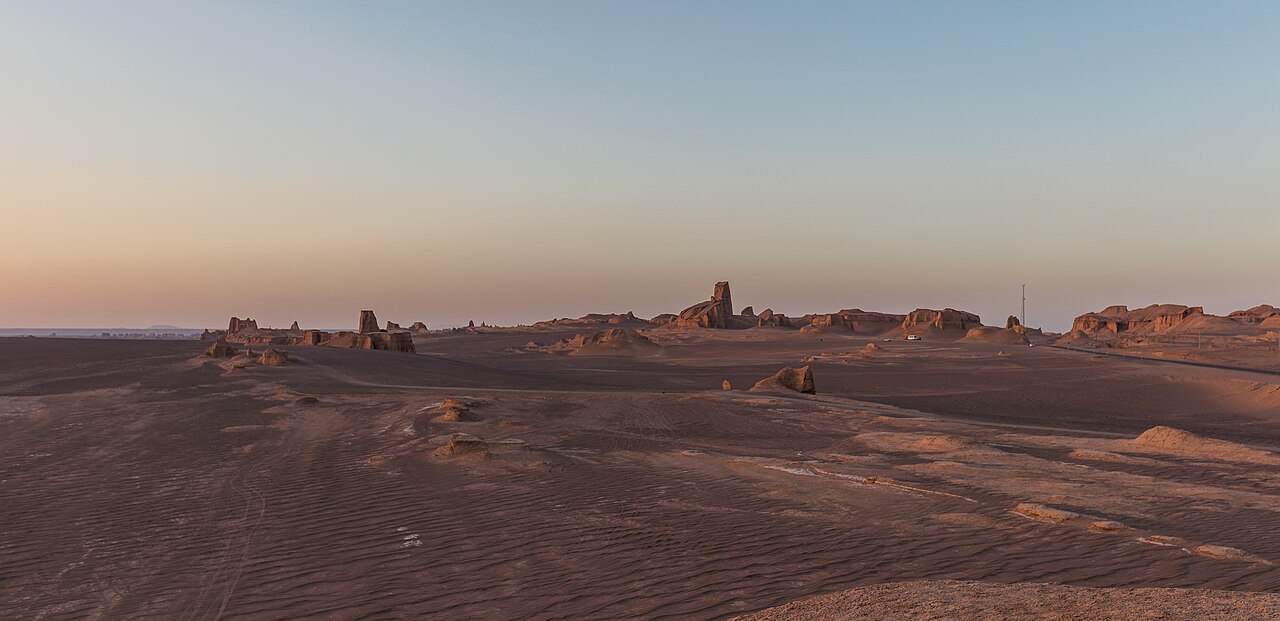

Why Iran is so dry
Iran’s average annual rainfall is often given as about 250 millimetres, less than a third of the world average over land. The reason is its shape. The Alborz and Zagros catch the moist air arriving from the Caspian and the Mediterranean, so the rain and snow fall on the outer slopes and the interior basins lie in a rain shadow. Most of the rain that does reach the plateau falls between November and April. Summer on the plateau is almost completely dry, and in a bad year whole provinces go months without rain. The droughts of the 2020s, and especially the very dry autumn of 2025, left reservoirs serving Tehran, Mashhad and other cities at record lows.
Five climates in one country
The central plateau
Tehran, Isfahan, Shiraz, Kashan, Qom and Mashhad share a continental semi-arid or arid climate. Summer days are hot and dry, typically in the mid to upper 30s °C in July in Tehran, but nights cool down because of the altitude. Winters are crisp, with frosts and occasional snow. Tehran gets roughly 200 to 250 mm of rain a year. A common winter problem is air pollution: when cold air is trapped under warmer air, smog builds up over the capital and the authorities sometimes close schools and offices.
The deserts
In Yazd, Kerman and the edges of the Kavir and Lut, rainfall can be well under 100 mm a year. Summer air temperatures pass 40°C, while winter nights can drop below freezing. The traditional architecture of these towns, windcatchers (بادگیر, bâdgir), thick mud-brick walls and underground cisterns, is a direct answer to this climate; see our page on Yazd.
The Caspian coast
Gilan, Mazandaran and Golestan are a different world: mild, humid and green, with rain in every season and the heaviest falls in autumn. Rasht and Bandar Anzali receive well over 1,000 mm a year, several times the national average, which is why Rasht is nicknamed the city of rain. Summers are muggy rather than hot. Rice, tea and citrus grow here. Our Rasht page and the post on Shomal, the north of Iran describe the region.
The Persian Gulf and Gulf of Oman coast
Khuzestan, Bushehr, Hormozgan and the coast of Sistan and Baluchestan have short, mild winters and very long, very hot summers. Ahvaz regularly records some of the highest air temperatures of any city in the world, above 48°C, with dry heat, while Bandar Abbas and the islands combine heat with high humidity. From December to March, by contrast, the coast and islands such as Kish and Qeshm are pleasant, with daytime temperatures in the 20s °C. The far south-east feels the edge of the Indian monsoon, and Chabahar on the Gulf of Oman has milder summers than the Persian Gulf ports.
The north-western and western mountains
East and West Azerbaijan, Ardabil, Kurdistan and Hamadan have the coldest winters in Iran. Snow lies for weeks, and temperatures of minus 10°C or lower are common in January in Ardabil and on the high plains. Summers are warm and pleasant, which makes the north-west a good choice in July and August, when the rest of the plateau is hot.
Winds and dust
Several regions have famous seasonal winds. In Sistan, the “wind of 120 days” (باد صد و بیست روزه) blows from late spring to early autumn, carrying sand from the dried Hamun lakes. Khuzestan and the south-west suffer dust storms blowing in from Iraq and the Arabian Peninsula, which can close airports and schools. These storms have become more frequent as wetlands on both sides of the border have dried.
The best time to visit, region by region
- Classic route (Tehran, Kashan, Isfahan, Yazd, Shiraz): April to May and October to early November. Shiraz is famous for its orange blossom in spring.
- Deserts and the Lut: November to February; summer is dangerous.
- Persian Gulf islands and coast: December to March.
- Caspian coast and Alborz: May to October; spring and autumn bring the most colour, summer the most visitors.
- North-west and Kurdistan: June to September.
Two calendar points matter as much as the weather. During the first two weeks of the Iranian new year, from about 20 March, Iranians travel in huge numbers and hotels fill up; see Nowruz, the Persian New Year. And the months of Muharram and Ramadan, which move through the seasons each year, change the rhythm of daily life. Our practical tips for travelling to Iran cover planning, and for safety readers should follow their own government’s current travel advice, which in 2026 advised against travel to Iran for many countries’ citizens.
Persian words from this page
| آب و هوا | âb-o havâ | weather, climate |
| بهار | bahâr | spring |
| تابستان | tâbestân | summer |
| پاییز | pâyiz | autumn |
| زمستان | zemestân | winter |
| باران | bârân | rain |
| برف | barf | snow |
| بادگیر | bâdgir | windcatcher |
Sources and further reading
- M. H. Ganji, “Climate”, in W. B. Fisher (ed.), The Cambridge History of Iran, Vol. 1 (Cambridge, 1968).
- Encyclopaedia Iranica, “Climate” (iranicaonline.org).
- Iran Meteorological Organization, climate normals for Tehran, Rasht, Yazd, Ahvaz and Bandar Abbas.
- H. E. Beck and others, “Present and future Köppen-Geiger climate classification maps at 1-km resolution”, Scientific Data 5 (2018).
Want to learn Persian? Get the free Starter Pack
Get the 14-page printable Starter Pack (all 32 letters, a 7-day reading plan, 100 core words and 20 survival phrases) and a short 5-email course. Free.
More in Iran Facts and Overview
- Iran at a Glance: Key Facts and Figures
- Geography of Iran: Mountains, Deserts and Seas
- Climate of Iran and the Best Time to Visit
- The 31 Provinces of Iran
- The People of Iran: Ethnic Groups
- Languages Spoken in Iran
- Religion in Iran Today
- How Iran Is Governed
- The Economy of Iran
- Iranian Currency: Rial and Toman Explained
- Persian Food: Dishes Every Visitor Should Try
- Iranian Festivals and Public Holidays
- Iranian Culture and Etiquette
- Iranian Handicrafts
- UNESCO World Heritage Sites in Iran
- Iran Records and Superlatives
- National Symbols of Iran
- Sports in Iran
- Practical Tips for Travelling to Iran