Iran is governed under the constitution of 1979, amended in 1989, which combines elected bodies, a president and a parliament, with unelected religious institutions headed by the Supreme Leader. The Supreme Leader is the most powerful figure in the state; since March 2026 the post has been held by Mojtaba Khamenei, chosen after his father Ali Khamenei was killed in a US and Israeli strike. The elected president, Masoud Pezeshkian since 2024, runs the government day to day.
| System | Islamic republic based on velâyat-e faqih (guardianship of the Islamic jurist) |
|---|---|
| Constitution | Approved by referendum December 1979; revised 1989 |
| Supreme Leader | Mojtaba Khamenei (from March 2026); before him Ali Khamenei (1989 to 2026) and Ruhollah Khomeini (1979 to 1989) |
| President | Masoud Pezeshkian (from July 2024); four-year term, at most two in a row |
| Parliament | Islamic Consultative Assembly (Majlis), 290 seats; speaker Mohammad Bagher Ghalibaf |
| Head of the judiciary | Gholam-Hossein Mohseni-Eje’i (since 2021) |
| Last national elections | Parliament and Assembly of Experts, March 2024; president, June and July 2024 |
The Supreme Leader
The office of Supreme Leader (رهبر, rahbar) grew out of Ayatollah Khomeini’s theory that, in the absence of the hidden twelfth Imam, a qualified Islamic jurist should guide the community. The constitution gives the Leader wide powers: he sets the general policies of the state, is commander-in-chief of the regular army and the Islamic Revolutionary Guard Corps (IRGC), can declare war and peace, and appoints the head of the judiciary, the head of state broadcasting, the top military commanders and half of the Guardian Council. He confirms the elected president in office and may dismiss him after a ruling of the Supreme Court or a vote of parliament. There is no fixed term. See our history pages on Ruhollah Khomeini and Ali Khamenei.
The succession of 2026
The system faced its first succession since 1989 during the war that began on 28 February 2026. With Ali Khamenei dead, Article 111 of the constitution came into force: a temporary council made up of the president, the head of the judiciary and a cleric of the Guardian Council, Alireza Arafi, took over the Leader’s duties. The Assembly of Experts announced on 8 to 9 March 2026 that it had chosen Mojtaba Khamenei, a mid-ranking cleric born in 1969 and long influential behind the scenes. The Assembly described the vote as unanimous; The New York Times and Bloomberg, citing their own sources, reported a divided vote and pressure from the IRGC. As of November 2026 he had issued written messages through state media but had not been seen in public, and reports about his health from foreign media and intelligence sources remained unconfirmed.

The president and the government
The president (رئیسجمهور, ra’is-jomhur) is elected by direct popular vote and heads the executive. He proposes the budget, appoints ministers, who each need a vote of confidence from parliament, and chairs the Supreme National Security Council, the body that coordinates defence and foreign policy. Masoud Pezeshkian, a heart surgeon and former health minister, won the early election of 2024 that followed the death of President Ebrahim Raisi in a helicopter crash. He defeated Saeed Jalili in a run-off on 5 July; turnout was about 40 percent in the first round, the lowest for any presidential election in the Islamic Republic, and about 50 percent in the run-off. His presidency is covered on our Pezeshkian presidency page.
Parliament (Majlis)
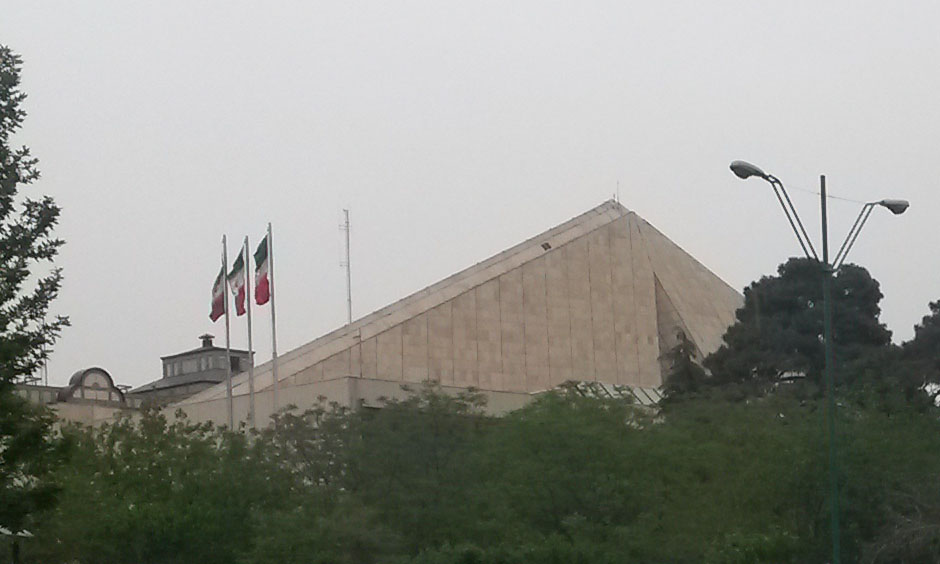
The Islamic Consultative Assembly, usually called the Majles (مجلس), has 290 members elected for four years from constituencies across the provinces, including five seats reserved for religious minorities. It passes laws, approves the budget and international treaties, and can question and impeach ministers; in March 2025 it removed the economy minister, Abdolnaser Hemmati, over inflation and the falling rial. Its speaker since 2020, Mohammad Bagher Ghalibaf, a former IRGC commander and mayor of Tehran, also led Iran’s delegation in the 2026 talks with the United States.
The Guardian Council
The Guardian Council (شورای نگهبان, Shurâ-ye Negahbân) has twelve members serving six-year terms: six Islamic jurists appointed by the Supreme Leader and six lawyers nominated by the head of the judiciary and approved by parliament. It has two powerful tasks. Every bill passed by parliament must be approved by the Council as compatible with Islamic law and the constitution. And it vets every candidate for president, parliament and the Assembly of Experts. In 2024, for example, it approved six of the 80 people who registered to run for president. Supporters of the system say vetting protects the constitution’s Islamic character; organisations such as Human Rights Watch and Freedom House say it prevents genuinely competitive elections, and Freedom House rates Iran “Not Free”.
The Assembly of Experts and the Expediency Council
The Assembly of Experts (مجلس خبرگان, Majles-e Khebregân) is a body of 88 clerics elected by popular vote for eight years, again after Guardian Council vetting. Its constitutional job is to choose the Supreme Leader and, in theory, to supervise him and remove him if he can no longer fulfil his duties. In practice it met in public mainly to endorse the Leader until 2026, when it made only the second choice of a Leader in its history. The Expediency Discernment Council, whose members are appointed by the Leader, settles disputes between parliament and the Guardian Council and advises the Leader on general policy.
The judiciary, the armed forces and local government
The head of the judiciary is appointed by the Leader for five-year terms and appoints the chief justice and the prosecutor-general. Alongside ordinary courts sit Revolutionary Courts, which hear cases of national security, drug trafficking and political offences, and the Special Court for the Clergy. Amnesty International, Iran Human Rights and the UN Special Rapporteur on Iran have criticised unfair trials and the very high number of executions in recent years; the judiciary says it applies Islamic law and protects national security. The armed forces are divided between the regular army (Artesh) and the IRGC, which also controls the Basij volunteer militia and has large economic interests. At the local level, voters elect city and village councils, which choose mayors.
How power works in practice
Scholars of Iran, such as Wilfried Buchta and Ervand Abrahamian, describe the system as a set of competing centres of power: elected officials, the Leader’s office, the clergy, the IRGC and powerful foundations. Elected presidents have often clashed with unelected bodies, from Khatami’s reform era to Pezeshkian’s government, whose ministers, according to a report in August 2026, were told by the Leader to stop publicising the country’s problems. Many analysts have argued that the war of 2026 strengthened the IRGC’s position. For the origins of this structure, read the 1979 referendum and the new constitution; for religion’s place in public life, see religion in Iran today.
Persian words from this page
| رهبر | rahbar | leader, Supreme Leader |
| ولایت فقیه | velâyat-e faqih | guardianship of the jurist |
| رئیسجمهور | ra’is-jomhur | president |
| مجلس | majles | parliament |
| شورای نگهبان | shurâ-ye negahbân | Guardian Council |
| مجلس خبرگان | majles-e khebregân | Assembly of Experts |
| انتخابات | entekhâbât | elections |
| سپاه | sepâh | the IRGC (short form) |
Sources and further reading
- Constitution of the Islamic Republic of Iran (1979, amended 1989), especially Articles 91 to 99, 107 to 112 and 113 to 142.
- Wilfried Buchta, Who Rules Iran? The Structure of Power in the Islamic Republic (Washington Institute for Near East Policy, 2000).
- Ervand Abrahamian, A History of Modern Iran (Cambridge, 2008).
- Freedom House, Freedom in the World: Iran.
- Reuters, Al Jazeera and The New York Times reporting on the succession of March 2026.
Want to learn Persian? Get the free Starter Pack
Get the 14-page printable Starter Pack (all 32 letters, a 7-day reading plan, 100 core words and 20 survival phrases) and a short 5-email course. Free.
More in Iran Facts and Overview
- Iran at a Glance: Key Facts and Figures
- Geography of Iran: Mountains, Deserts and Seas
- Climate of Iran and the Best Time to Visit
- The 31 Provinces of Iran
- The People of Iran: Ethnic Groups
- Languages Spoken in Iran
- Religion in Iran Today
- How Iran Is Governed
- The Economy of Iran
- Iranian Currency: Rial and Toman Explained
- Persian Food: Dishes Every Visitor Should Try
- Iranian Festivals and Public Holidays
- Iranian Culture and Etiquette
- Iranian Handicrafts
- UNESCO World Heritage Sites in Iran
- Iran Records and Superlatives
- National Symbols of Iran
- Sports in Iran
- Practical Tips for Travelling to Iran