Persian food is built around rice. A typical Iranian meal pairs steamed rice (chelow) with a slow-cooked stew (khoresh) or with kebabs, and puts fresh herbs, yoghurt and flatbread on the side. The flavours come from saffron, dried lime, herbs, walnuts and pomegranate, and from a balance of sour and sweet rather than chilli heat.

| Staples | Rice (برنج, berenj) and flatbread (نان, nân) |
|---|---|
| Key flavours | Saffron, dried lime, turmeric, fresh herbs, walnuts, pomegranate molasses, barberries, rosewater |
| Dish most often called national | Chelow kabab (rice with grilled kebab) |
| Everyday drinks | Black tea (chây) and doogh, a salted yoghurt drink |
| UNESCO links | Rasht, Creative City of Gastronomy (2015); lavash flatbread culture, Representative List (2016, shared with four neighbours) |
This page explains how a Persian meal fits together and which dishes are worth looking for. For a longer alphabetical list of dish names with pronunciation, see Iranian food names: 40+ Persian dishes. The story of how this cuisine developed, from Sasanian court banquets to modern Tehran, is told in A History of Persian Cuisine.
Rice: chelow, polow and the prized tahdig
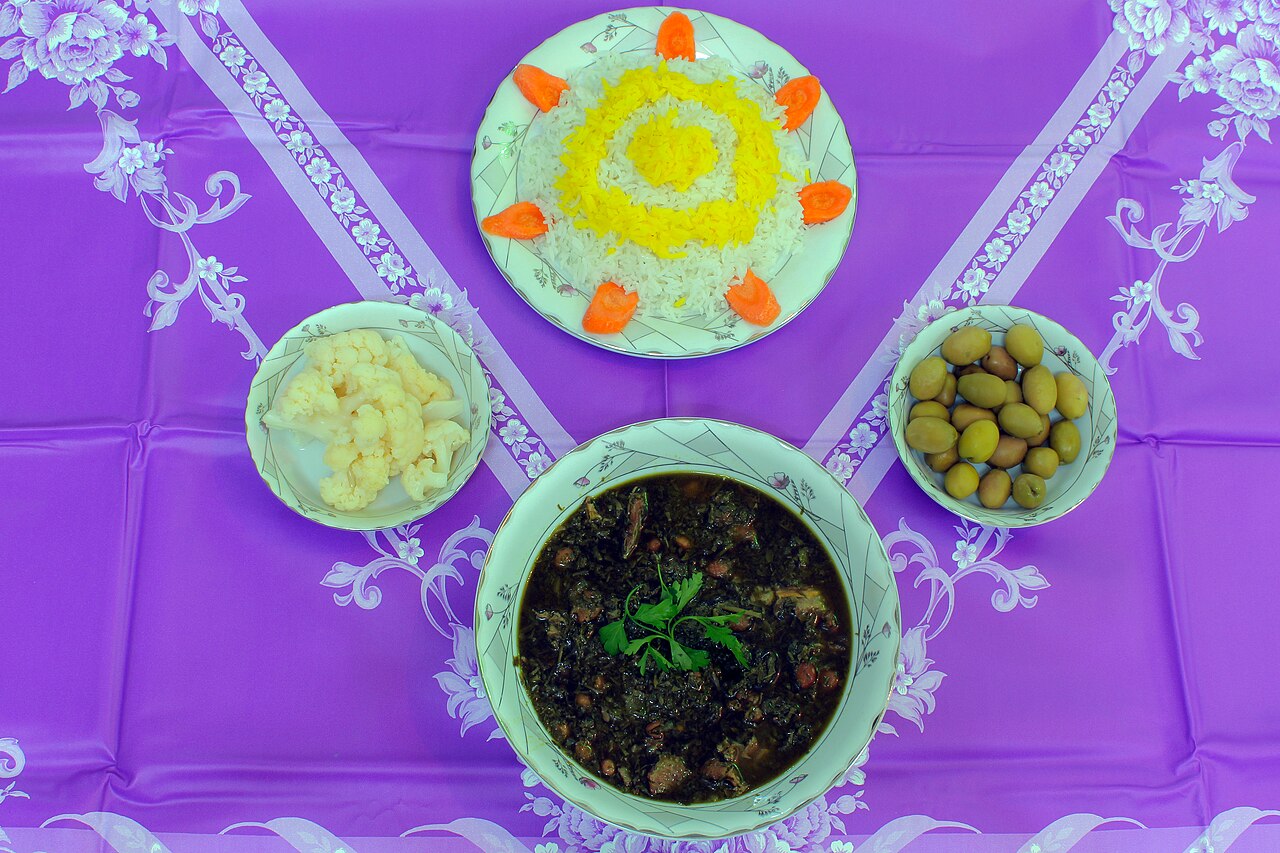
Iranians take rice seriously. Long-grain rice is soaked, boiled briefly, drained and then steamed slowly over low heat with oil or butter, so that each grain stays separate. Plain rice cooked this way is chelow. A spoonful is often coloured with saffron water and scattered on top.
The layer that forms on the bottom of the pot is tahdig (تهدیگ), literally “bottom of the pot”. It can be plain golden rice, or rice laid over thin slices of potato or flatbread. At family meals it is the part people reach for first.
When rice is cooked together with other ingredients it becomes polow. Some common ones:
- Zereshk polow: saffron rice with sour barberries, usually served with chicken.
- Bâghâli polow: rice with dill and broad beans, often with a braised lamb shank.
- Albâlu polow: rice with sour cherries.
- Lubiyâ polow: rice with green beans, minced meat and tomato, an everyday family dish.
- Shirin polow: “sweet rice” with orange peel, almonds and pistachios, made for weddings.
In the Caspian provinces of Gilan and Mazandaran, where rice is grown, people often cook kateh: rice simmered until it has absorbed all its water, without draining. It is quicker and stickier than chelow.
Khoresh: the stews that go with rice
A khoresh (خورش) is a slow-cooked stew of meat, vegetables or pulses, served over or beside rice. Three appear on almost every restaurant menu and in most home kitchens.
Ghormeh sabzi
Ghormeh sabzi (قورمهسبزی) is a deep green stew of herbs (parsley, coriander, fenugreek and leek or chives) fried slowly until dark, then cooked with lamb or beef, kidney beans and whole dried limes. Many Iranians name it as their favourite dish. The fenugreek gives it a smell that lingers in the house for hours.
Gheymeh
Gheymeh is a tomato-based stew of yellow split peas and small pieces of meat, flavoured with dried lime and topped with crisp fried potato straws. It is the dish most often cooked in large pots and given away as nazri (votive food) during the mourning month of Muharram.
Fesenjun
Fesenjun is made from ground walnuts cooked down for hours with pomegranate molasses until the sauce turns almost black. It is usually made with chicken or duck. Cooks in the north tend to make it more sour; in Tehran and the south it is often sweetened.
Other stews worth trying are khoresh-e bâdemjân (aubergine and tomato), khoresh-e karafs (celery and herbs) and, in spring, khoresh-e rivâs with wild rhubarb.
Kebabs: restaurant and street food
Kebab (کباب, kabâb) is what most visitors eat first, because it is the standard restaurant meal. Kabâb-e kubideh is minced lamb or beef mixed with grated onion, pressed onto wide flat skewers and grilled over charcoal. Jujeh kabâb is chicken marinated in saffron, lemon and onion. Kabâb-e barg uses thin strips of lamb or beef fillet. Served on a bed of chelow with grilled tomatoes, butter and a shaker of sour red sumac, the meal is called chelow kabab. In homes, though, stews and polows are eaten far more often than kebab.
Âsh, âbgusht and other home cooking
Âsh (آش) is a thick soup of herbs, pulses and grains. The best known, âsh-e reshteh, contains noodles, beans and chickpeas and is finished with kashk (fermented whey), fried onion and mint fried in oil. Âsh is so central that the Persian word for a cook is âshpaz, “âsh-maker”, and a kitchen is âshpazkhâneh.
Âbgusht, also called dizi after the stone pot it is cooked in, is lamb simmered with chickpeas, white beans, potato and tomato. It is eaten in two stages: first the broth is poured over torn bread, then the meat and vegetables are pounded with a pestle into a paste eaten with bread and raw onion.
Lighter home dishes include kuku sabzi, a thick herb omelette baked with walnuts and barberries, and kashk-e bâdemjân, a dip of fried aubergine, kashk and mint.
Bread, herbs and what sits on the side
Bread is bought fresh, often twice a day. Sangak is a long wholewheat bread baked on a bed of hot pebbles; barbari is thick, oval and ridged; lavâsh is paper-thin; taftun is soft and round. A plate of fresh herbs, sabzi khordan (basil, mint, tarragon, spring onion, radish), is eaten by hand with bread, white cheese and walnuts.
Almost every meal comes with yoghurt in some form: plain, as mâst-o khiâr with cucumber and dried mint, or as mâst-o musir with Persian shallot. Salâd shirâzi is diced cucumber, tomato and onion with lime juice. Pickles (torshi) and doogh complete the table.
Regional dishes
Iranian food varies a great deal between regions, and many dishes are hard to find outside their home province.
- Gilan and Mazandaran: sour, herb-heavy cooking with fish and rice. Mirzâ ghâsemi is smoked aubergine with garlic, tomato and egg; bâghâlâ ghâtogh is broad beans with dill and egg. Rasht’s food culture earned it a place in UNESCO’s Creative Cities Network in 2015 (see Rasht).
- Azerbaijan: kufteh tabrizi, a meatball as big as a fist with a stuffing of egg, dried fruit and walnuts, cooked in a tomato broth.
- Isfahan: beryuni, minced lamb cooked with spices and served on flatbread, a local lunch since at least the Safavid period.
- The Persian Gulf coast and Khuzestan: hotter, spicier food with fish and shrimp; ghalieh mâhi is fish in a sour sauce of tamarind, coriander and fenugreek.
- Shiraz: kalam polow, rice with cabbage, herbs and small meatballs.
Sweets, tea and drinks
Many towns are known for one sweet. Isfahan makes gaz, a soft nougat with pistachios; Qom is famous for sohân, a saffron brittle; Yazd for its dry, cardamom-scented baklava; Urmia for noghl, sugar-coated almonds. Sholeh zard, saffron rice pudding decorated with cinnamon, is cooked for religious vows and at Ramadan. In summer, fâludeh shirâzi (frozen rice noodles in rosewater syrup with lime) and bastani sonnati, saffron ice cream with pistachios, are sold everywhere.
Tea is served black in small glasses, often with a sugar cube held between the teeth or with nabât, saffron rock sugar. Alcohol is illegal for Muslims in Iran; non-alcoholic malt drinks are widely sold instead.
Food and the calendar
Certain dishes belong to certain days. Sabzi polow ba mâhi, herb rice with fish, is eaten on the eve of Nowruz, and âsh-e reshteh in the days before it. Watermelon and pomegranate are eaten on Yalda Night in December. During Ramadan the fast is broken with dates, tea, soup and sweets such as zulbia and bâmieh. More on these occasions is on the page about Iranian festivals and public holidays, and what to expect as a dinner guest is covered in Iranian culture and etiquette.
Persian words from this page
| برنج | berenj | rice (uncooked) |
| چلو | chelow | plain steamed rice |
| پلو | polow | rice cooked with other ingredients |
| تهدیگ | tahdig | crispy rice from the bottom of the pot |
| خورش | khoresh | stew |
| آشپز | âshpaz | cook |
| نان | nân | bread |
| دوغ | dugh | salted yoghurt drink |
Sources and further reading
- Najmieh Batmanglij, Food of Life: Ancient Persian and Modern Iranian Cooking and Ceremonies, Mage Publishers (25th anniversary edition, 2011).
- Margaret Shaida, The Legendary Cuisine of Persia, Grub Street (first published 1992).
- Encyclopaedia Iranica, “Cooking” (iranicaonline.org).
- UNESCO Creative Cities Network, Rasht (Gastronomy, designated 2015).
- UNESCO Intangible Cultural Heritage, “Flatbread making and sharing culture: Lavash, Katyrma, Jupka, Yufka” (2016).
Want to learn Persian? Get the free Starter Pack
Get the 14-page printable Starter Pack (all 32 letters, a 7-day reading plan, 100 core words and 20 survival phrases) and a short 5-email course. Free.
More in Iran Facts and Overview
- Iran at a Glance: Key Facts and Figures
- Geography of Iran: Mountains, Deserts and Seas
- Climate of Iran and the Best Time to Visit
- The 31 Provinces of Iran
- The People of Iran: Ethnic Groups
- Languages Spoken in Iran
- Religion in Iran Today
- How Iran Is Governed
- The Economy of Iran
- Iranian Currency: Rial and Toman Explained
- Persian Food: Dishes Every Visitor Should Try
- Iranian Festivals and Public Holidays
- Iranian Culture and Etiquette
- Iranian Handicrafts
- UNESCO World Heritage Sites in Iran
- Iran Records and Superlatives
- National Symbols of Iran
- Sports in Iran
- Practical Tips for Travelling to Iran