Iran’s official currency is the rial, but almost everyone talks about prices in tomans, and one toman equals ten rials. So a price written as 500,000 rials will be spoken as “fifty thousand tomans”, and often just “fifty”. This page explains the two units, how prices are said in conversation, the notes you will see, and the law of 2025 that will remove four zeros from the rial.
| Official currency | Iranian rial (ریال, riyâl), code IRR |
|---|---|
| Spoken unit | Toman (تومان, tomân; colloquially tomen) = 10 rials |
| Issuer | Central Bank of the Islamic Republic of Iran |
| Planned change | 10,000 current rials = 1 new rial = 100 qirân (law of 2025) |
| Exchange rate | Changes fast. Example: about 2,031,000 rials (203,100 tomans) to the US dollar on the open market on 24 August 2026 (Bonbast data, via bne IntelliNews) |
Rial and toman: where the two units come from
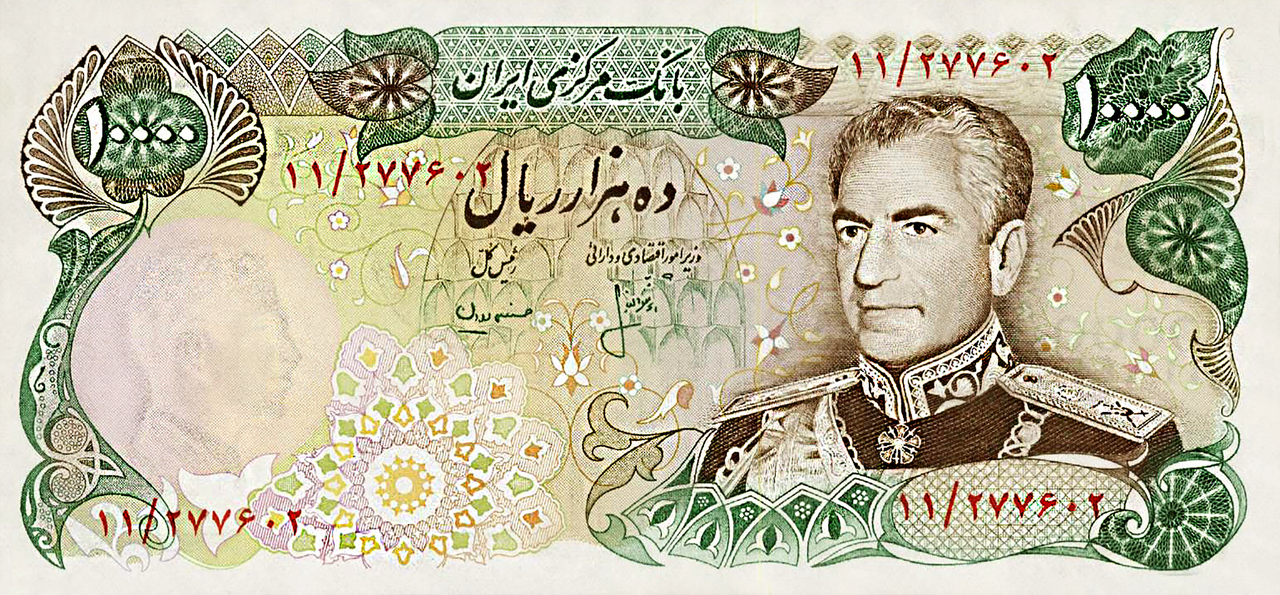
The toman is the older name. It comes from a Mongol and Turkic word, tümen, meaning ten thousand, and in Safavid and Qajar Iran it was a large unit of account worth 10,000 dinars. In 1825 the Qajar shah introduced the qirân, worth a tenth of a toman. In 1932, under Reza Shah, the rial replaced the qirân at the same value and became the official currency. The toman was never abolished from speech: it simply stayed as the everyday name for 10 rials. Nearly a century later, Iranians still think in tomans, while banks, official price lists and the central bank use rials.

How prices are said in conversation
In shops, taxis and markets, people almost always speak in tomans. To get from rials to tomans, drop the last zero: 1,500,000 rials is 150,000 tomans, said sad-o panjâh hezâr tomân (one hundred and fifty thousand tomans).
Because prices have become so large, people shorten them further. In everyday speech the word hezâr (thousand) is very often dropped, so a taxi driver who says panjâh tomân (fifty tomans) almost certainly means 50,000 tomans, or 500,000 rials. Larger sums are counted in millions: do milyun means two million tomans. Context tells you which is meant, and if in doubt, ask. Some useful phrases:
- چنده؟ chande? How much is it? (colloquial for چند است؟)
- قیمتش چنده؟ qeymatesh chande? What’s its price?
- تومن یا ریال؟ tomen yâ riyâl? Tomans or rials?
- پنجاه هزار تومن panjâh hezâr tomen Fifty thousand tomans
- تخفیف میدید؟ takhfif midid? Can you give a discount?
Two more habits are worth knowing. Price tags and banknotes use Persian digits (۰ ۱ ۲ ۳ ۴ ۵ ۶ ۷ ۸ ۹), so it helps to learn them; our lesson on Persian numbers from 1 to 1,000 covers both the digits and the spoken words. And when you ask what you owe, a shopkeeper or driver may first reply qâbel nadâre (it’s not worth anything), a polite formula you should not take literally; see taarof, Persian politeness.
Notes, cheques and cards
Iranian banknotes are printed in rials, with the value in Persian and in Western digits. The notes that matter in daily life are the larger ones, such as the 100,000-rial note (10,000 tomans). Above them circulate “Iran cheques” (ایرانچک, Irân-chek), bearer cheques issued by the central bank that are used exactly like banknotes; the largest, a 10,000,000-rial cheque, was reported by banknote specialists to have been issued in March 2026. Coins are rarely used now because their value is so small.
In practice, most Iranians pay by domestic bank card or phone, through the national Shetab network, even at small shops and taxis. Because of sanctions, foreign Visa and Mastercard cards do not work in Iran, so visitors have to bring cash in foreign currency and exchange it at a licensed exchange office (صرافی, sarrâfi), or buy a prepaid local tourist card. Check the current situation before travelling; see our practical tips for travelling to Iran.
Removing four zeros: the new rial
Plans to cut zeros from the currency have been discussed since the 1990s. A 2019 government bill would have renamed the currency the toman, worth 10,000 rials, and parliament approved a version of it in 2020, but it stalled. In 2025 parliament passed a new law that keeps the name rial. It was approved by parliament in October 2025 and by the Guardian Council in November 2025, and on 22 November 2025 President Pezeshkian instructed the central bank to begin implementation.
Under the law, 10,000 current rials will equal one new rial, divided into 100 qirân (قران), reviving the old Qajar coin name. The central bank has up to two years to prepare, and old and new money may circulate side by side for up to three years. As of autumn 2026 no new-rial notes had been reported in circulation, and reports in August 2026 spoke of the change being phased in from 2027.
A handy fact for learners: one new rial will be worth exactly 1,000 of today’s tomans. So a price spoken today as panjâh hezâr tomân (50,000 tomans, or 500,000 rials) will be 50 new rials. Economists quoted in Iranian and foreign media stress that the change is cosmetic: it makes prices easier to write but does not change their value, which depends on inflation. The economy of Iran page explains why the rial has lost so much value.
Persian words from this page
| پول | pul | money |
| اسکناس | eskenâs | banknote |
| سکه | sekke | coin |
| پول خرد | pul-e khord | small change |
| قیمت | qeymat | price |
| گران | gerân | expensive |
| ارزان | arzân | cheap |
| هزار | hezâr | thousand |
Sources and further reading
- Encyclopaedia Iranica, “Coins and coinage” (iranicaonline.org).
- Central Bank of the Islamic Republic of Iran, banknote and Iran cheque issues.
- Iran International, “Iran’s Central Bank ordered to slash four zeros from national currency” (22 November 2025).
- Planet Banknote, “Iran’s Redenomination: Four Zeros Off the Rial, the New Qiran” (updated September 2026).
- bne IntelliNews, report on the open-market rial rate (24 August 2026).
Want to learn Persian? Get the free Starter Pack
Get the 14-page printable Starter Pack (all 32 letters, a 7-day reading plan, 100 core words and 20 survival phrases) and a short 5-email course. Free.
More in Iran Facts and Overview
- Iran at a Glance: Key Facts and Figures
- Geography of Iran: Mountains, Deserts and Seas
- Climate of Iran and the Best Time to Visit
- The 31 Provinces of Iran
- The People of Iran: Ethnic Groups
- Languages Spoken in Iran
- Religion in Iran Today
- How Iran Is Governed
- The Economy of Iran
- Iranian Currency: Rial and Toman Explained
- Persian Food: Dishes Every Visitor Should Try
- Iranian Festivals and Public Holidays
- Iranian Culture and Etiquette
- Iranian Handicrafts
- UNESCO World Heritage Sites in Iran
- Iran Records and Superlatives
- National Symbols of Iran
- Sports in Iran
- Practical Tips for Travelling to Iran