Iran’s year is shaped by two kinds of festival: ancient seasonal celebrations such as Nowruz, the Persian New Year at the March equinox, and Yalda, the longest night in December; and the religious days of Shi’a Islam, which follow the lunar calendar and move about eleven days earlier each year. Public holidays include both, plus a handful of political anniversaries from the 1979 revolution.

Three calendars at once
Iranians live with three calendars. The official one is the Solar Hijri calendar, whose year begins at Nowruz; the year 1405 began in March 2026. Its twelve months (Farvardin to Esfand) are tied to the seasons, so the ancient festivals fall on the same Western date every year, give or take a day. Religious days follow the lunar Islamic calendar, which is about eleven days shorter, so Ramadan or Muharram can fall in any season. The Gregorian calendar is used for international business. Our post on the Persian calendar, its days and months explains the month names; the story of how the calendar developed is in The History of the Iranian Calendar.
Friday is the weekly day of rest, and many offices also close on Thursday.
The festivals of the Iranian year
- Last Tuesday evening of the year Chahârshanbe Suri, the fire festival
- 1 Farvardin (20 or 21 March) Nowruz, New Year
- 13 Farvardin (1 or 2 April) Sizdah Bedar, the picnic day that ends Nowruz
- 13 Tir (early July) Tirgan, a midsummer water festival
- Mehr (early October) Mehregan, the autumn festival
- Night before 1 Dey (20 or 21 December) Yalda, the longest night
- 10 Bahman (late January) Sadeh, the midwinter fire festival
Chahârshanbe Suri
On the evening before the last Wednesday of the year, people light small bonfires in streets and parks and jump over them, calling out zardi-ye man az to, sorkhi-ye to az man: “my yellowness (sickliness) to you, your redness (health) to me.” Children go from door to door banging spoons on bowls (qâshoq-zani) and are given sweets and nuts. Fireworks have made the night noisy and, in recent years, dangerous; hospitals treat burn injuries every year. Our post on the Festival of Fire describes the customs in more detail.
Nowruz
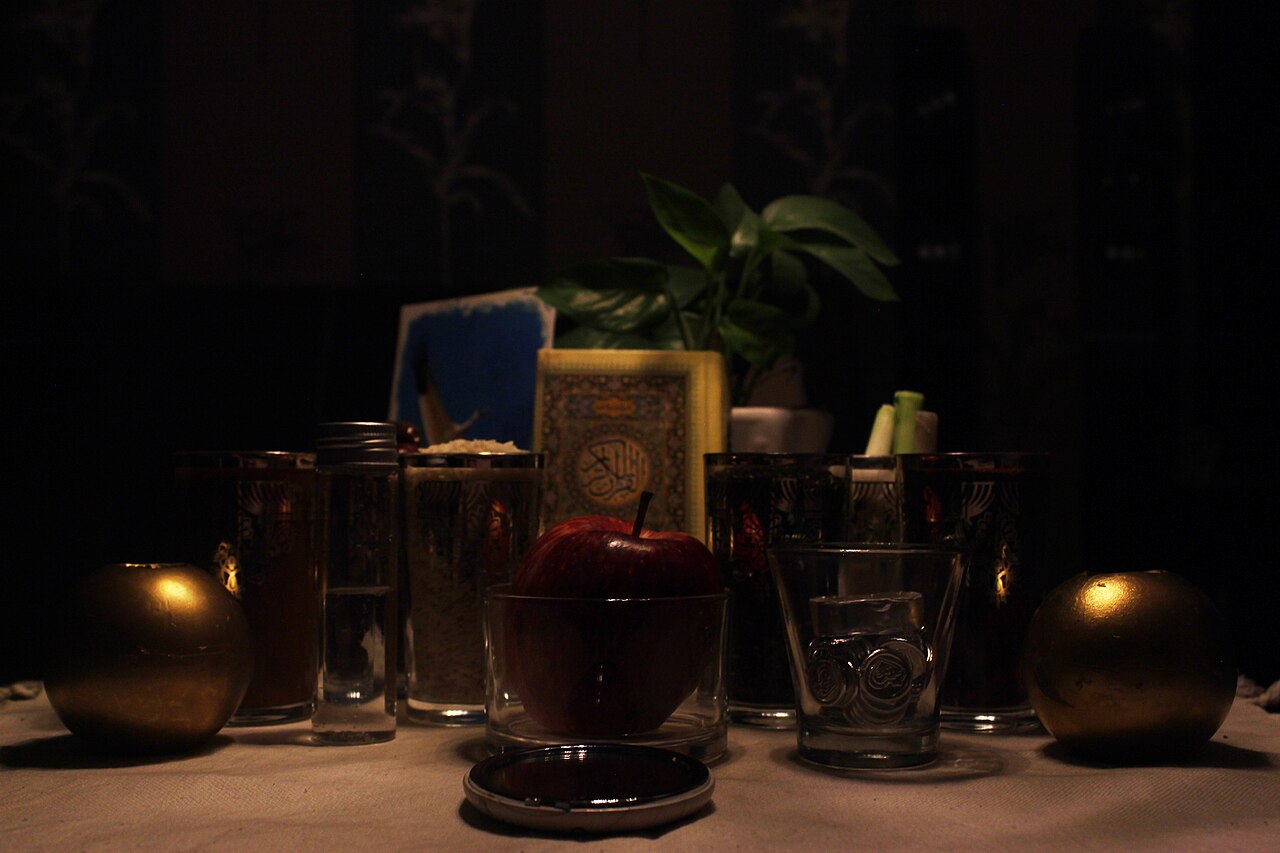
Nowruz (نوروز, “new day”) begins at the exact moment of the spring equinox, the sâl-tahvil, which families wait for together around the haft-sin table. Weeks of spring cleaning (khâne-tekâni) come first. The holiday that follows is the longest of the year: schools close for about two weeks and people visit relatives in order of seniority, starting with the eldest. Nowruz is also celebrated in Afghanistan, Central Asia, Azerbaijan, the Kurdish regions and beyond, and is inscribed on UNESCO’s list of intangible heritage jointly by Iran and many of these neighbours. For the customs, greetings and the haft-sin items, read our full guide to Nowruz, the Persian New Year; for its origins, see Nowruz through History.
Sizdah Bedar
On the thirteenth day of Farvardin, thirteen being thought unlucky, families leave the house and spend the day outdoors with picnics, games and music. The sprouted greens (sabzeh) from the haft-sin are thrown into running water to carry away the year’s bad luck, and young unmarried women knot blades of grass while making a wish. Officially the day is called Nature Day. See also Sizdah Bedar, the 13th day of Nowruz.
Yalda
Shab-e Yalda is the night before the first day of Dey, the longest night of the year. Families stay up late, often at the grandparents’ house, eating watermelon, pomegranates and dried fruit and nuts (âjil), and reading verses of Hafez to tell fortunes (fâl-e Hâfez). The tradition, shared with Afghanistan, was added to UNESCO’s Representative List in 2022 under the name Yaldâ/Chella. Our post on Yalda Night covers the foods, greetings and meaning.
Mehregan, Tirgan and Sadeh
These three are older festivals of the Zoroastrian calendar, kept today mainly by Zoroastrians in Yazd, Kerman and Tehran, and revived by many other Iranians in recent decades. Mehregan honours Mehr (Mithra) and the autumn harvest; it was inscribed by Iran and Tajikistan on UNESCO’s list in 2024. Tirgan is a summer festival of water, linked in legend to the archer Arash, whose arrow fixed the border between Iran and Turan; people splash each other and tie coloured threads around their wrists. Sadeh, about fifty days before Nowruz, celebrates the discovery of fire with a large bonfire at sunset; it was inscribed by Iran and Tajikistan in 2023. None of the three is a public holiday.
Religious holidays
Most public holidays are Shi’a Muslim days, and because they follow the lunar calendar their dates have to be checked each year.
- Tasua and Ashura (9 and 10 Muharram): the most important days of mourning, for the martyrdom of Imam Hossein at Karbala in 680. There are street processions, chest-beating (sineh-zani), the passion play ta’zieh, and free food (nazri) cooked in huge pots and handed out to anyone passing. Arbaeen, forty days later, is also a holiday.
- Ramadan (ramazân): a month of fasting from dawn to sunset. Restaurants close during the day in most places and eating in public is not allowed. The 21st, the anniversary of Imam Ali’s death, is a holiday.
- Eid al-Fitr (eyd-e fetr), at the end of Ramadan, Eid al-Adha (eyd-e ghorbân) and Eid al-Ghadir are happy holidays.
- Other days: the birthday of the Prophet Muhammad, the birthday of Imam Ali, the Prophet’s mission (mab’as), the birthday of the Twelfth Imam on 15 Sha’ban (when streets are decorated with lights) and several other anniversaries of the Imams’ deaths.
On mourning days music is not played in public and weddings are not held. Iran’s Armenian and Assyrian Christians keep Christmas (Armenians on 6 January), and Jews and Zoroastrians keep their own festivals, but these are not national holidays. The page on religion in Iran today describes these communities.
Political anniversaries
The Islamic Republic added several national days after 1979. The main public holidays are 22 Bahman (about 11 February), marking the victory of the revolution in 1979; 12 Farvardin, Islamic Republic Day, the anniversary of the 1979 referendum; 14 and 15 Khordad (early June), the death of Ayatollah Khomeini in 1989 and the 1963 uprising; and 29 Esfand, the nationalisation of the oil industry in 1951. Rallies are organised by the state on 22 Bahman. The official calendar of holidays is published each year and has been changed more than once, so check the current one before planning around a date.
Persian words from this page
| نوروز | Nowruz | New Year (“new day”) |
| نوروز مبارک | Nowruz mobârak | Happy New Year |
| چهارشنبهسوری | Chahârshanbe Suri | fire festival before Nowruz |
| سیزدهبدر | Sizdah Bedar | 13th day of Nowruz |
| شب یلدا | Shab-e Yaldâ | Yalda Night |
| مهرگان | Mehregân | autumn festival |
| عید | eyd | feast, festive holiday |
| تعطیل | ta’til | closed, a day off |
Sources and further reading
- Mary Boyce, A Persian Stronghold of Zoroastrianism, Oxford, 1977 (festivals of the Zoroastrian villages of Yazd).
- Encyclopaedia Iranica, “Nowruz” and “Čahāršanba-sūrī”.
- UNESCO Intangible Cultural Heritage: “Yaldā/Chella” (2022), “Sadeh/Sada celebration” (2023), “Ceremony of Mehregan” (2024), and the multinational Nowruz inscription.
- Peter J. Chelkowski (ed.), Ta’ziyeh: Ritual and Drama in Iran, New York University Press, 1979.
Want to learn Persian? Get the free Starter Pack
Get the 14-page printable Starter Pack (all 32 letters, a 7-day reading plan, 100 core words and 20 survival phrases) and a short 5-email course. Free.
More in Iran Facts and Overview
- Iran at a Glance: Key Facts and Figures
- Geography of Iran: Mountains, Deserts and Seas
- Climate of Iran and the Best Time to Visit
- The 31 Provinces of Iran
- The People of Iran: Ethnic Groups
- Languages Spoken in Iran
- Religion in Iran Today
- How Iran Is Governed
- The Economy of Iran
- Iranian Currency: Rial and Toman Explained
- Persian Food: Dishes Every Visitor Should Try
- Iranian Festivals and Public Holidays
- Iranian Culture and Etiquette
- Iranian Handicrafts
- UNESCO World Heritage Sites in Iran
- Iran Records and Superlatives
- National Symbols of Iran
- Sports in Iran
- Practical Tips for Travelling to Iran