Iran’s official national symbols are the green, white and red flag with its central emblem, adopted in 1980, and the national anthem in use since 1990. Alongside them, older symbols such as the Lion and Sun, the Faravahar and the Simorgh remain part of Iranian identity, and some, especially the Lion and Sun, have taken on political meaning since the revolution.
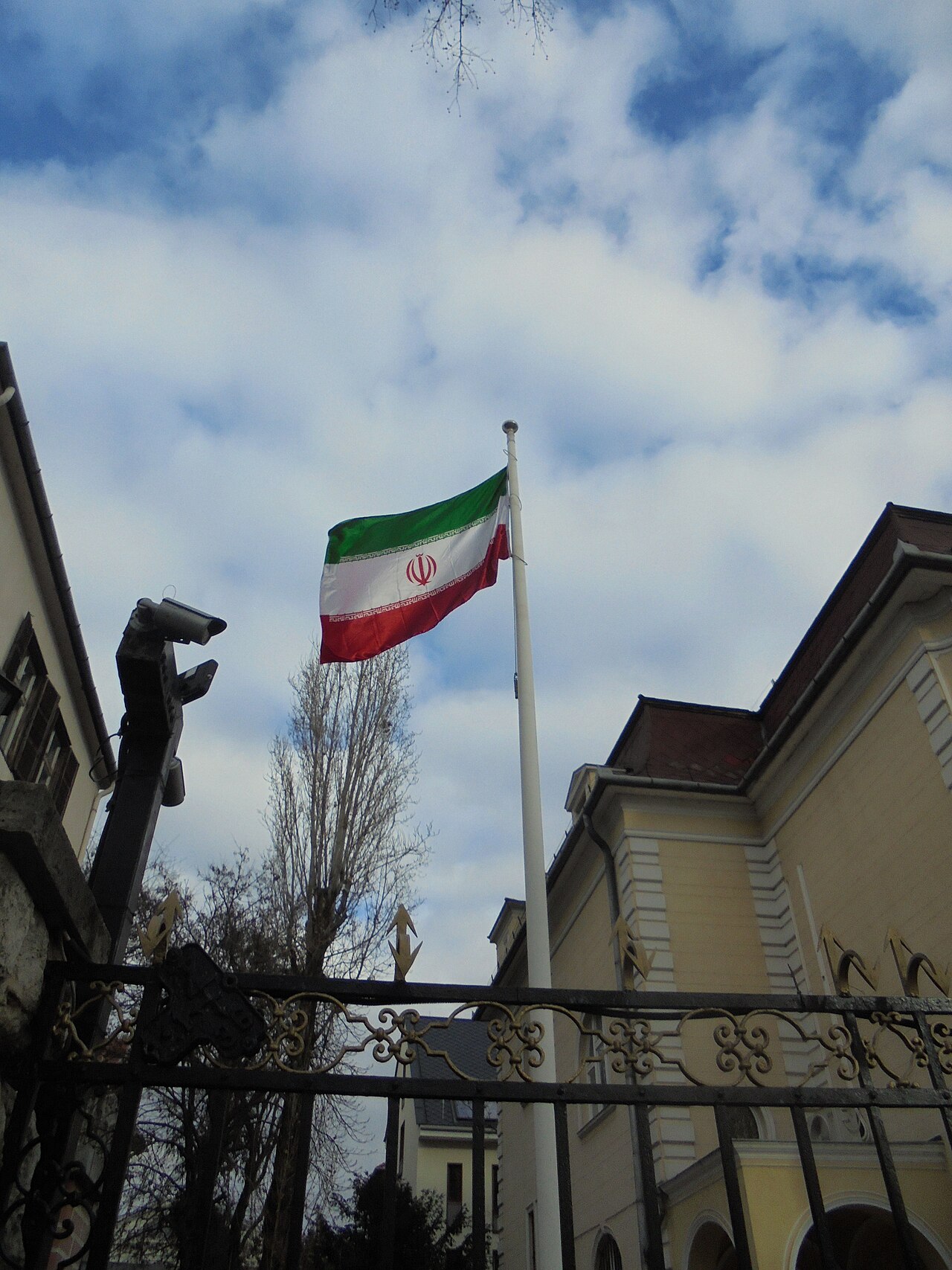

| Flag | Green, white and red horizontal bands with the national emblem in red; adopted 29 July 1980 (Article 18 of the constitution) |
|---|---|
| Emblem | Stylised word Allah formed of four crescents and a sword; designed by Hamid Nadimi, approved in May 1980 |
| National anthem | Sorud-e Melli-ye Jomhuri-ye Eslâmi, music by Hassan Riahi, adopted 1990 |
| Earlier emblem | The Lion and Sun (shir-o khorshid), official until 1979 |
| Persian word for flag | پرچم (parcham) |
The flag
The green, white and red tricolour is older than the Islamic Republic. It was formalised during the Constitutional Revolution, when the 1907 supplement to the constitution described a flag of these three colours with the Lion and Sun in the centre. The colours are commonly explained as green for Islam and growth, white for peace and red for courage or martyrdom, but these readings are traditions rather than a legal definition.
After the 1979 revolution the Lion and Sun was removed, and on 29 July 1980 the present design was adopted. Two changes were made. The new emblem was placed in the centre, and the phrase Allâhu akbar (“God is great”) was written 11 times along the lower edge of the green band and 11 times along the upper edge of the red band, 22 in all. The number recalls 22 Bahman 1357 (11 February 1979), the day the revolution triumphed, when people shouted the phrase from rooftops. The script is a geometric form of Kufic.
The emblem
The emblem was designed by the artist Hamid Nadimi and approved by Ayatollah Khomeini in May 1980. It is a symmetrical monogram of the word Allâh, made of four curved crescents around a central upright sword. It can also be read as a stylised version of the phrase lâ ilâha illâ Allâh (“there is no god but God”). Its overall shape suggests a tulip, the traditional Iranian flower of martyrdom, linked to the old belief that a tulip grows from the blood of a young man who dies for his country. The emblem appears on passports, coins and banknotes and official buildings.
The national anthem
The current anthem has been in use since 1990, when it replaced the anthem Pâyande bâd Irân (“Long live Iran”), used from 1980. The music is by Hassan Riahi; the words were chosen from proposals by several poets. It is short, about a minute long, and speaks of the revolution, independence and the Imam. Before 1979 the Pahlavi state used an imperial anthem, the Sorud-e Shâhanshâhi.
Many Iranians also know Ey Irân (“O Iran”), a patriotic song written in 1944 with words by Hossein Golgolab and music by Ruhollah Khaleqi. It has never been the official anthem but is sung at gatherings in Iran and abroad, and is often heard as an unofficial national song.
The Lion and Sun
The Lion and Sun (شیر و خورشید, shir-o khorshid), a lion holding a sword with the sun rising behind its back, became a symbol of the Iranian state under the Safavids and especially the Qajars, and was the centre of the flag from 1907 until 1979. Its roots lie in astrology, where the sun is in the sign of Leo. The Iranian Red Cross was called the Red Lion and Sun Society until 1980, when it became the Red Crescent. Today the Lion and Sun flag is widely used by Iranians abroad, including by opponents of the Islamic Republic, while inside Iran the symbol survives on old buildings, tiles and coins. Its history is told in Flags and Symbols of Iran.
Older symbols from myth and religion
- Faravahar (فروهر): the winged figure seen on Achaemenid reliefs at Persepolis and Behistun. Scholars still debate whether it originally represented the god Ahura Mazda or the royal glory; today it is the best-known emblem of Zoroastrianism and is widely worn by Iranians of all backgrounds as a sign of Iranian heritage. See Zoroastrianism through the Ages.
- Derafsh-e Kâviyâni: the banner of the blacksmith Kaveh, who in the Shahnameh raises his leather apron on a spear to lead the revolt against the tyrant Zahhak. Later it was the royal banner of the Sasanian kings, said to have been captured by the Arabs at the battle of Qadisiyya.
- Simorgh (سیمرغ): the great wise bird of the Shahnameh who raises the hero Zal, and the goal of the birds’ journey in Attar’s Conference of the Birds.
- Homâ: a bird of good fortune whose shadow was believed to bring kingship; it is the logo of the national airline, Iran Air.
Flowers, animals and other emblems
Iran has no long-standing law naming a national animal or flower, but several are widely treated as national emblems.
- The rose: the Damask rose, gol-e Mohammadi, grown for rosewater around Kashan and in Fars, is often named the national flower. The tulip (lâleh) is the flower of martyrdom, seen on murals and in the emblem.
- The Asiatic cheetah (yuzpalang): it survives in the wild only in Iran and is critically endangered. The national football team wore an image of the cheetah on its shirts at the 2014 World Cup to draw attention to it.
- The Persian lion, the animal of the Lion and Sun, died out in Iran in the 20th century.
- Mount Damavand and the Persian Gulf appear on banknotes and in patriotic poetry, and the name “Persian Gulf” is itself defended as a national symbol; 10 Ordibehesht (30 April) is marked as National Persian Gulf Day.
- Nowruz and the haft-sin table are the most widely shared cultural symbol of all; see festivals and holidays.
Wrestling is often called Iran’s national sport, and the zurkhaneh, the “house of strength”, is its most distinctive traditional one; both are described on the page on sports in Iran. For a quick summary of the state’s basic facts, see Iran at a glance.
Persian words from this page
| پرچم | parcham | flag |
| سرود ملی | sorud-e melli | national anthem |
| شیر و خورشید | shir-o khorshid | Lion and Sun |
| لاله | lâleh | tulip |
| گل محمدی | gol-e Mohammadi | Damask rose |
| یوزپلنگ | yuzpalang | cheetah |
| سیمرغ | Simorgh | mythical bird |
Sources and further reading
- Constitution of the Islamic Republic of Iran (1979, amended 1989), Article 18 (the flag).
- Afsaneh Najmabadi, Women with Mustaches and Men without Beards, University of California Press, 2005 (chapter on the Lion and Sun).
- Encyclopaedia Iranica, “Flags of Persia” and “Derafš-e Kāvīān”.
- Ferdowsi, Shahnameh, the stories of Kaveh and Zahhak and of Zal and the Simorgh (tr. Dick Davis, Penguin, 2006).
Want to learn Persian? Get the free Starter Pack
Get the 14-page printable Starter Pack (all 32 letters, a 7-day reading plan, 100 core words and 20 survival phrases) and a short 5-email course. Free.
More in Iran Facts and Overview
- Iran at a Glance: Key Facts and Figures
- Geography of Iran: Mountains, Deserts and Seas
- Climate of Iran and the Best Time to Visit
- The 31 Provinces of Iran
- The People of Iran: Ethnic Groups
- Languages Spoken in Iran
- Religion in Iran Today
- How Iran Is Governed
- The Economy of Iran
- Iranian Currency: Rial and Toman Explained
- Persian Food: Dishes Every Visitor Should Try
- Iranian Festivals and Public Holidays
- Iranian Culture and Etiquette
- Iranian Handicrafts
- UNESCO World Heritage Sites in Iran
- Iran Records and Superlatives
- National Symbols of Iran
- Sports in Iran
- Practical Tips for Travelling to Iran