Iran is divided into 31 provinces, called ostân (استان) in Persian. Each has a capital city and a governor-general appointed by the central government. They range from Tehran, with over 13 million people, to Ilam, with under 600,000, and the current total of 31 dates from 2010, when Alborz province was split off from Tehran.
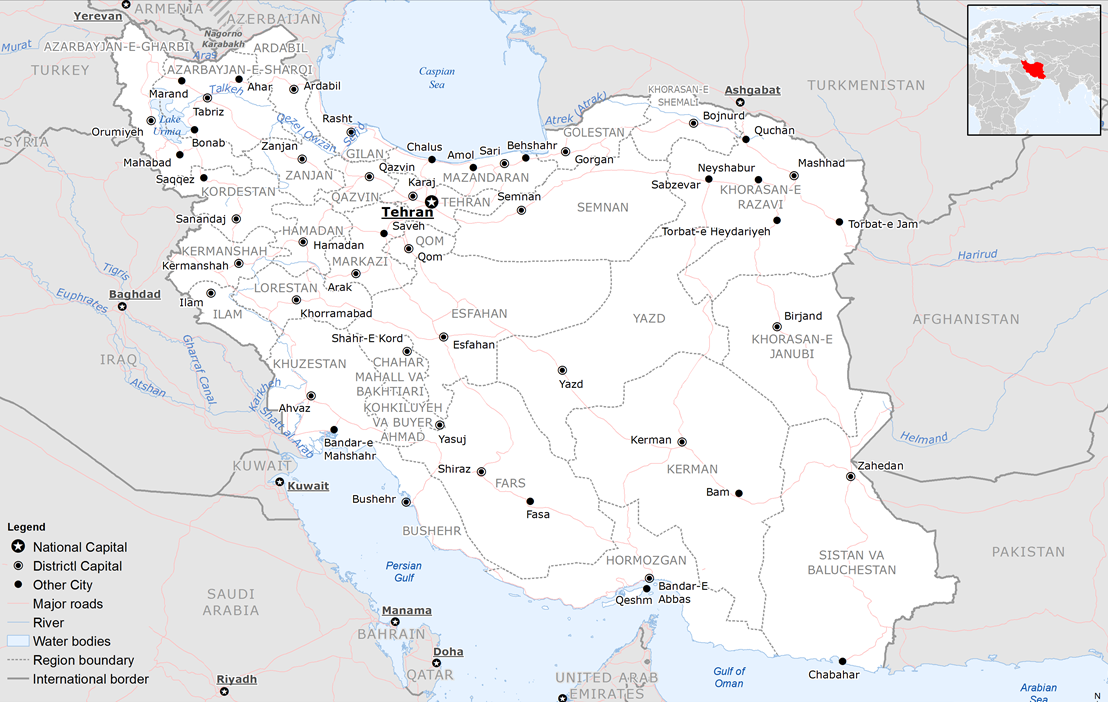

How the provincial system works
Iran is a centralised state. Each province is run by an ostândâr (استاندار), a governor-general nominated by the Ministry of the Interior and approved by the cabinet. Below the province come counties (shahrestân), each with a governor (farmândâr) and a main town; then districts (bakhsh); then rural districts (dehestân) and villages. Cities and villages elect their own councils, which choose mayors, but budgets and major decisions are largely controlled from Tehran. Provinces do not have their own parliaments, though each elects members of the national Majlis and of the Assembly of Experts according to its population.
The number of counties keeps rising as parliament creates new ones, often after local campaigns, because county status brings offices, jobs and budget lines. For the same reason, proposals to split large provinces such as Kerman, Fars and Isfahan come up regularly.
From ten numbered provinces to thirty-one
Iran’s modern provinces date from a law of 1937 under Reza Shah, which replaced the old system of large governorates, such as Azerbaijan, Khorasan and Fars, with ten provinces, at first known by number: the First Province, the Second Province and so on. Names returned over the following decades, and provinces were divided as the population grew. Several new provinces were created after the revolution: Ardabil (1993), Qom (1995), Qazvin and Golestan (1997). In 2004 the vast Khorasan province was split into Razavi Khorasan, North Khorasan and South Khorasan, and in 2010 Alborz, centred on Karaj, became the 31st. Our history page on Reza Shah’s reforms explains the centralising project behind the 1937 law.
All 31 provinces
Population figures are 2023 estimates based on Statistical Centre of Iran projections, rounded to the nearest thousand; the last full census was in 2016. Areas are in square kilometres. Provinces are listed by population.
| Province | Capital | Population (2023 est.) | Area (km²) | Notes |
|---|---|---|---|---|
| Tehran تهران | Tehran | 13,323,000 | 18,814 | Smallest of the large provinces by area, home to about one in six Iranians |
| Razavi Khorasan خراسان رضوی | Mashhad | 6,444,000 | 118,884 | Imam Reza shrine; the largest part of old Khorasan, split in 2004 |
| Isfahan اصفهان | Isfahan | 5,136,000 | 107,029 | Safavid capital; also Kashan and Natanz |
| Fars فارس | Shiraz | 4,904,000 | 122,608 | The original Persis, with Persepolis and Pasargadae |
| Khuzestan خوزستان | Ahvaz | 4,725,000 | 64,055 | Oil, the Karun river, a large Arab population, Susa |
| East Azerbaijan آذربایجان شرقی | Tabriz | 3,925,000 | 45,650 | Azerbaijani-speaking heartland |
| Mazandaran مازندران | Sari | 3,302,000 | 23,701 | Caspian coast and the Alborz forests |
| West Azerbaijan آذربایجان غربی | Urmia | 3,278,000 | 37,437 | Lake Urmia; Azerbaijani, Kurdish and Assyrian communities |
| Kerman کرمان | Kerman | 3,184,000 | 183,285 | Largest province by area; pistachios, the Lut, Bam |
| Sistan and Baluchestan سیستان و بلوچستان | Zahedan | 2,777,000 | 180,726 | Borders Afghanistan and Pakistan; Chabahar port |
| Alborz البرز | Karaj | 2,730,000 | 5,833 | Newest province, split from Tehran in 2010 |
| Gilan گیلان | Rasht | 2,546,000 | 14,042 | Rice, tea and rain on the Caspian |
| Kermanshah کرمانشاه | Kermanshah | 2,003,000 | 24,998 | Behistun and Taq-e Bostan |
| Golestan گلستان | Gorgan | 1,893,000 | 20,195 | Turkmen Sahra; created in 1997 |
| Hormozgan هرمزگان | Bandar Abbas | 1,806,000 | 70,669 | Strait of Hormuz, Kish, Qeshm and Hormuz islands |
| Lorestan لرستان | Khorramabad | 1,784,000 | 28,294 | Land of the Lurs in the central Zagros |
| Hamadan همدان | Hamadan | 1,756,000 | 19,368 | Ancient Ecbatana |
| Kurdistan کردستان | Sanandaj | 1,614,000 | 29,137 | Kurdish culture and the Zagros uplands |
| Markazi مرکزی | Arak | 1,436,000 | 29,130 | The name means central; industrial Arak |
| Qom قم | Qom | 1,300,000 | 11,526 | Shrine of Fatima Masumeh and the seminaries; created in 1995 |
| Qazvin قزوین | Qazvin | 1,284,000 | 15,549 | Safavid capital, gateway to Alamut; created in 1997 |
| Ardabil اردبیل | Ardabil | 1,284,000 | 17,800 | Sheikh Safi shrine, Mount Sabalan; created in 1993 |
| Bushehr بوشهر | Bushehr | 1,174,000 | 22,743 | Port and nuclear power plant on the Persian Gulf |
| Yazd یزد | Yazd | 1,156,000 | 76,469 | Desert city, Zoroastrian heritage |
| Zanjan زنجان | Zanjan | 1,103,000 | 21,773 | Soltaniyeh dome |
| Chaharmahal and Bakhtiari چهارمحال و بختیاری | Shahr-e Kord | 973,000 | 16,332 | High Zagros, Bakhtiari country, Zayandeh Rud source |
| North Khorasan خراسان شمالی | Bojnord | 868,000 | 28,434 | Split from Khorasan in 2004 |
| South Khorasan خراسان جنوبی | Birjand | 786,000 | 151,913 | Desert east; split from Khorasan in 2004 |
| Kohgiluyeh and Boyer-Ahmad کهگیلویه و بویراحمد | Yasuj | 728,000 | 15,504 | Forested Zagros valleys, Mount Dena |
| Semnan سمنان | Semnan | 715,000 | 97,491 | Edge of the Dasht-e Kavir; space launch site |
| Ilam ایلام | Ilam | 591,000 | 20,133 | Least populous; on the Iraqi border |
What the table shows
Iran’s population is very unevenly spread. Tehran and Alborz together cover less than 2 percent of the country’s area but hold about a fifth of its people. The largest provinces by area, Kerman, Sistan and Baluchestan, South Khorasan, Fars and Razavi Khorasan, are mostly desert or mountain, with people concentrated in oasis towns. The Caspian provinces of Gilan and Mazandaran are small but densely settled.
The provinces also map, roughly, onto Iran’s ethnic and linguistic diversity. Azerbaijani is the main language in East Azerbaijan, Ardabil and Zanjan and widely spoken in West Azerbaijan, Qazvin and Hamadan; Kurdish in Kurdistan, Kermanshah and parts of West Azerbaijan and Ilam; Luri in Lorestan and neighbouring provinces; Baluchi in Sistan and Baluchestan; and Arabic in parts of Khuzestan. The pages on the people of Iran and languages of Iran look at this in more detail. For place names in English and Persian, see Iranian cities in English, and for the capitals themselves, start with Tehran, Mashhad and Isfahan.
Persian words from this page
| استان | ostân | province |
| استاندار | ostândâr | governor-general of a province |
| شهرستان | shahrestân | county |
| فرماندار | farmândâr | county governor |
| بخش | bakhsh | district |
| مرکزی | markazi | central |
Sources and further reading
- Statistical Centre of Iran, 2016 National Population and Housing Census and population projections.
- Ministry of the Interior of Iran, country divisions (taqsimât-e keshvari).
- CIA, The World Factbook: Iran, administrative divisions.
- Ervand Abrahamian, A History of Modern Iran (Cambridge, 2008), on Reza Shah’s centralisation.
Want to learn Persian? Get the free Starter Pack
Get the 14-page printable Starter Pack (all 32 letters, a 7-day reading plan, 100 core words and 20 survival phrases) and a short 5-email course. Free.
More in Iran Facts and Overview
- Iran at a Glance: Key Facts and Figures
- Geography of Iran: Mountains, Deserts and Seas
- Climate of Iran and the Best Time to Visit
- The 31 Provinces of Iran
- The People of Iran: Ethnic Groups
- Languages Spoken in Iran
- Religion in Iran Today
- How Iran Is Governed
- The Economy of Iran
- Iranian Currency: Rial and Toman Explained
- Persian Food: Dishes Every Visitor Should Try
- Iranian Festivals and Public Holidays
- Iranian Culture and Etiquette
- Iranian Handicrafts
- UNESCO World Heritage Sites in Iran
- Iran Records and Superlatives
- National Symbols of Iran
- Sports in Iran
- Practical Tips for Travelling to Iran