Iran’s handicrafts range from hand-knotted carpets, the best known of all, to miniature painting, khatam inlay, minakari enamel, engraved metalwork, termeh cloth and pottery. Many of these crafts are still made by hand in family workshops, above all in Isfahan, Shiraz, Yazd, Tabriz and Kashan, and several are recognised on UNESCO’s lists of intangible heritage.

| Persian term | صنایع دستی (sanâye’-e dasti), “hand industries” |
|---|---|
| Main centres | Isfahan (metalwork, enamel, block printing, miniature), Shiraz (khatam), Yazd (termeh), Tabriz, Kashan, Kerman and Qom (carpets), Hamadan (pottery) |
| UNESCO intangible heritage | Carpet weaving in Fars and in Kashan (2010); art of miniature (2020, with Azerbaijan and Türkiye); illumination, tazhib (2023, multinational); âyeneh-kâri mirror work (2025) |
| Craft city | Isfahan, UNESCO Creative City of Crafts and Folk Art (2015) |
Carpets and other woven floor coverings
The Persian carpet (فرش, farsh, or ghâli) is Iran’s most famous product. A hand-knotted carpet is made by tying thousands of individual knots of wool or silk around the warp threads of a loom, row by row, and then cutting them to form the pile. Iranian weavers mostly use the asymmetrical “Persian” knot. Fine city carpets from Isfahan, Nain, Qom and Tabriz follow a drawn design (naqsheh) and can take a weaver months or years.
Village and nomad weaving is different in spirit: designs are woven from memory and vary from piece to piece. The Qashqai and Luri gabbeh is thick and loosely knotted, with simple blocks of colour and small figures. The gelim (kilim) is a flat-woven rug with no pile. The oldest surviving pile carpet, the Pazyryk carpet of about the 5th century BCE, was found in a frozen tomb in Siberia, and its design is often linked to Achaemenid Persia; the Ardabil Carpet, woven for the Safavid shrine at Ardabil and dated 1539–40, is now in the Victoria and Albert Museum in London.
The long story of the craft is told in A History of Persian Carpets. Arak (Sarouk), Kashan and Kerman are towns whose names became carpet types; see Arak.
Painting on paper: miniature and illumination
Persian miniature painting (نگارگری, negârgari) grew out of book illustration for works such as Ferdowsi’s Shahnameh and Nizami’s Khamseh. The great schools are named after the courts that paid for them: Tabriz under the Ilkhanids and Safavids, Herat under the Timurids, Shiraz and Isfahan. Kamal al-Din Behzad and Reza Abbasi are the best-known names. Illumination (tazhib), the gold and coloured border and title ornament of manuscripts, is a related art. Both are still taught and practised, and many shops in Isfahan sell miniatures painted on paper, bone or wood. See A History of Persian Painting and Safavid Art: Carpets, Miniatures and Tiles.
Khatam: marquetry in tiny triangles
Khatam (خاتم, khâtam) is a form of inlay in which thin rods of wood, bone, brass and other materials are bundled together in triangular patterns, glued, sliced into thin sheets and laid onto boxes, frames, chess boards and furniture. Close up, a khatam surface looks like a field of tiny stars. Shiraz and Isfahan are the main centres. Doors and panels decorated with khatam can be seen in Safavid and Qajar buildings.
Metal and enamel
Minakari
Minakari (میناکاری, minâkâri) is painted enamel on metal, usually copper. The piece is coated with a white enamel base, painted with coloured glazes of flowers and birds, and fired in a kiln. The turquoise-blue plates and vases made in Isfahan are one of the most recognisable Iranian souvenirs.
Qalamzani and turquoise inlay
In qalamzani (metal engraving), craftsmen hammer small chisels into copper, brass or silver to cut patterns and scenes; the sound of the hammers is part of the atmosphere of Isfahan’s bazaar. In firuzeh-kubi, small chips of turquoise (firuzeh), traditionally from the mines near Neyshabur, are set close together on copper or brass objects.
Textiles: termeh and qalamkar
Termeh (ترمه) is a fine woven cloth of wool and silk, often with the curling paisley motif called boteh jegheh. It is a speciality of Yazd and is used for tablecloths, wedding cloths and the cover of the Nowruz table. Qalamkar is cotton printed by hand with carved wooden blocks dipped in natural dyes, made mainly in Isfahan. Other regions have their own embroidery: the needlework of Baluch women, Turkmen embroidery and the sermeh-duzi gold embroidery of Isfahan.
Pottery, tiles and mirror work
Iranian pottery has a history of more than 7,000 years. Medieval Kashan was famous for lustreware and glazed tiles, and the Persian word for tile, kâshi, is usually traced to the city’s name. Today Lalejin near Hamadan is the best-known centre for glazed pottery, and Meybod near Yazd makes simple painted wares. At Kalpurgan in Sistan and Baluchestan, women still shape unglazed pots by hand without a wheel in a technique they describe as thousands of years old.
Âyeneh-kâri, mirror mosaic, covers the interiors of shrines and Qajar palaces with thousands of small pieces of cut mirror. It was added to UNESCO’s Representative List in 2025. The Shah Cheragh shrine in Shiraz and the Mirror Hall of Golestan Palace are famous examples.
Buying crafts
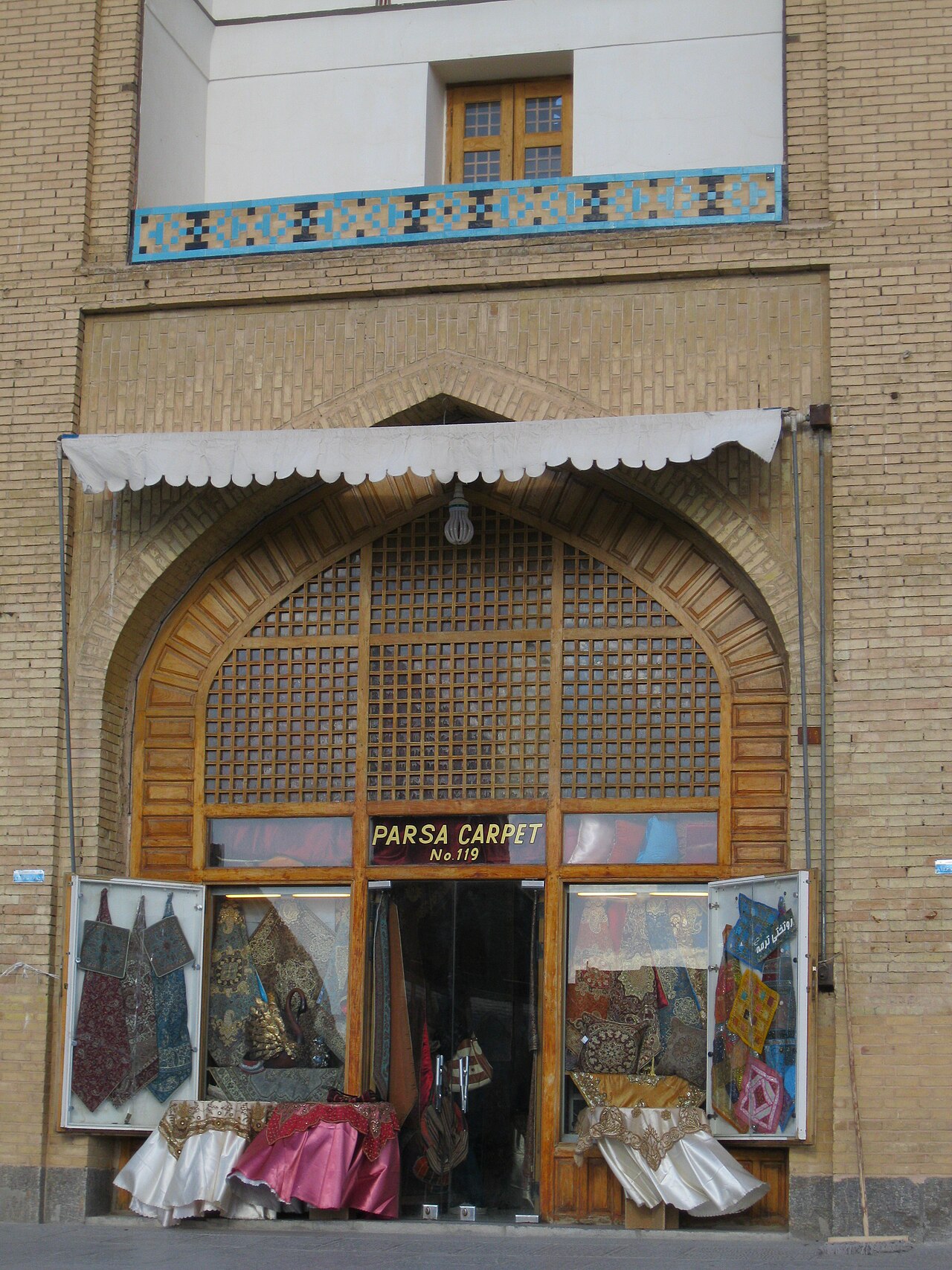
The covered bazaars of Isfahan, Tabriz, Shiraz and Kerman, and the arcades around Naqsh-e Jahan Square, are the main places to see crafts made and sold. Prices are usually negotiable, and in a good shop you will be offered tea before anyone mentions money. Hand-knotted carpets and older objects may need export paperwork, and some countries, notably the United States, restrict imports of Iranian goods, so check the current customs rules of both countries before buying anything valuable.
Persian words from this page
| صنایع دستی | sanâye’-e dasti | handicrafts |
| فرش | farsh | carpet |
| گلیم | gelim | flat-woven rug |
| نگارگری | negârgari | miniature painting |
| خاتم | khâtam | inlay marquetry |
| میناکاری | minâkâri | enamel work |
| فیروزه | firuzeh | turquoise |
| کاشی | kâshi | tile |
Sources and further reading
- UNESCO Intangible Cultural Heritage: “Traditional skills of carpet weaving in Fars” and “in Kashan” (2010); “Art of miniature” (2020); “Ayeneh-Kari, the art of mirror-work in Persian architecture” (2025).
- Jon Thompson and others, Carpet Magic, Barbican Art Gallery, 1983; and Encyclopaedia Iranica, “Carpets”.
- Sheila R. Canby, Persian Painting, British Museum Press, 1993.
- Hans E. Wulff, The Traditional Crafts of Persia, MIT Press, 1966.
Want to learn Persian? Get the free Starter Pack
Get the 14-page printable Starter Pack (all 32 letters, a 7-day reading plan, 100 core words and 20 survival phrases) and a short 5-email course. Free.
More in Iran Facts and Overview
- Iran at a Glance: Key Facts and Figures
- Geography of Iran: Mountains, Deserts and Seas
- Climate of Iran and the Best Time to Visit
- The 31 Provinces of Iran
- The People of Iran: Ethnic Groups
- Languages Spoken in Iran
- Religion in Iran Today
- How Iran Is Governed
- The Economy of Iran
- Iranian Currency: Rial and Toman Explained
- Persian Food: Dishes Every Visitor Should Try
- Iranian Festivals and Public Holidays
- Iranian Culture and Etiquette
- Iranian Handicrafts
- UNESCO World Heritage Sites in Iran
- Iran Records and Superlatives
- National Symbols of Iran
- Sports in Iran
- Practical Tips for Travelling to Iran