Iran has one of the largest and most varied economies in the Middle East, built on vast oil and gas reserves but also on manufacturing, agriculture and trade. Since 2018 it has been squeezed by sanctions, and in 2025 and 2026 a run of shocks, the June 2025 war with Israel, the return of UN sanctions, and the US and Israeli war that began in February 2026, pushed it into deep recession with inflation of 50 percent or more and a collapsing rial.
| Proven oil reserves | About 208 billion barrels, among the four largest in the world (OPEC Annual Statistical Bulletin) |
|---|---|
| Proven gas reserves | About 33 trillion cubic metres, the second largest after Russia (OPEC) |
| Inflation | 50.9% in 2025; 68.9% forecast for 2026 (IMF World Economic Outlook, April 2026) |
| Growth | Contraction of 6.1% forecast for 2026 (IMF, April 2026) |
| Main oil buyer | China, taking over 80% of Iran’s shipped crude in 2025 (Kpler data, reported by Al Jazeera) |
| Currency | Rial; on the open market about 700,000 to the US dollar in January 2025 and over 2,000,000 by August 2026 |
Oil and gas
Oil has shaped Iran’s modern history since the first commercial strike at Masjed Soleyman in 1908. The fields lie mostly in Khuzestan and the southern Zagros, and the island of Kharg in the Persian Gulf handles most crude exports. Gas is, if anything, even more important at home: the South Pars field, which Iran shares with Qatar’s North Field, supplies most of the gas that heats Iranian homes, fuels power stations and feeds the petrochemical plants around Asaluyeh. Fuel is heavily subsidised, so Iranians pay some of the lowest petrol prices in the world, and attempts to raise them have been politically explosive, most notably in November 2019; see our history page on the protests of 2017 to 2019. The long struggle over who controls this wealth goes back to the nationalisation of Iranian oil in 1951.
Beyond oil: industry, farming and trade
Unlike most Persian Gulf economies, Iran has a large industrial base. It builds cars (Iran Khodro and Saipa are the biggest makers), makes steel at plants such as Mobarakeh near Isfahan, and produces cement, petrochemicals, pharmaceuticals and household goods, largely for its own market. Agriculture employs a large share of the rural population. Iran is the world’s leading producer of saffron, by most estimates around 90 percent of the global crop, mainly from Khorasan, and a major grower of pistachios, dates, citrus and rice. Hand-woven carpets, once a leading export, still matter culturally; see Iranian handicrafts.
A large part of the economy is controlled by the state, by religious and revolutionary foundations (bonyâds), and by companies linked to the IRGC, especially in construction, energy and telecommunications. Economists inside and outside Iran have long argued that this limits competition and that privatisation has often transferred firms to politically connected owners rather than to the open market.

Sanctions
The United States has had sanctions on Iran since 1979, but the decisive measures came after 2010, when the US and EU targeted oil sales and banking, and again after 2018, when the US left the 2015 nuclear agreement and imposed what it called “maximum pressure”. In September 2025 the UN sanctions lifted under that agreement were reimposed through the “snapback” mechanism. Sanctions cut Iran off from most of the international banking system, which is why foreign cards do not work in Iran, and force it to sell oil at a discount through intermediaries. Our history page on sanctions on Iran explains their effect on daily life, and Iran’s nuclear programme covers the dispute behind them.
The crisis of 2025 and 2026
By late 2025 the economy was under severe strain. The rial reached record lows in December 2025, food prices were up by about 72 percent on a year earlier according to official figures, and shopkeepers in Tehran’s bazaar went on strike, the start of nationwide protests. The war that began on 28 February 2026 caused far greater damage. US and Israeli strikes hit Kharg Island, the South Pars gas field and industrial sites, a near-total internet shutdown was followed by restricted access until late May, and from April the United States imposed a naval blockade of Iranian ports while shipping through the Strait of Hormuz largely stopped. The Iranian government put total war damage at about 270 billion dollars, according to reports in May 2026. In April 2026 the IMF cut its forecast for Iran to a 6.1 percent contraction for the year, with inflation near 70 percent.
For ordinary Iranians, the result is a sharp fall in living standards. Salaries paid in rials buy far less each month, many families have turned savings into gold, dollars or property, and young graduates face high unemployment; Al Jazeera, citing official data, reported in January 2026 that nearly one in five young people was out of work. Emigration of doctors, engineers and students, a long-standing worry, accelerated.
The rial
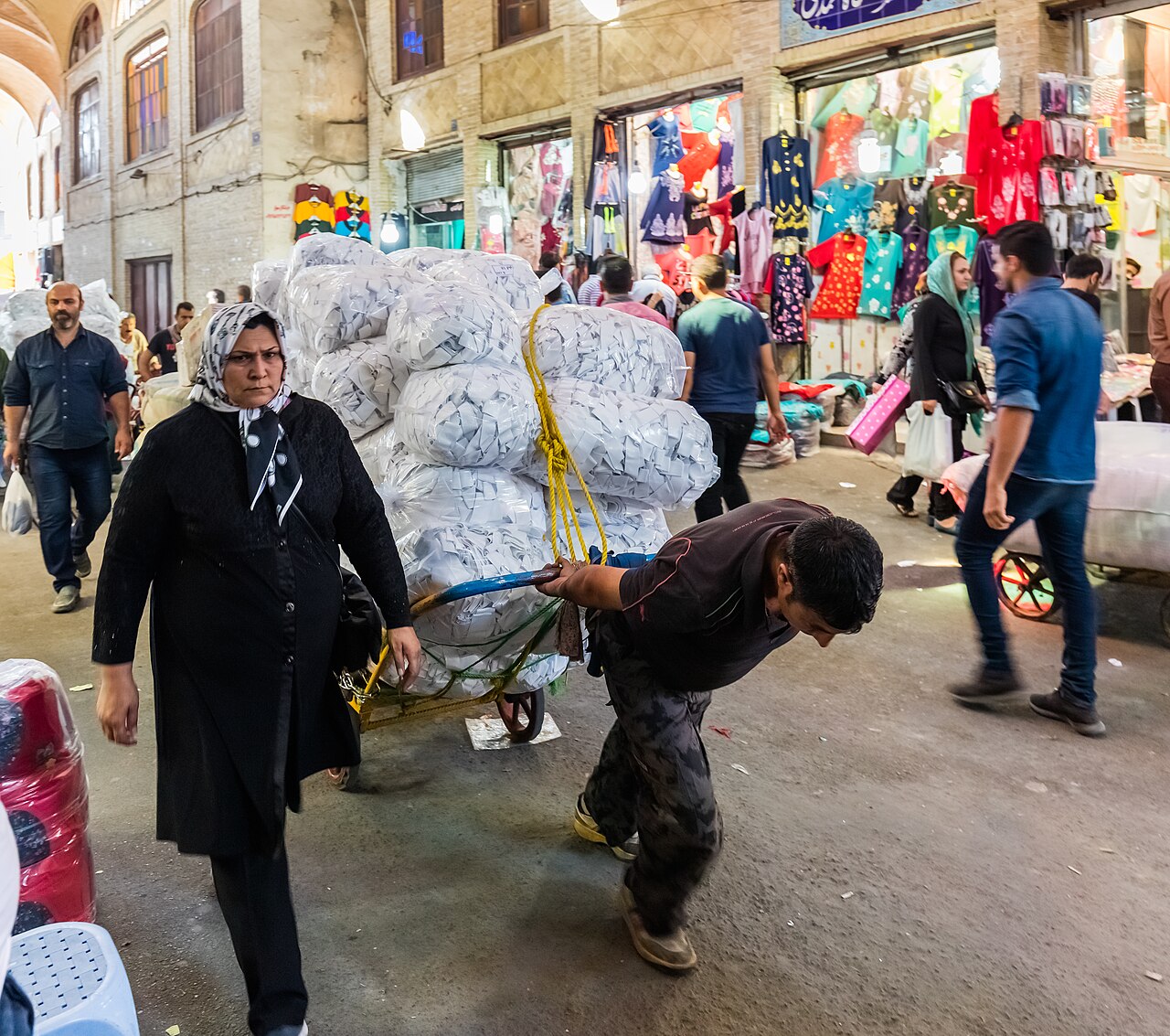
The rial’s decline is the most visible sign of the crisis. On the open market, which most Iranians use as the real reference, a US dollar cost about 700,000 rials in January 2025, about 1.36 million in December 2025 and more than 2 million by August 2026. The first two figures were reported by Al Jazeera, the last comes from free-market data compiled by Bonbast and reported by bne IntelliNews. These figures move quickly and the official rates are lower. Parliament approved a plan in 2025 to remove four zeros from the currency, which will make prices easier to write but will not by itself change their value. The guide to the rial and toman explains how money works in practice, and a walk through Tehran’s Grand Bazaar shows the traditional heart of Iranian commerce.
Persian words from this page
| اقتصاد | eqtesâd | economy |
| نفت | naft | oil |
| تورم | tavarrom | inflation |
| تحریم | tahrim | sanctions |
| گرانی | gerâni | high prices |
| بازار | bâzâr | market, bazaar |
| زعفران | za’farân | saffron |
| پسته | peste | pistachio |
Sources and further reading
- International Monetary Fund, World Economic Outlook, April 2026.
- OPEC, Annual Statistical Bulletin (proven reserves).
- World Bank, Iran Economic Monitor.
- Al Jazeera, “Why is Iran’s economy failing, prompting deadly protests?” (16 January 2026).
- bne IntelliNews, report on the open-market rial rate (24 August 2026).
- Djavad Salehi-Isfahani, writings on the Iranian economy and living standards.
Want to learn Persian? Get the free Starter Pack
Get the 14-page printable Starter Pack (all 32 letters, a 7-day reading plan, 100 core words and 20 survival phrases) and a short 5-email course. Free.
More in Iran Facts and Overview
- Iran at a Glance: Key Facts and Figures
- Geography of Iran: Mountains, Deserts and Seas
- Climate of Iran and the Best Time to Visit
- The 31 Provinces of Iran
- The People of Iran: Ethnic Groups
- Languages Spoken in Iran
- Religion in Iran Today
- How Iran Is Governed
- The Economy of Iran
- Iranian Currency: Rial and Toman Explained
- Persian Food: Dishes Every Visitor Should Try
- Iranian Festivals and Public Holidays
- Iranian Culture and Etiquette
- Iranian Handicrafts
- UNESCO World Heritage Sites in Iran
- Iran Records and Superlatives
- National Symbols of Iran
- Sports in Iran
- Practical Tips for Travelling to Iran